
A grant requires evaluation of a supported employment project. Which tool best links resources, activities, and intended employment outcomes?
Select an answer to reveal the explanation.
Short Explanation
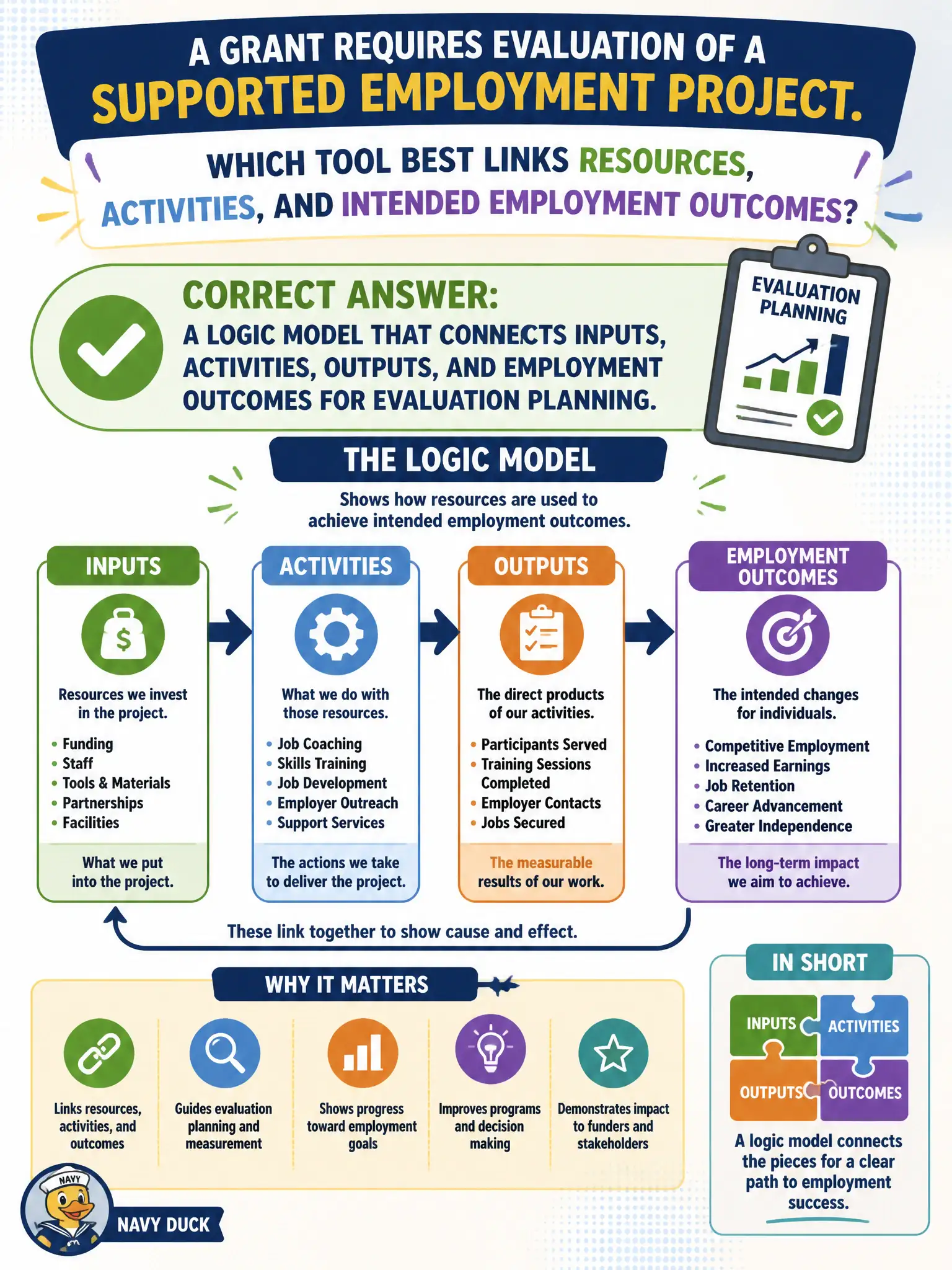
A logic model is the recipe card: ingredients (inputs), cooking steps (activities), and the meal you hope to serve (employment outcomes). Funders love seeing that chain spelled out. Without it, evaluation is just guessing in the kitchen.
Full Explanation
A logic model that connects inputs, activities, outputs, and employment outcomes best links resources and work to intended results for evaluating a grant-funded supported employment project in a community rehab program. Logic models make program theory explicit for municipal funders and staff so evaluation metrics map to a coherent pathway. A random list of office supplies unrelated to program theory is not an evaluation framework. A staff birthday calendar used as the sole evaluation framework tracks social events, not employment causal pathways. A client satisfaction emoji poll with no link to activities or outcomes may capture affect but not the required resources-to-outcomes chain. Exam caveat: logic models guide measurement; they do not themselves prove effectiveness without data collection on the specified indicators over time. Operational check: draft a one-page logic model naming grant inputs, key supported-employment activities, outputs such as employer contacts, and employment outcomes; align each evaluation metric to a model element before the civic grant reporting cycle. In civic rehabilitation settings, documenting the rationale and verifying the next concrete step keeps practice aligned with CRC standards and client rights.