
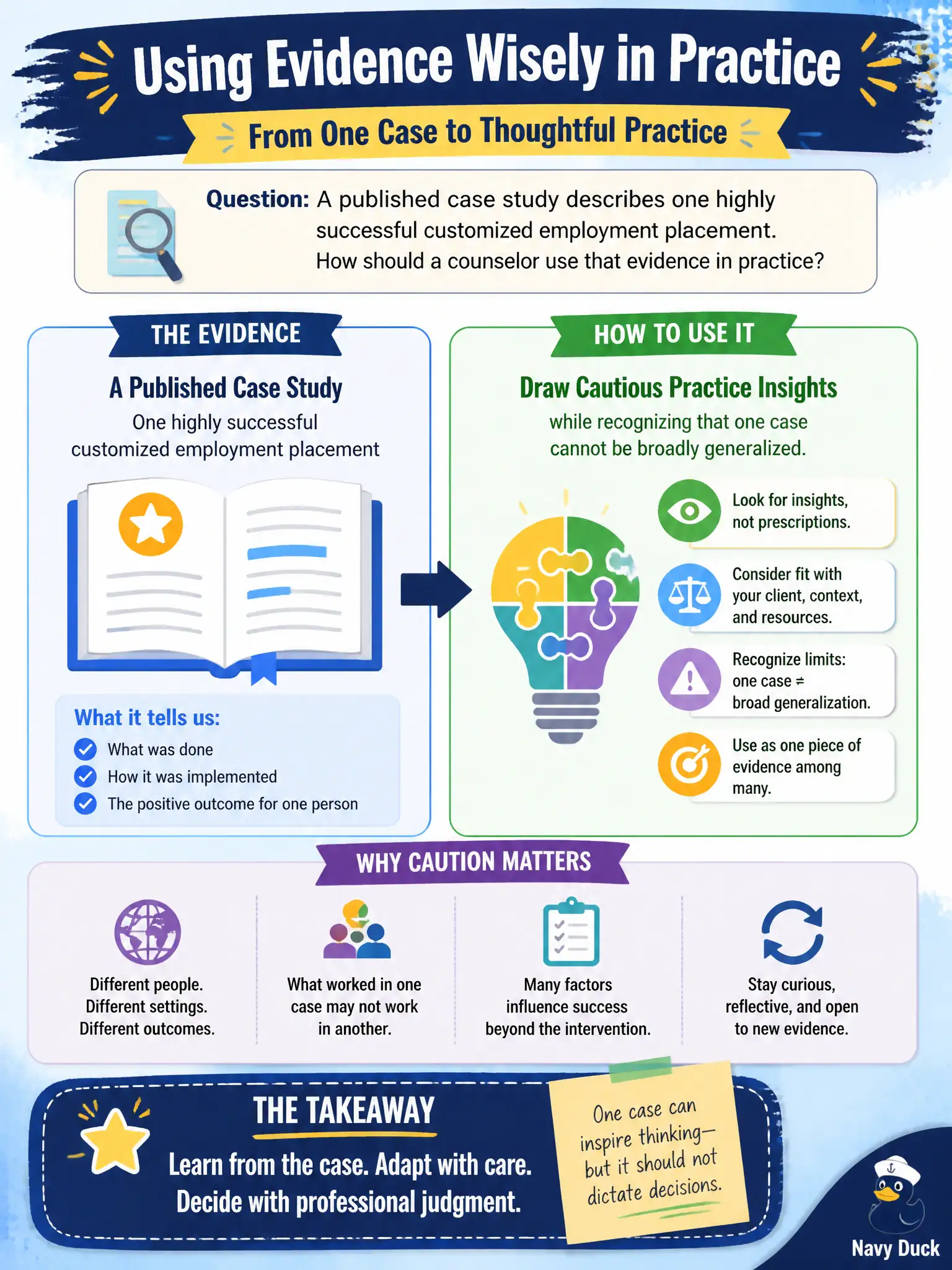
A published case study describes one highly successful customized employment placement. How should a counselor use that evidence in practice?
Select an answer to reveal the explanation.
Short Explanation
A great case study is like one amazing restaurant review—useful flavor, not a guarantee every kitchen cooks the same. Borrow ideas carefully and don't pretend one success covers the whole menu. That's research literacy without throwing the story out.
Full Explanation
A published case study of one highly successful customized employment placement can offer cautious practice insights, but one case cannot be broadly generalized to every municipal client and setting. Counselors borrow ideas while testing fit locally rather than treating a single narrative as universal proof of method superiority. Treating the single case as proof that the method works for every client in every setting commits classic overgeneralization. Ignoring case studies entirely because qualitative reports never inform counseling discards useful practice wisdom and hypothesis generation for CRP innovation. Requiring that all future placements copy the case study's steps verbatim without client individuality contradicts person-centered rehabilitation. Exam caveat: case studies are low on the causal evidence hierarchy for population claims but can still inform clinical reasoning when triangulated with other evidence and client context. Operational check: extract transferable principles from the case study, compare them to the current civic client's goals and barriers, pilot adapted steps with outcome tracking, and avoid agency-wide mandates based on a single success story. In civic rehabilitation settings, documenting the rationale and verifying the next concrete step keeps practice aligned with CRC standards and client rights.