
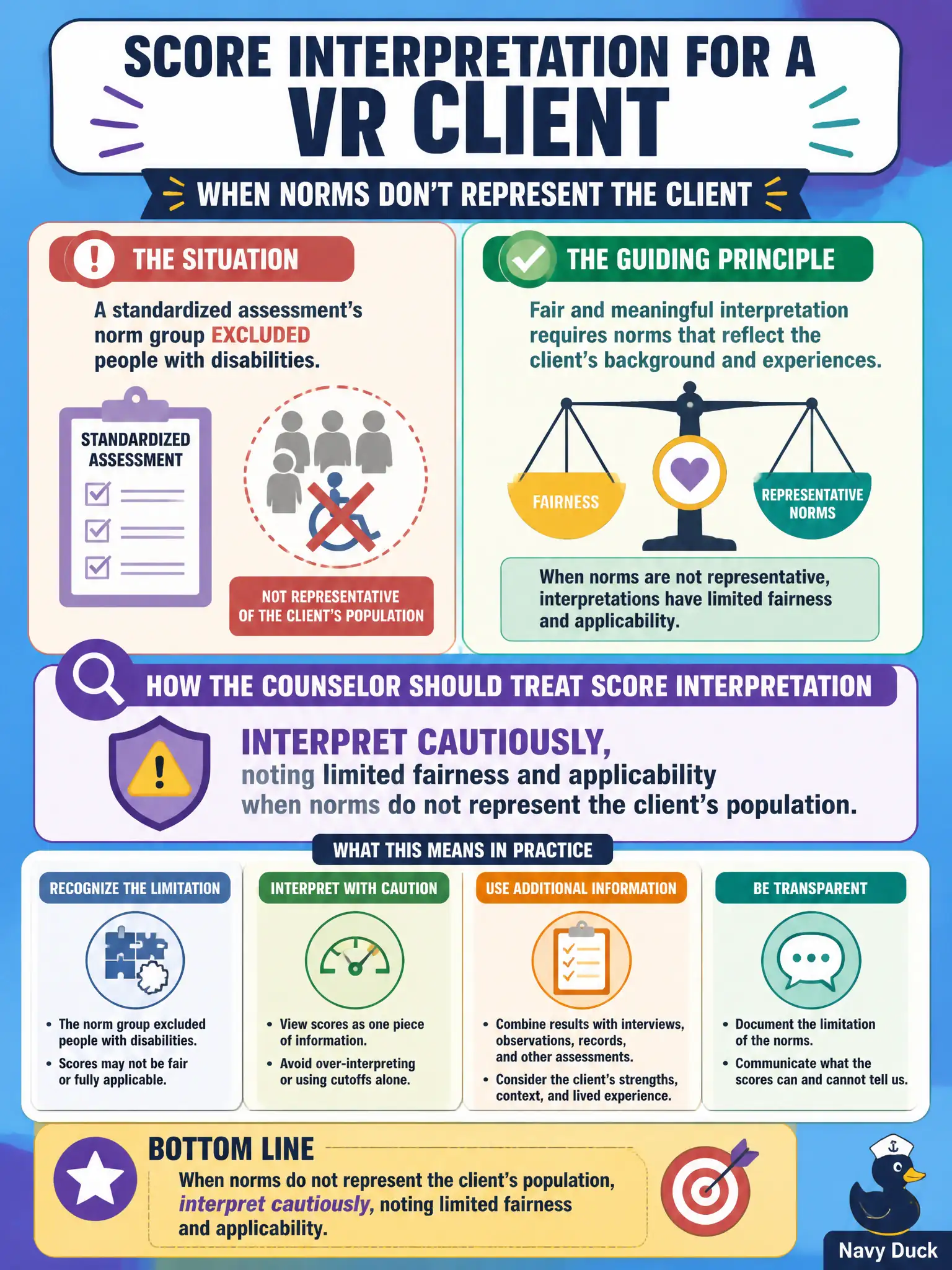
A standardized assessment's norm group excluded people with disabilities. How should the counselor treat score interpretation for a VR client?
Select an answer to reveal the explanation.
Short Explanation
Norms are the comparison crowd on the bleachers. If people like your client never made the bleachers, that percentile can mislead. Read the score gently and say out loud what the comparison group left out.
Full Explanation
When a standardized assessment's norm group excluded people with disabilities, counselors should interpret scores cautiously for VR clients, noting limited fairness and applicability when norms do not represent the client's population. Norm representation affects meaning; caution prevents overconfident percentile claims in municipal rehabilitation decisions. Interpreting scores as equally precise for all clients because norms never affect meaning ignores a core psychometric fairness issue. Assuming exclusion of people with disabilities always raises every client's percentile rank is an unsupported generalization. Using the scores for diagnostic labeling even when the manual warns against that use compounds misuse. Exam caveat: cautious interpretation may still allow limited descriptive use with explicit limitations disclosed to the client; it does not always mean discarding every score without thought, but it does forbid treating non-representative norms as equally authoritative. Operational check: disclose norm limitations in the assessment feedback session, avoid high-stakes cut scores based solely on mismatched norms, and seek instruments with more inclusive norms or local validation when available for civic VR clients.