
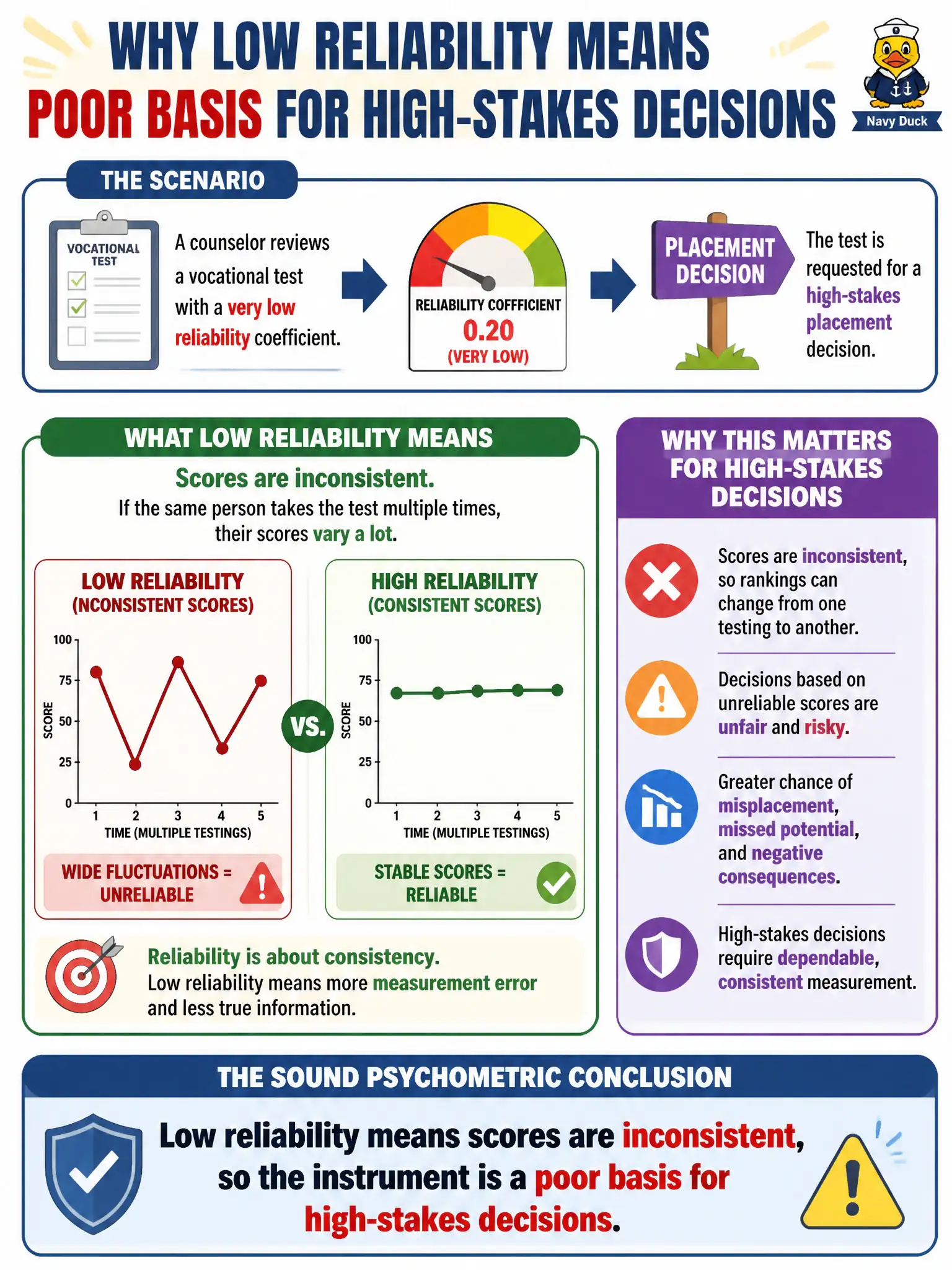
A counselor reviews a vocational test with a very low reliability coefficient and is asked to use it for a high-stakes placement decision. What is the soundest psychometric conclusion?
Select an answer to reveal the explanation.
Short Explanation
Reliability is whether the yardstick gives the same reading when nothing real has changed. If that number is tiny, today's score might be tomorrow's different story—so don't bet someone's career on it. High-stakes calls need tools that hold still.
Full Explanation
A very low reliability coefficient means scores are inconsistent across repeated measurement, so the instrument is a poor basis for high-stakes municipal placement decisions. Psychometrically sound CRC practice withholds consequential inferences when reliability evidence is inadequate, protecting clients from noisy scores dressed as precision. Low reliability is not ideal for high-stakes decisions because fluctuating scores are somehow useful; instability undermines trust in the result. Reliability matters for vocational tests as well as personality inventories; limiting concern to personality tools is incorrect. Any published test may not be used for high-stakes decisions regardless of reliability evidence—publication alone is not a quality guarantee for civic VR use. Exam caveat: reliability is necessary but not sufficient; validity for the intended use must also be considered, and local norms or accommodations can further affect interpretation. Operational check: before using scores for a high-stakes civic placement choice, review the manual's reliability coefficients for relevant populations, reject or heavily caveat tools with very low reliability, and select an alternative instrument with stronger evidence.