
After a successful placement, a grateful client's family offers the counselor a large expensive gift. What is the most ethically sound response?
Select an answer to reveal the explanation.
Short Explanation
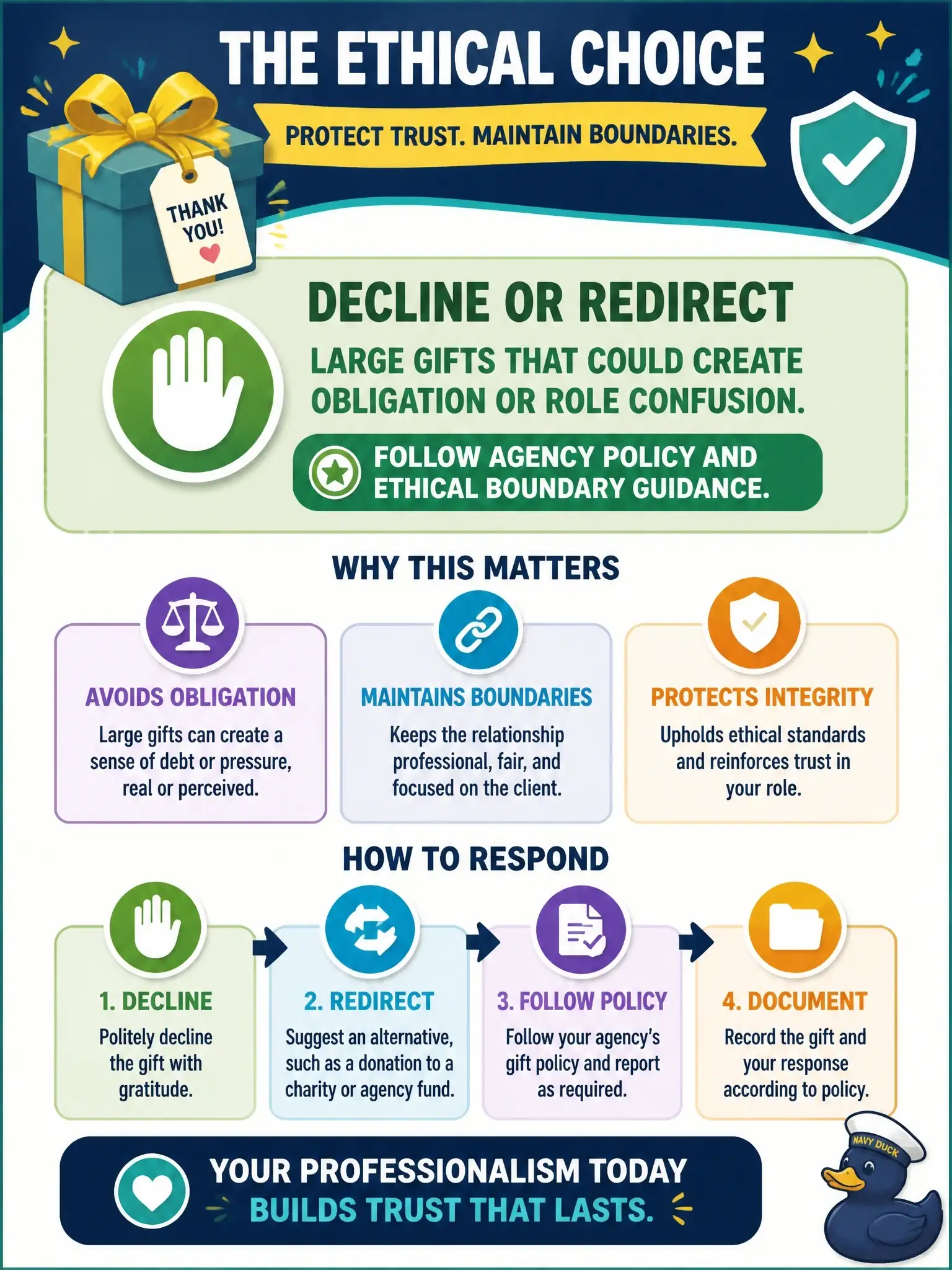
Huge thank-you gifts can feel like a warm hug that turns into a leash, because someone may expect favors or silence. You should decline or redirect them, check agency policy and ethical boundary guidance, then thank the family and document the offer. Kindness doesn't require a pricey present.
Full Explanation
Following successful placement, a large expensive gift from a grateful family creates boundary risk in civic and agency practice. The ethically sound response is to decline or redirect large gifts that could create obligation or role confusion, following agency policy and ethical boundary guidance. Substantial presents can imply indebtedness, dual benefit, or favoritism and may compromise judgment even when gratitude is sincere.
The response that says accept the gift privately and omit it from records because gratitude proves no boundary issue fails by concept: gratitude does not erase conflict-of-interest dynamics, and concealment worsens ethics risk. The response that says accept the gift and request additional cash to share with the team fails as exploitation. The response that says accept only if the family posts a public endorsement naming the counselor fails because it converts a gift into marketing consideration and further blurs roles.
Exam caveat: cultural meanings of gift-giving matter, and small tokens may be handled differently under policy, but a large expensive gift is the classic decline/redirect scenario. Operational check: thank the family, explain policy, offer non-gift alternatives such as agency donation if allowed, document the offer and response, and consult if cultural refusal would cause serious harm requiring a nuanced plan.