
A private-practice CRC markets as able to write legal capacity evaluations for guardianship without additional forensic qualification. What credentialing concern should be flagged?
Select an answer to reveal the explanation.
Short Explanation
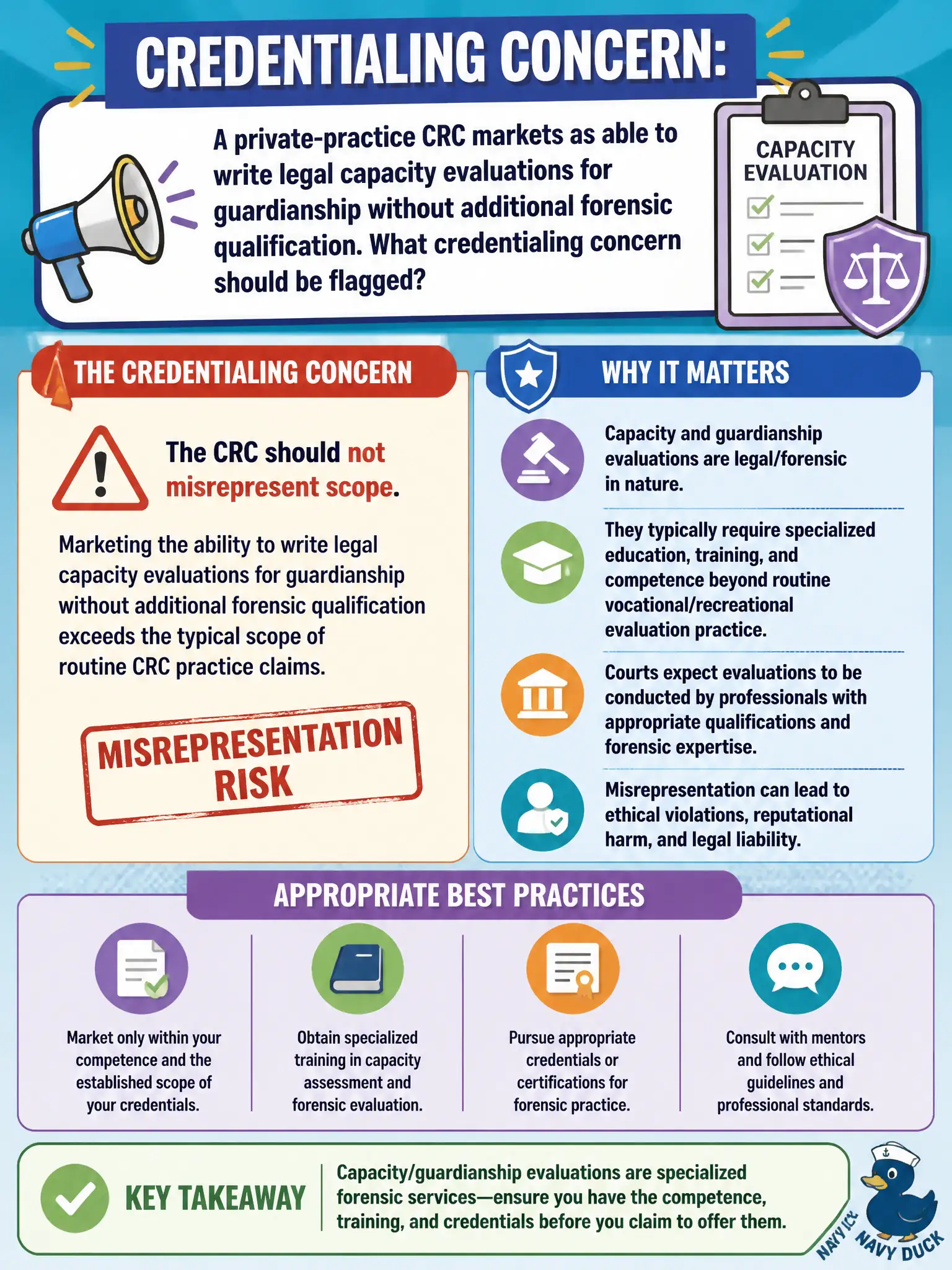
A CRC credential is powerful — it is not a free pass to market legal capacity/guardianship opinions you are not qualified to give. Scope honesty beats flashy ads.
Full Explanation
Credential integrity in private practice means not marketing legal capacity or guardianship evaluations without appropriate forensic competence and credentials beyond routine CRC claims. Civic courts rely on qualified evaluators; misrepresenting scope risks client harm, court error, and professional discipline. Ordinary CRC preparation centers rehabilitation counseling, not automatic qualification as a forensic capacity expert in every jurisdiction.
Claiming any CRC may automatically perform legal capacity evaluations in every jurisdiction fails by concept because capacity opinions are specialized and jurisdictionally regulated. Asserting that marketing unrestricted forensic capacity opinions is required to maintain CRC certification fails because certification does not mandate overclaiming forensic scope. Equating guardianship capacity work with writing a standard IPE fails because IPE planning is not a legal adjudicative capacity determination and uses different standards of proof and purpose.
Exam caveat: some counselors obtain additional forensic training and court appointments—answer based on not misrepresenting ordinary CRC scope. Operational check: revise websites and brochures to remove capacity/guardianship evaluation claims unless credentials support them, refer such requests to qualified forensic evaluators, and document the referral rationale for risk management.