
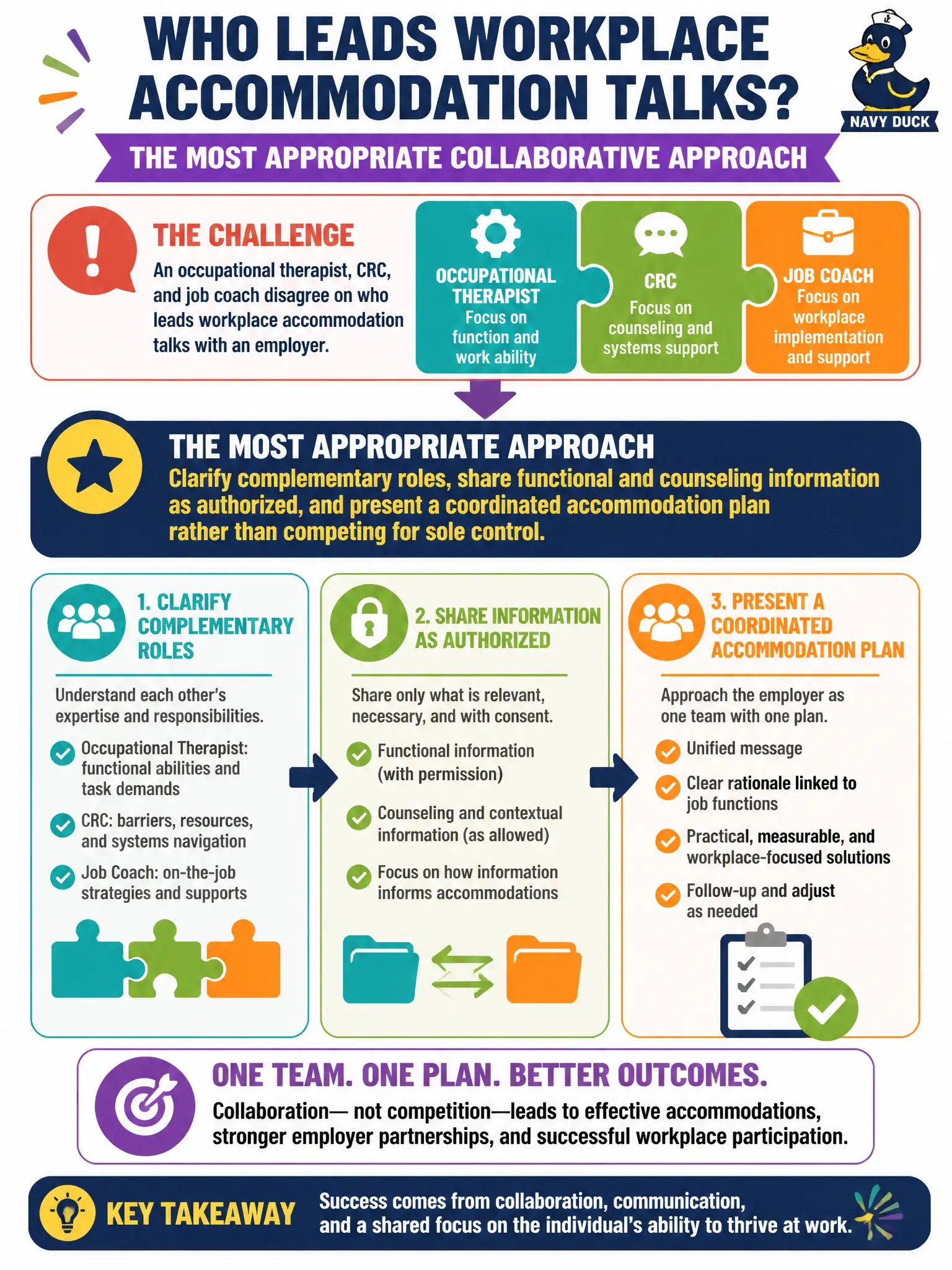
An occupational therapist, CRC, and job coach disagree on who leads workplace accommodation talks with an employer. What collaborative approach is most appropriate?
Select an answer to reveal the explanation.
Short Explanation
Accommodation talks go smoother when OT, CRC, and job coach play as one band. Clarify parts, share what you are allowed to share, and stop fighting for the microphone.
Full Explanation
Workplace accommodation planning for municipal and private employers works best when OT, CRC, and job coach clarify complementary roles, share authorized functional and counseling information, and present one coordinated plan. Competing for sole control confuses employers and weakens the interactive process that civic employment inclusion depends on.
Having only the job coach speak because counselors and OTs should never contact employers fails by concept: employer contact is often essential and can be role-shared with authorization. Excluding the OT so the CRC owns all accommodation decisions fails because functional and ergonomic expertise is frequently OT’s contribution. Asking the employer to pick one professional and refusing team information-sharing fails as anti-collaborative practice that fragments the accommodation request.
Exam caveat: confidentiality and release-of-information rules still govern what can be shared with employers—coordinate content, not unbounded disclosure. Operational check: hold a brief pre-meeting among disciplines, agree who leads which topics, share a single accommodation recommendation sheet, and document employer responses in one case narrative.