
A city human-services board asks whether ADA Title I concepts matter when a covered employer interviews a wheelchair user. Which counselor-level clarification is most accurate?
Select an answer to reveal the explanation.
Short Explanation
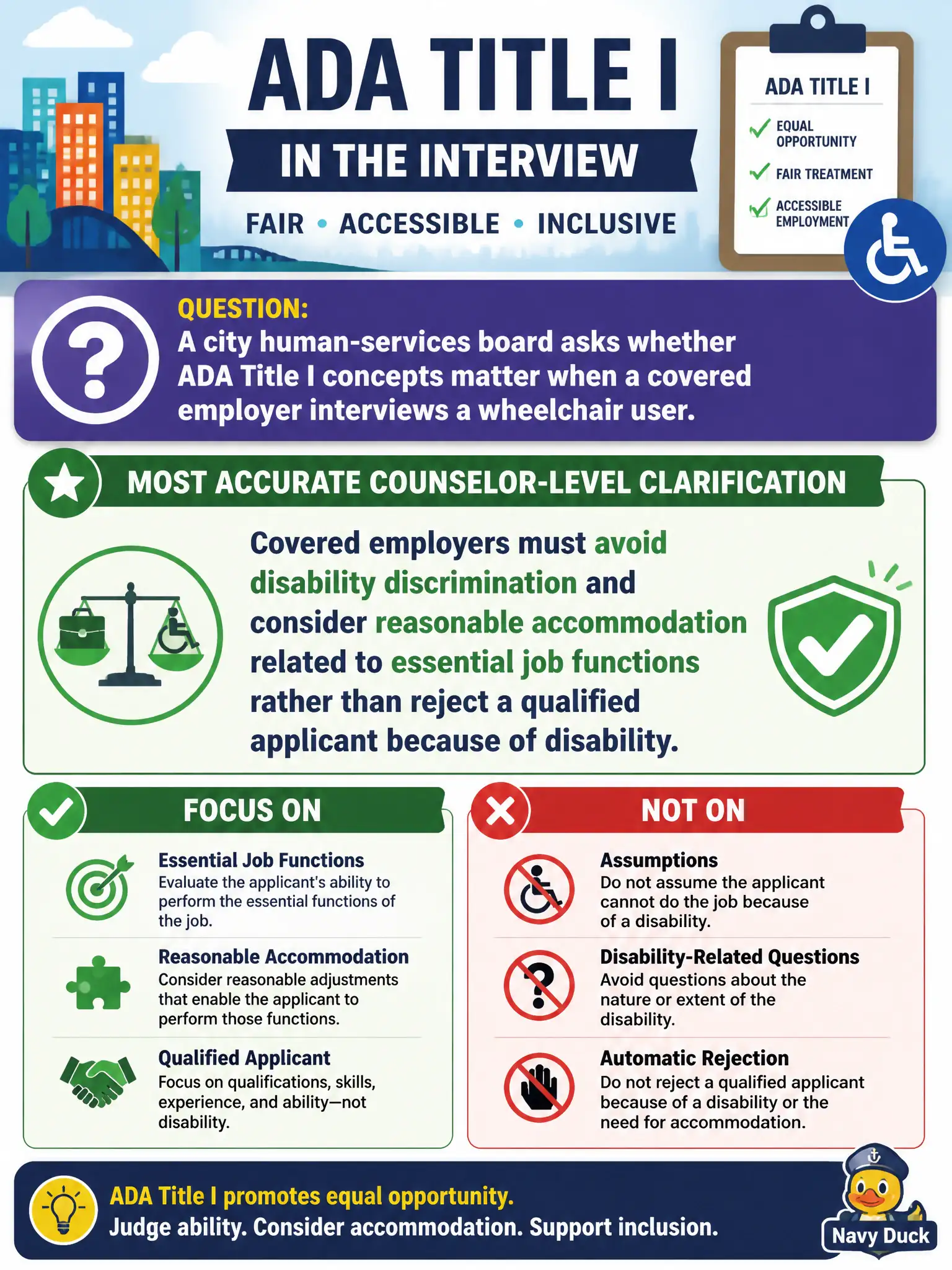
Picture the interview as a skills gate, not a disability quiz. Covered employers focus on essential functions and reasonable accommodation — not rejecting a qualified wheelchair user out of hand.
Full Explanation
For a city human-services board advising employers, ADA Title I concepts matter whenever a covered employer interviews a qualified applicant who uses a wheelchair. Covered employers must avoid disability discrimination and consider reasonable accommodation related to essential job functions rather than reject someone because of disability. Title I is not limited to federal employees; pre-interview diagnosis fishing is generally restricted; and preferring candidates without mobility devices is not a lawful substitute for the accommodation analysis.
Claiming Title I applies only to federal employees fails by concept because Title I covers many private and nonprofit employers that meet coverage thresholds, not merely the federal workforce. Allowing any employer to demand a full medical diagnosis before an interview fails because disability-related medical inquiries are generally limited before a conditional offer. Treating reasonable accommodation as optional if the employer prefers nondisabled candidates fails because preference is not a defense to discrimination or refusal to consider accommodations for essential functions.
Exam caveat: coverage, undue hardship, and essential-function analyses are fact-specific; the tested counselor-level point is nondiscrimination plus accommodation tied to essential functions. Operational check: coach employers to describe essential functions, ask about ability to perform them with or without accommodation, defer medical inquiries until the proper stage, and document interactive-process steps when accommodation is requested.