
A supervisor assumes a wheelchair user cannot supervise a team and blocks a promotion. What should the counselor primarily address?
Select an answer to reveal the explanation.
Short Explanation
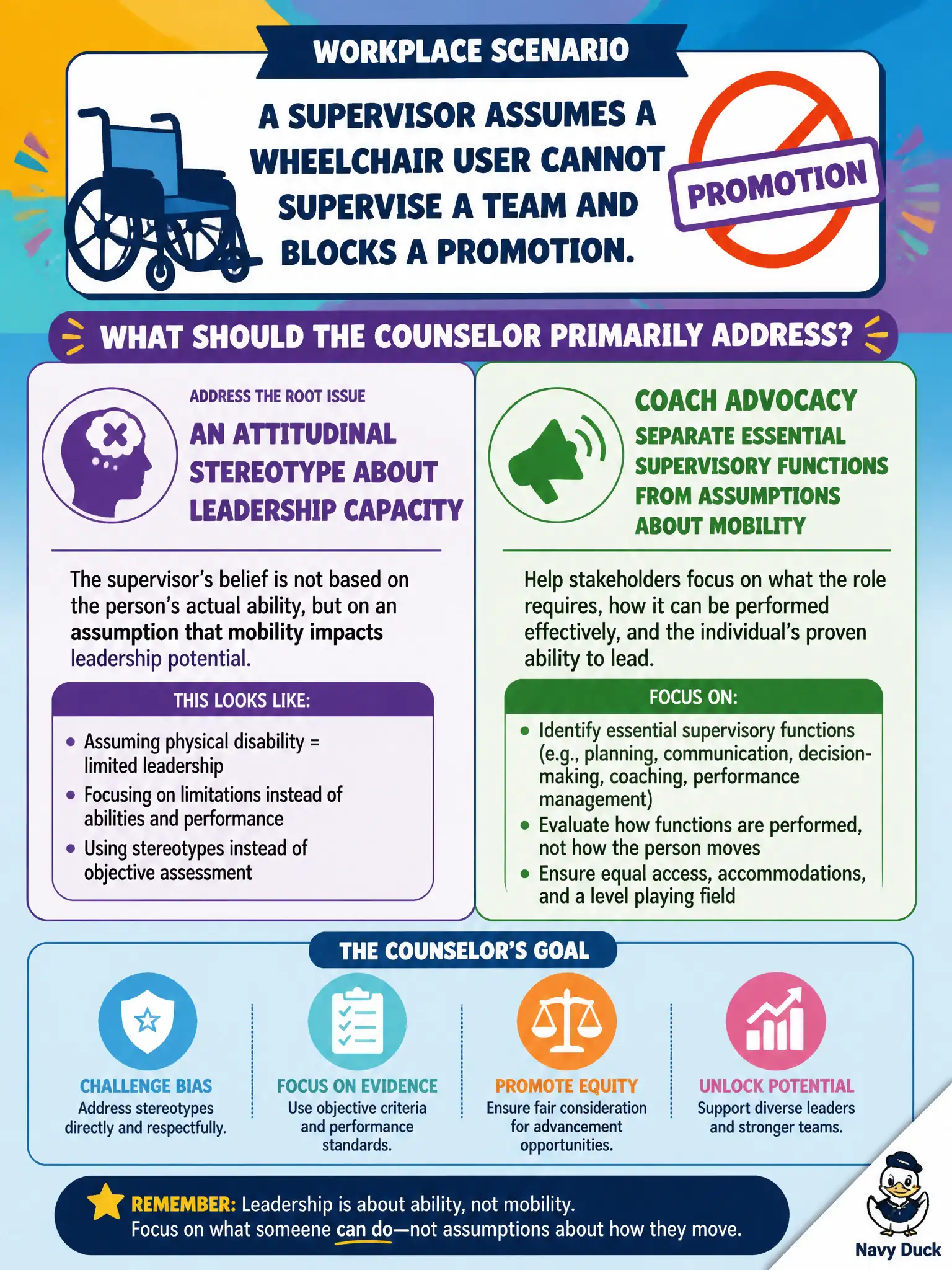
Wheels don't cancel a leadership brain. When a supervisor blocks a promotion on stereotype, that's an attitudinal barrier—challenge it by tying the talk to actual supervisory duties, not mobility myths. Coach advocacy that keeps the goal on the table.
Full Explanation
A supervisor assuming a wheelchair user cannot supervise a team and blocking promotion is an attitudinal stereotype about leadership capacity. The counselor addresses that barrier and coaches advocacy that separates essential supervisory functions—planning, feedback, accountability—from assumptions about mobility. Equity in civic workplaces requires challenging mobility-to-leadership myths.
Accepting that wheelchair users are medically barred from all supervisory titles endorses the stereotype. Focusing only on architectural issues because attitudes never affect promotion ignores a primary barrier in this scenario. Requiring the client to abandon management goals to remain ‘realistic’ internalizes discrimination.
Leadership essential functions are cognitive and interpersonal more than ambulatory; mobility stereotypes in promotion decisions are classic attitudinal barriers.
Exam caveat: promotion blocks based on mobility stereotypes are attitudinal; analyze essential supervisory functions separately from mobility.
Operational check: map essential supervisor functions versus mobility myths; coach an interactive-process/advocacy script; engage HR/employer education; support the client’s management goal unless essential functions truly cannot be performed with/without accommodation.