
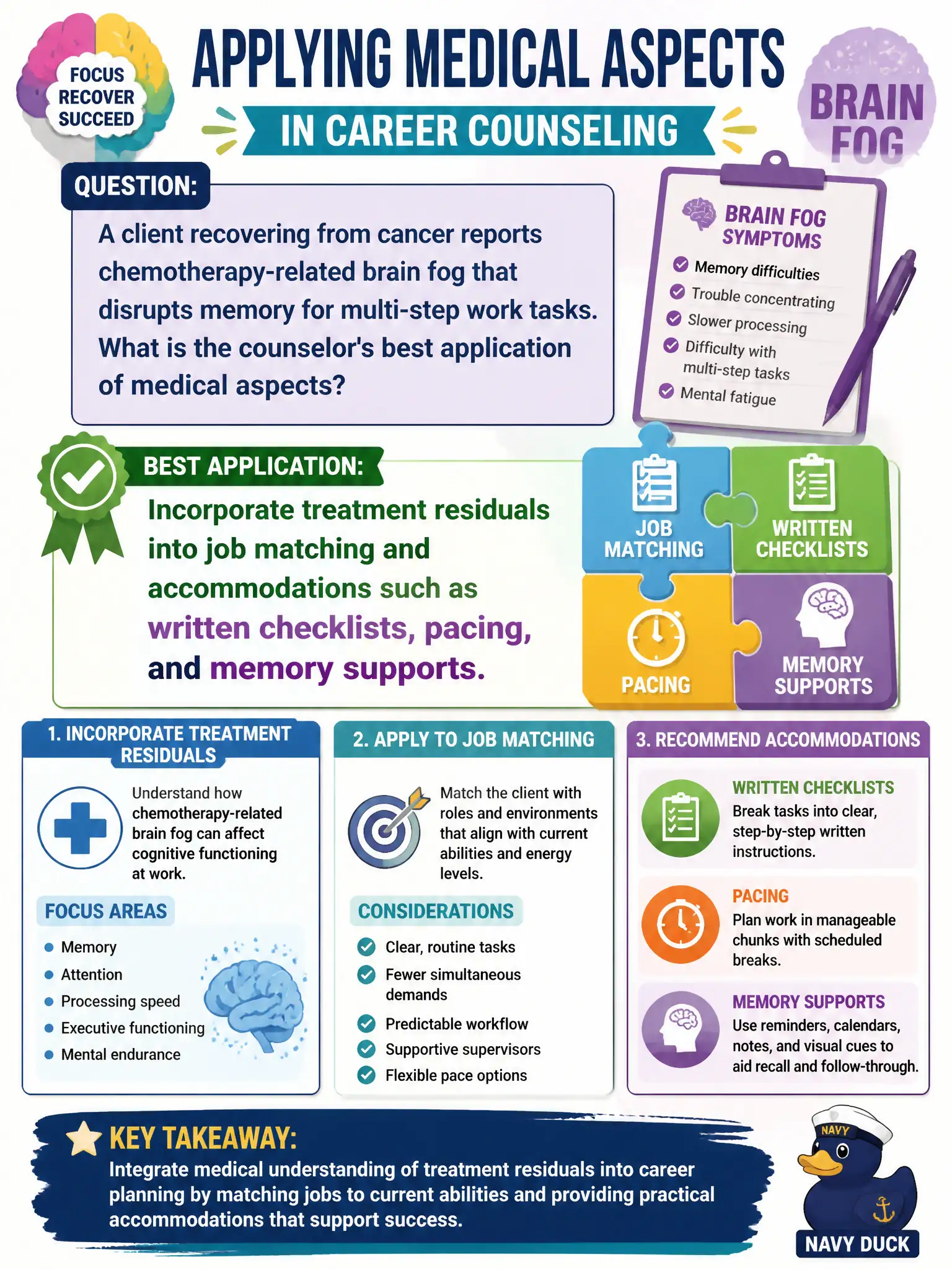
A client recovering from cancer reports chemotherapy-related brain fog that disrupts memory for multi-step work tasks. What is the counselor's best application of medical aspects?
Select an answer to reveal the explanation.
Short Explanation
Chemo fog is a real residual—not laziness in a lab coat. Multi-step tasks get slippery when memory hiccups, so build checklists, pacing, and smarter job matches. Honor the treatment leftover instead of arguing it away.
Full Explanation
Chemotherapy-related brain fog that disrupts memory for multi-step work tasks is a treatment residual that belongs in job matching and accommodations—written checklists, pacing, memory supports—not dismissal as motivation failure. Medical aspects counseling after cancer care includes cognitive residuals that persist beyond infusion day. Community VR should design supports around those residuals.
Dismissing cognitive complaints because chemotherapy never affects cognition after infusion ends contradicts common survivor reports and clinical recognition of chemo-related cognitive changes. Treating brain fog as motivation failure misattributes a medical residual. Requiring immediate return to unmodified multi-step roles to force recovery can set up failure and shame.
Cancer survivorship care plans increasingly note cognitive residuals; VR should ask for those details when matching multi-step occupations.
Exam caveat: cancer treatment residuals, including cognitive fog, inform accommodations and matching.
Operational check: inventory cognitive task breakdowns; build checklist/pacing accommodations; coordinate with oncology/rehab providers as needed; avoid unmodified full-complexity return until supports are in place.