
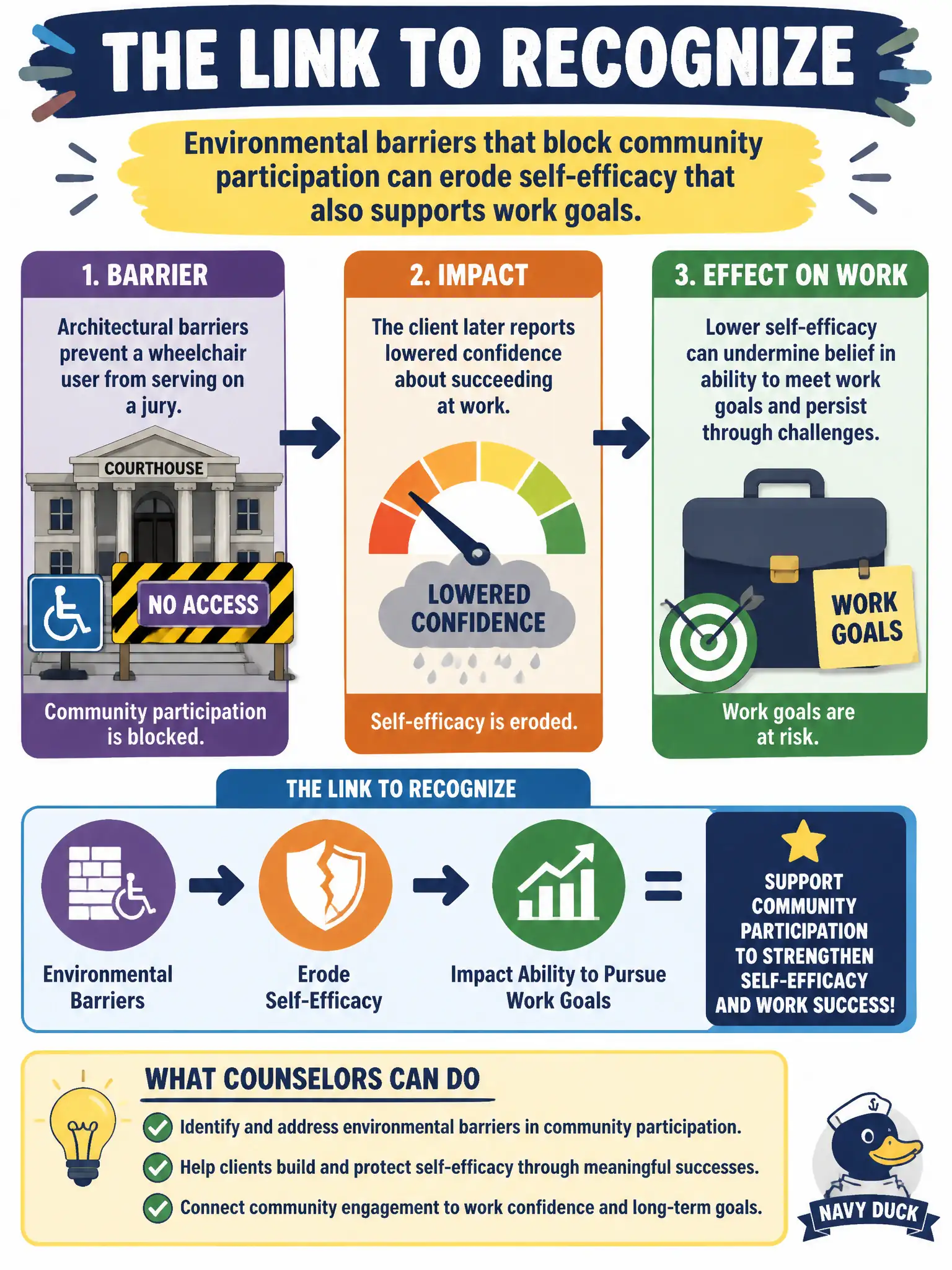
Architectural barriers prevent a wheelchair user from serving on a jury, and the client later reports lowered confidence about succeeding at work. What link should the counselor recognize?
Select an answer to reveal the explanation.
Short Explanation
Get locked out of the courthouse and it can whisper 'you don't belong' into the job search too. Environmental barriers don't stay in one building—they chip at confidence that work requires. Fixing access and rebuilding efficacy travel together.
Full Explanation
Architectural barriers that prevent a wheelchair user from serving on a jury can erode self-efficacy that also supports work goals. Civic exclusion is not vocationally irrelevant; environmental barriers that block community participation can generalize into lowered confidence about succeeding at work. Rehab counselors should recognize that psychosocial carryover and address both access advocacy and self-efficacy rebuilding.
Claiming civic exclusion is unrelated to vocational self-efficacy and can be ignored misses the confidence link. Asserting only workplace ramps matter denies courthouse-access carryover. Attributing self-efficacy drops solely to personality traits, never inaccessible environments, blames the person for structural barriers.
ADA/access advocacy for courthouses and other civic venues is legitimate rehab activity when exclusion wounds the confidence clients need for employment.
Exam caveat: environmental barriers in civic life can undermine vocational self-efficacy; connect community access to rehab goals.
Operational check: validate the confidence impact; advocate for courthouse access remediation; use mastery experiences and encouragement to rebuild work self-efficacy; document the barrier-psychosocial link in the plan.