
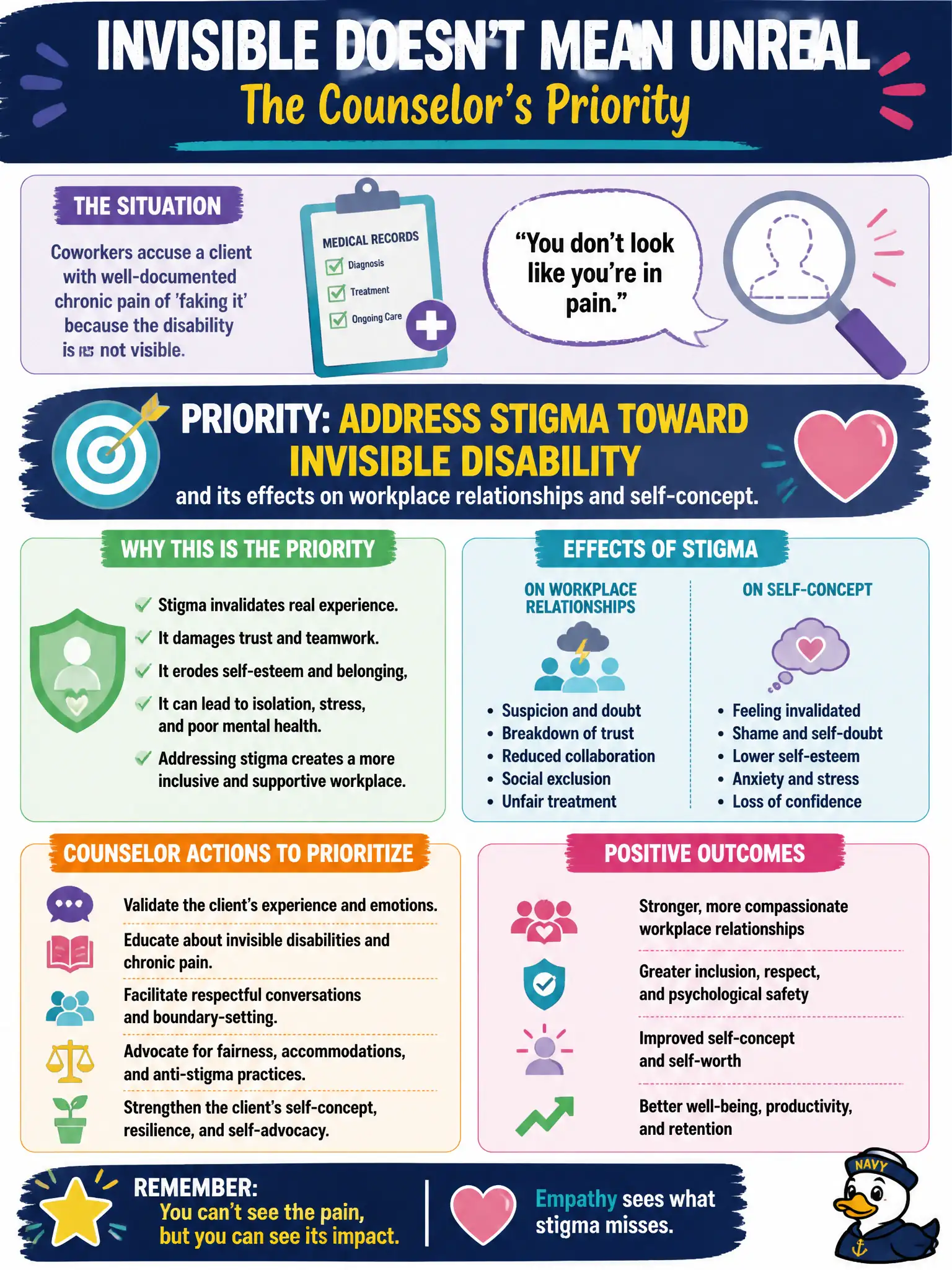
Coworkers accuse a client with well-documented chronic pain of 'faking it' because the disability is not visible. What psychosocial issue should the counselor prioritize?
Select an answer to reveal the explanation.
Short Explanation
Invisible pain gets the 'prove it' treatment, and that stigma cuts deep. Coworkers who cry fake aren't reading the medical file—they're reading appearances. Counsel the psychosocial hit, document supports, and don't let legitimacy hinge on whether strangers can see it.
Full Explanation
Coworkers accusing a client with well-documented chronic pain of ‘faking it’ because the disability is invisible highlight stigma toward invisible disability and its effects on workplace relationships and self-concept. The counselor prioritizes that psychosocial issue—validation, coping, and possible advocacy—rather than forcing visibility or dismissing legitimacy. Invisible disability stigma is common in community employment settings.
Encouraging symptom exaggeration so peers can ‘see’ disability trades integrity for visibility and can backfire. Accepting the accusation as proof invisible disabilities are not legitimate vocational factors colludes with stigma. Focusing only on architectural ramps ignores interpersonal stigma that ramps cannot fix.
Invisible disability stigma can drive under-accommodation and social isolation at work; counselor advocacy may include HR education when the client consents.
Exam caveat: invisible-disability stigma is a psychosocial/workplace-relationship target distinct from purely architectural barriers.
Operational check: validate the client’s experience; assess impact on self-concept and work relationships; coach disclosure/boundary strategies; address workplace education or HR pathways as the client chooses.