
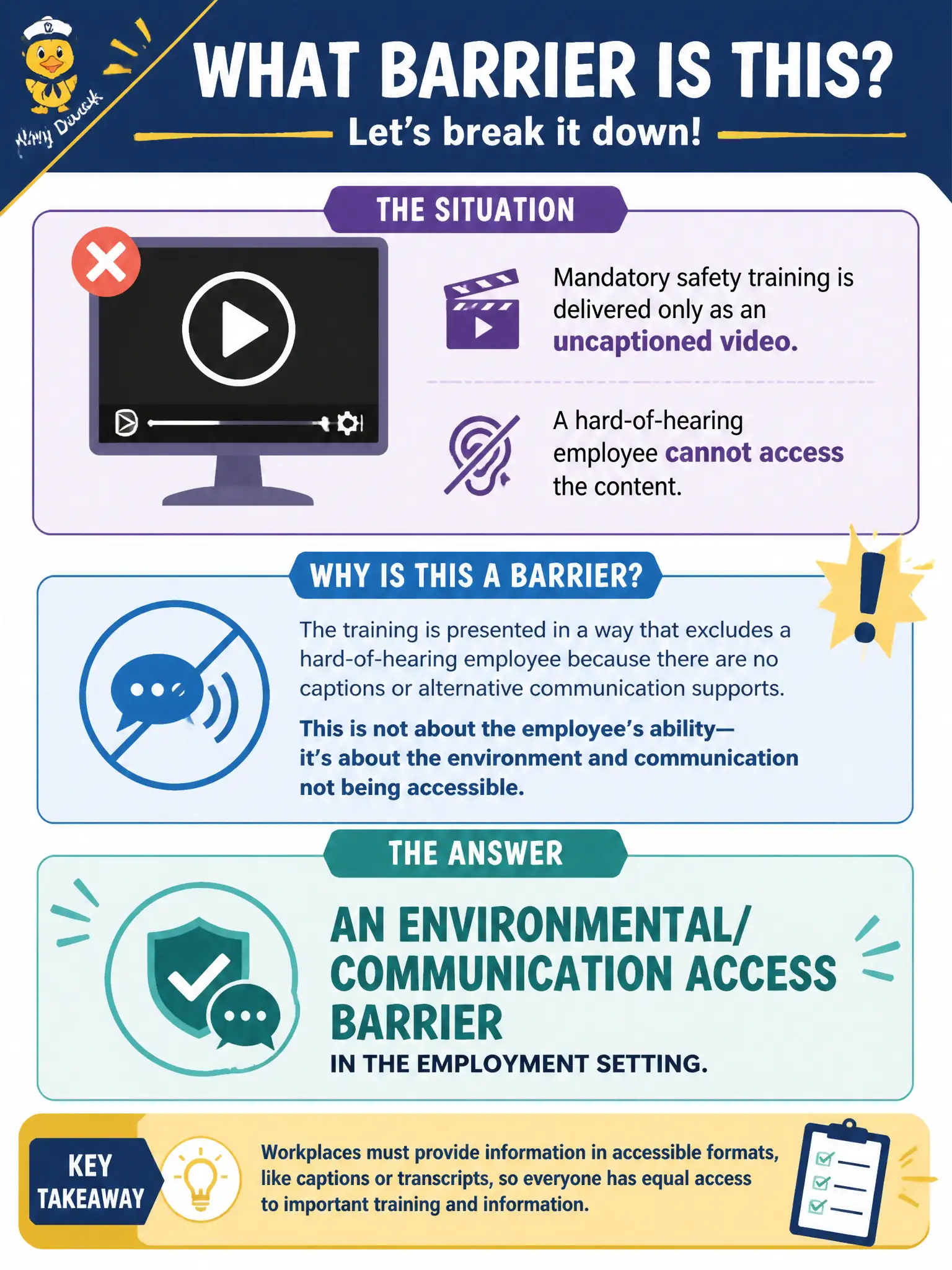
Mandatory safety training is delivered only as an uncaptioned video. A hard-of-hearing employee cannot access the content. What barrier is this?
Select an answer to reveal the explanation.
Short Explanation
No captions on mandatory training is a locked door made of silence. The room and the media are the problem—communication access—not the employee's ears being 'difficult.' Fix the video access and the training barrier shrinks.
Full Explanation
Mandatory safety training delivered only as an uncaptioned video creates an environmental/communication access barrier for a hard-of-hearing employee. The content channel—not coworker pity narratives or medical comorbidity labels—is what blocks equal access. Civic employers must provide effective communication access for required training.
Calling the problem a medical comorbidity unrelated to the work environment misplaces the barrier outside the employment setting. Labeling it solely an attitudinal pity narrative from coworkers misses the inaccessible training medium. Treating it as a crisis-counseling issue that replaces the need for captioning substitutes therapy for an environmental fix.
Captioning mandatory safety content is both an effective-communication duty and a risk-management control; inaccessible training creates liability and injury risk.
Exam caveat: inaccessible training media are communication/environmental barriers requiring access fixes such as captions or transcripts.
Operational check: request captioning or an accessible alternate format before the compliance deadline; verify comprehension; document the access request and resolution with the employer. Re-verify length and fidelity of the written plan at the next supervisory case review so civic accountability stays visible.