
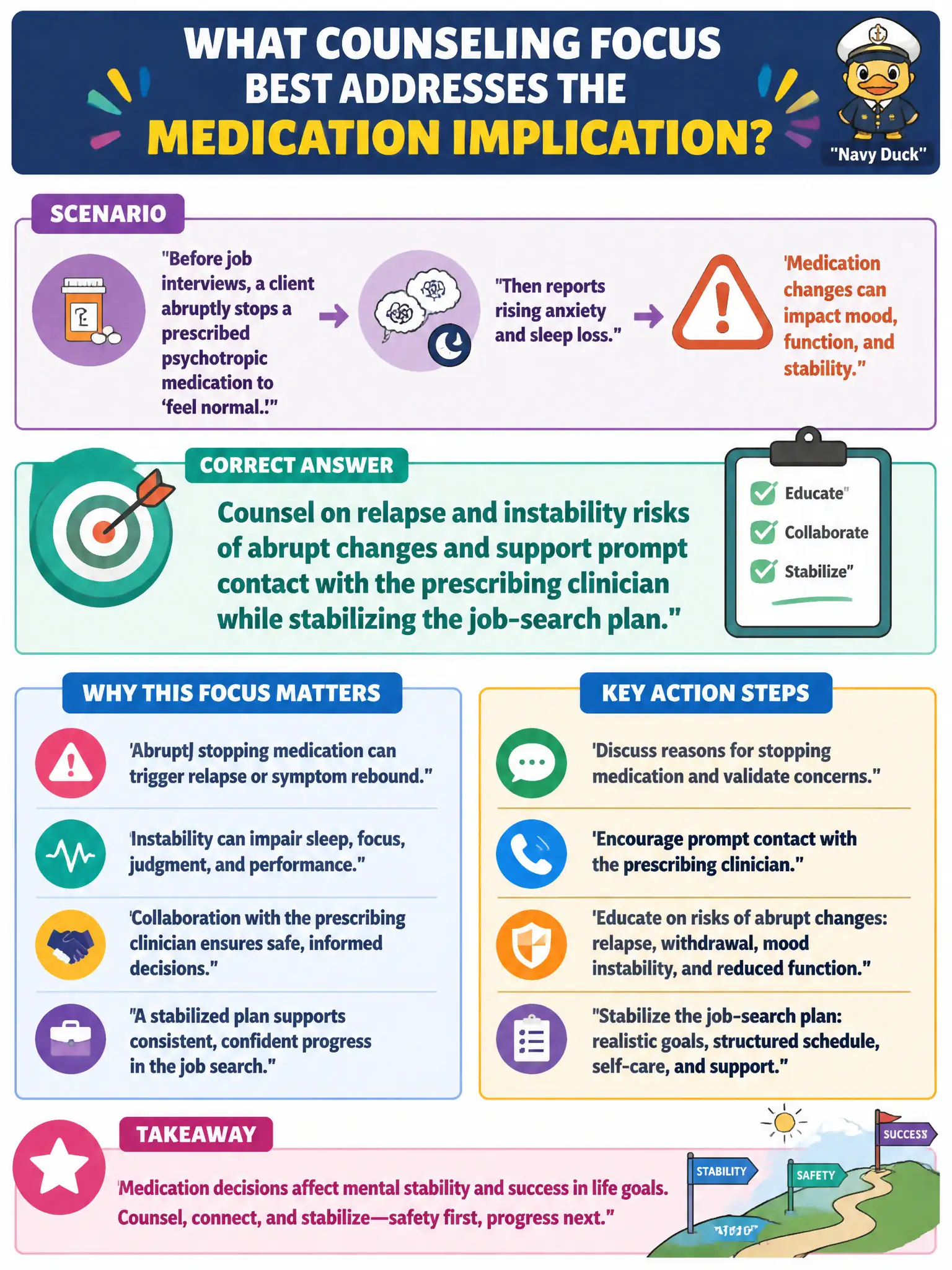
Before job interviews, a client abruptly stops a prescribed psychotropic medication to 'feel normal,' then reports rising anxiety and sleep loss. What counseling focus best addresses the medication implication?
Select an answer to reveal the explanation.
Short Explanation
Quitting psych meds cold turkey before interviews is like yanking the stabilizer off a bike right before a hill. 'Feeling normal' can flip into anxiety and sleepless nights that tank the search. Coach the risk, get the prescriber back in the loop, and keep the job plan steady.
Full Explanation
Abruptly stopping a prescribed psychotropic medication before interviews to ‘feel normal,’ then experiencing rising anxiety and sleep loss, calls for counseling on relapse and instability risks and prompt contact with the prescribing clinician while the job-search plan is stabilized. Medication adherence is a vocational stability factor, not a psychiatry-only silo. Community rehab counselors address the implication without praising unsafe stoppage.
Praising the stoppage as proof of employment readiness ignores emerging instability. Recommending caffeine as a full substitute for psychotropic stability is clinically inadequate. Ignoring adherence because medication ‘belongs only to psychiatry’ fragments care the CRC is obligated to coordinate around.
Stability before interviews is itself a placement strategy; public VR timelines should flex when abrupt medication change destabilizes sleep and anxiety.
Exam caveat: abrupt psychotropic changes are a medication-implication red flag tied to vocational instability; support return to prescriber guidance.
Operational check: urge prompt prescriber contact; monitor sleep/anxiety/safety; temporarily simplify job-search demands until stability returns; document education on abrupt-change risks.