
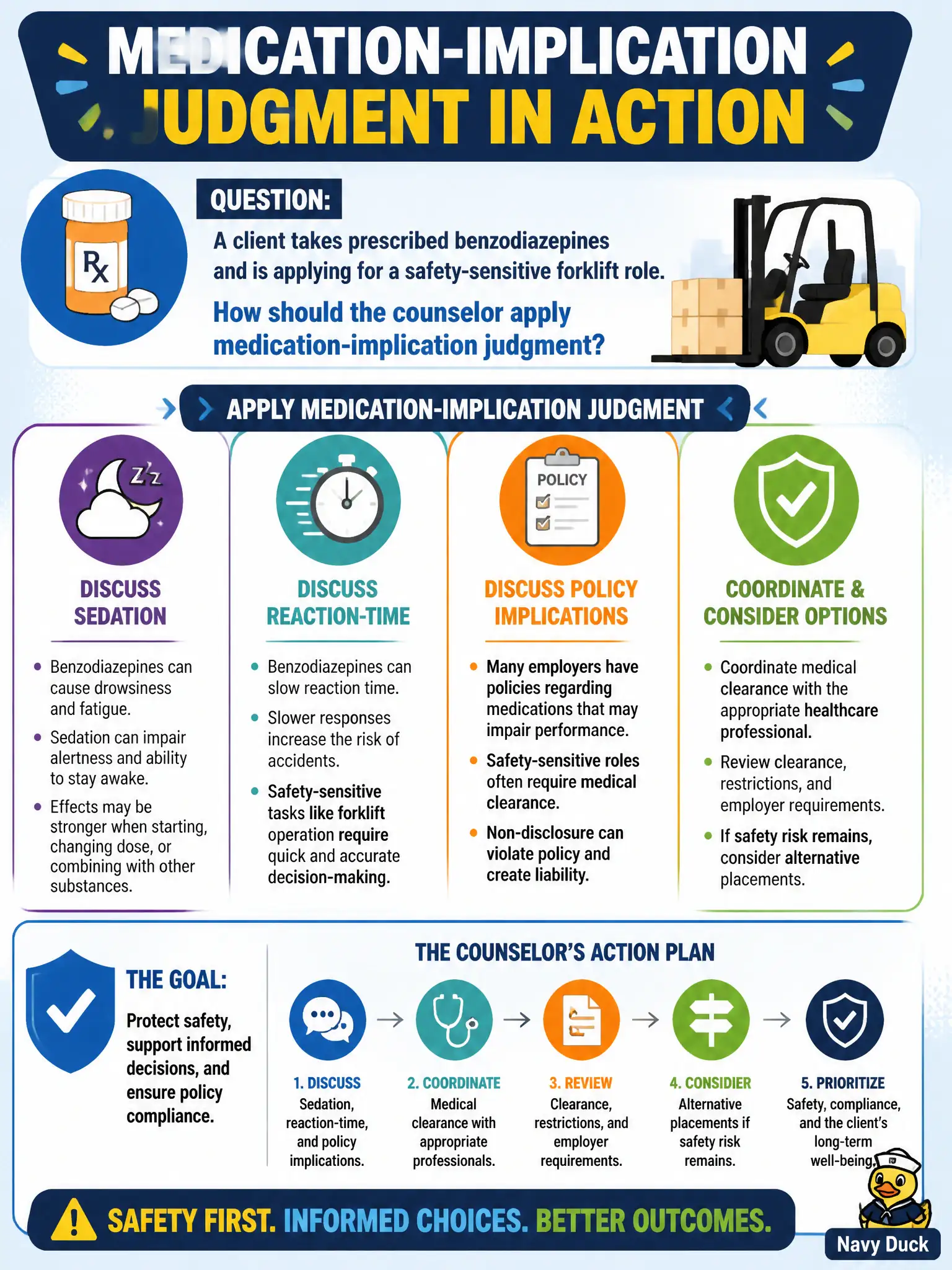
A client takes prescribed benzodiazepines and is applying for a safety-sensitive forklift role. How should the counselor apply medication-implication judgment?
Select an answer to reveal the explanation.
Short Explanation
Benzodiazepines and forklifts are a bad mixer—think drowsy driving with a warehouse twist. You don't shame the prescription, but you do talk sedation, reaction time, clearance, and maybe a different job if safety still wobbles. Honesty with occupational health beats a hidden risk.
Full Explanation
Prescribed benzodiazepines in a safety-sensitive forklift application require discussion of sedation, reaction-time, and policy implications, medical clearance coordination, and consideration of alternative placements if safety risk remains. Prescription status does not automatically equal workplace safety for machinery operation. Civic and industrial placements demand transparent fitness judgment, not concealment.
Ignoring the medication because prescriptions never affect fitness denies pharmacology and employer policy reality. Guaranteeing clearance because any prescribed drug is automatically workplace-safe overpromises. Requiring the client to hide benzodiazepine use from occupational health endangers safety and can constitute fraud.
Occupational health clearance processes exist precisely for sedating medications in powered industrial truck roles; counselors facilitate honesty inside that civic safety system.
Exam caveat: safety-sensitive roles plus sedating medications trigger clearance and alternative-placement analysis—not concealment or blanket guarantees.
Operational check: review job safety demands and medication effects with the client; seek appropriate medical/occupational health input; explore alternate placements if clearance is denied or risk remains.