
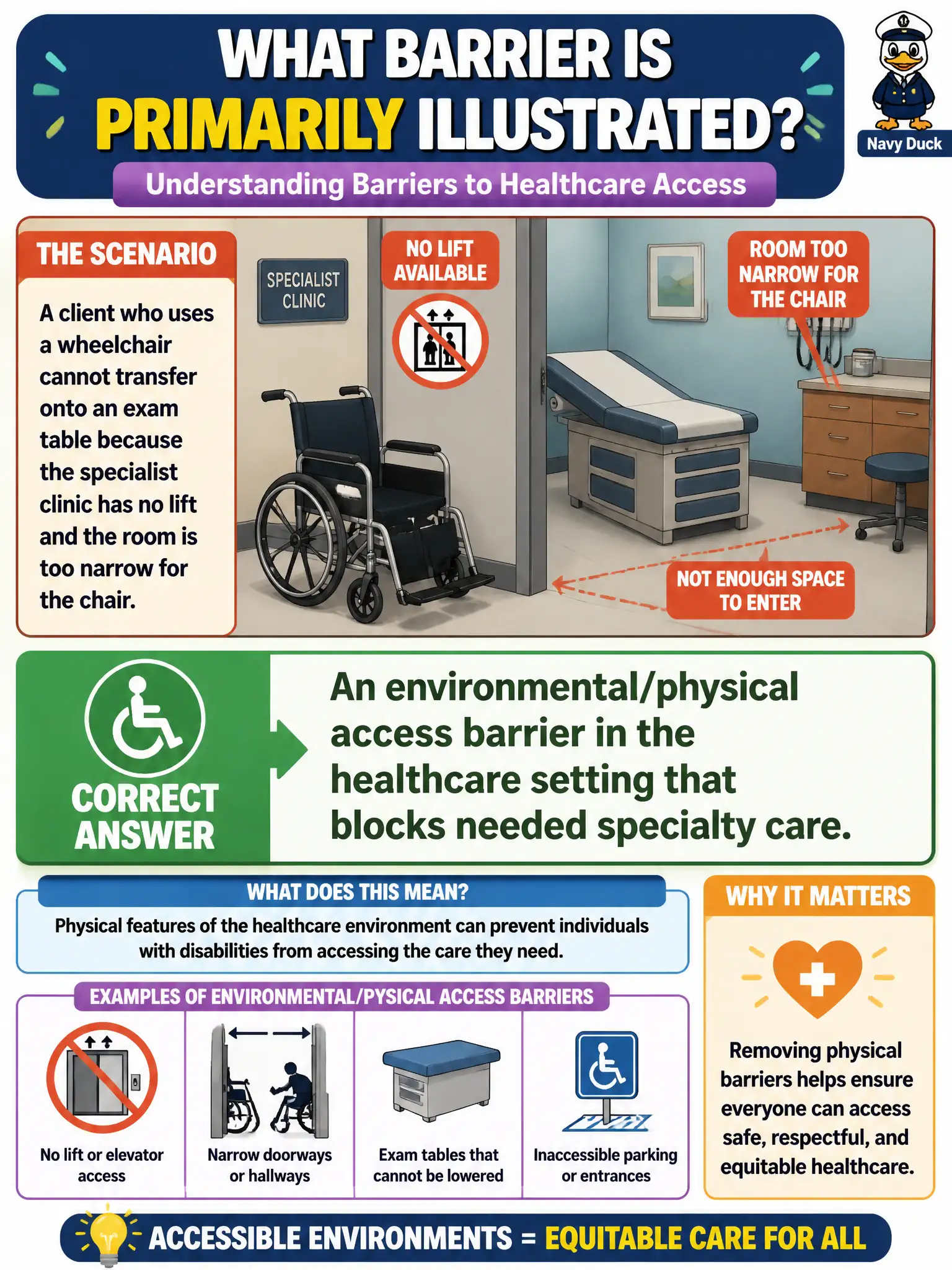
A client who uses a wheelchair cannot transfer onto an exam table because the specialist clinic has no lift and the room is too narrow for the chair. What barrier type is primarily illustrated?
Select an answer to reveal the explanation.
Short Explanation
If the exam room is a maze and there's no lift, the barrier is the building—not the client's motivation. Narrow doors and missing table lifts are classic environmental blockers that keep people from the specialist care rehab depends on. Name the access problem so it can be fixed or rerouted.
Full Explanation
Inability to transfer onto an exam table because a specialty clinic lacks a lift and the room is too narrow is primarily an environmental/physical access barrier in healthcare. Architecture and equipment gaps block needed care regardless of motivation. Advocacy for accessible clinical environments is core civic rehab counseling when specialty follow-up is required for vocational readiness.
Calling it a purely motivational barrier because clinic layout never affects access denies environmental causation. Labeling it attitudinal only, as if equipment gaps are always intentional discrimination policies, misclassifies a physical access failure (attitude may coexist but is not the primary illustrated barrier). Calling it a psychometric barrier related to IQ testing is category error.
Healthcare access barriers delay specialty clearance that VR often needs for work readiness, so clinic accessibility advocacy is vocationally consequential, not peripheral.
Exam caveat: classify barriers accurately—physical clinic layout/equipment problems are environmental access barriers.
Operational check: document the access failure; request accessible room/lift or alternate accessible site; escalate ADA/access advocacy with the clinic; delay only the specialty visit logistics, not the advocacy.