
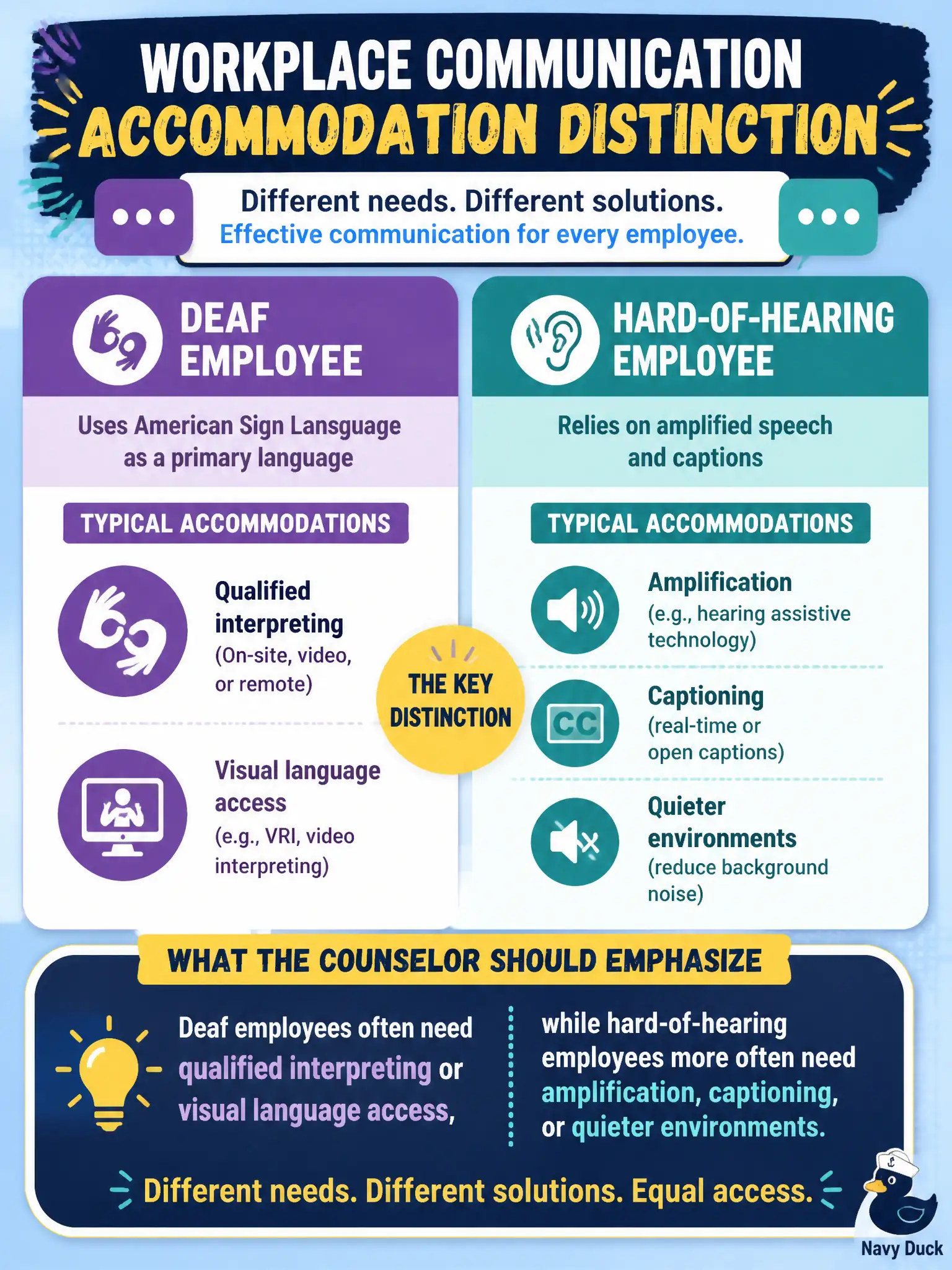
Two clients need workplace communication access: one is Deaf and uses American Sign Language as a primary language; the other is hard of hearing and relies on amplified speech and captions. What accommodation distinction should the counselor emphasize?
Select an answer to reveal the explanation.
Short Explanation
Deaf and hard-of-hearing are neighbors, not twins. One may live in a signed-language world and need an interpreter; the other may still use hearing with volume, captions, or a quieter room. Match the access tool to the person's communication reality.
Full Explanation
Deaf clients who use ASL as a primary language typically need qualified interpreting or visual language access, whereas hard-of-hearing clients more often need amplification, captioning, and acoustic/visual supports. Collapsing both into one accommodation package misses language-access versus auditory-access distinctions that determine meeting and safety communication equity. Public employers and CRPs must tailor access, not assume one hearing-related kit fits all.
Requiring identical supports for all hearing-related disabilities erases ASL language needs versus amplification/caption needs. Claiming only hard-of-hearing clients need access services while Deaf clients rely solely on lipreading denies effective communication rights. Assuming written notes alone always replace interpreters for Deaf employees in safety-critical briefings underestimates speed, complexity, and equity of access.
Exam caveat: distinguish Deaf/ASL interpreting needs from hard-of-hearing amplification and captioning needs.
Operational check: ask preferred communication mode; arrange qualified interpreters for ASL users; arrange amplification/captions for hard-of-hearing users; verify safety briefings are accessible in the chosen modality.