
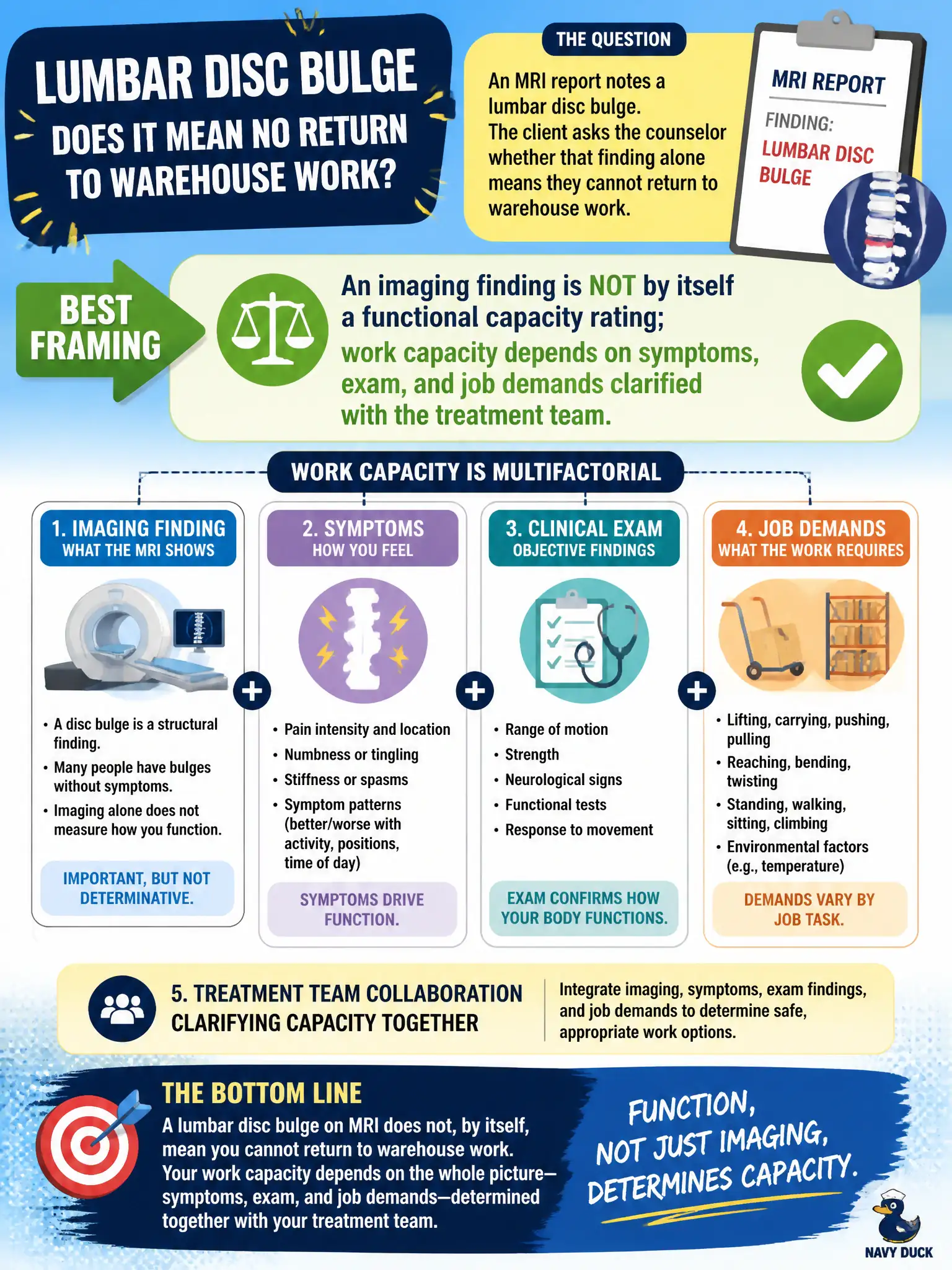
An MRI report notes a lumbar disc bulge. The client asks the counselor whether that finding alone means they cannot return to warehouse work. What is the counselor's best framing?
Select an answer to reveal the explanation.
Short Explanation
An MRI snapshot is not a job description. Plenty of people have disc bulges on film and still work; others have clean scans and serious limits. Tie planning to symptoms, exam findings, and what the job actually asks—then loop in the treatment team.
Full Explanation
An MRI disc bulge is an imaging finding, not by itself a functional capacity rating. Return-to-warehouse decisions depend on symptoms, clinical exam, and essential job demands clarified with the treatment team—often via functional capacity data—not radiology alone. Civic VR counselors frame imaging as one input among functional evidence so clients are neither over-restricted nor pushed into unsafe tasks.
Claiming any MRI disc bulge permanently precludes lifting jobs overgeneralizes anatomy into lifetime vocational destiny. Reinterpreting radiology as definitive work restrictions without consulting providers exceeds the counselor’s role and may be wrong clinically. Asserting MRI always overrides functional capacity evaluations when they conflict elevates pictures over demonstrated performance.
Clients deserve counseling that neither catastrophizes every bulge nor dismisses pain; functional capacity and essential demands remain the vocational bridge from imaging to work.
Exam caveat: imaging ≠ automatic work capacity; integrate symptoms, exam, FCE/job demands, and provider input.
Operational check: review symptoms and provider restrictions; request or review functional capacity relative to warehouse demands; avoid counseling the MRI as a standalone employment verdict.