
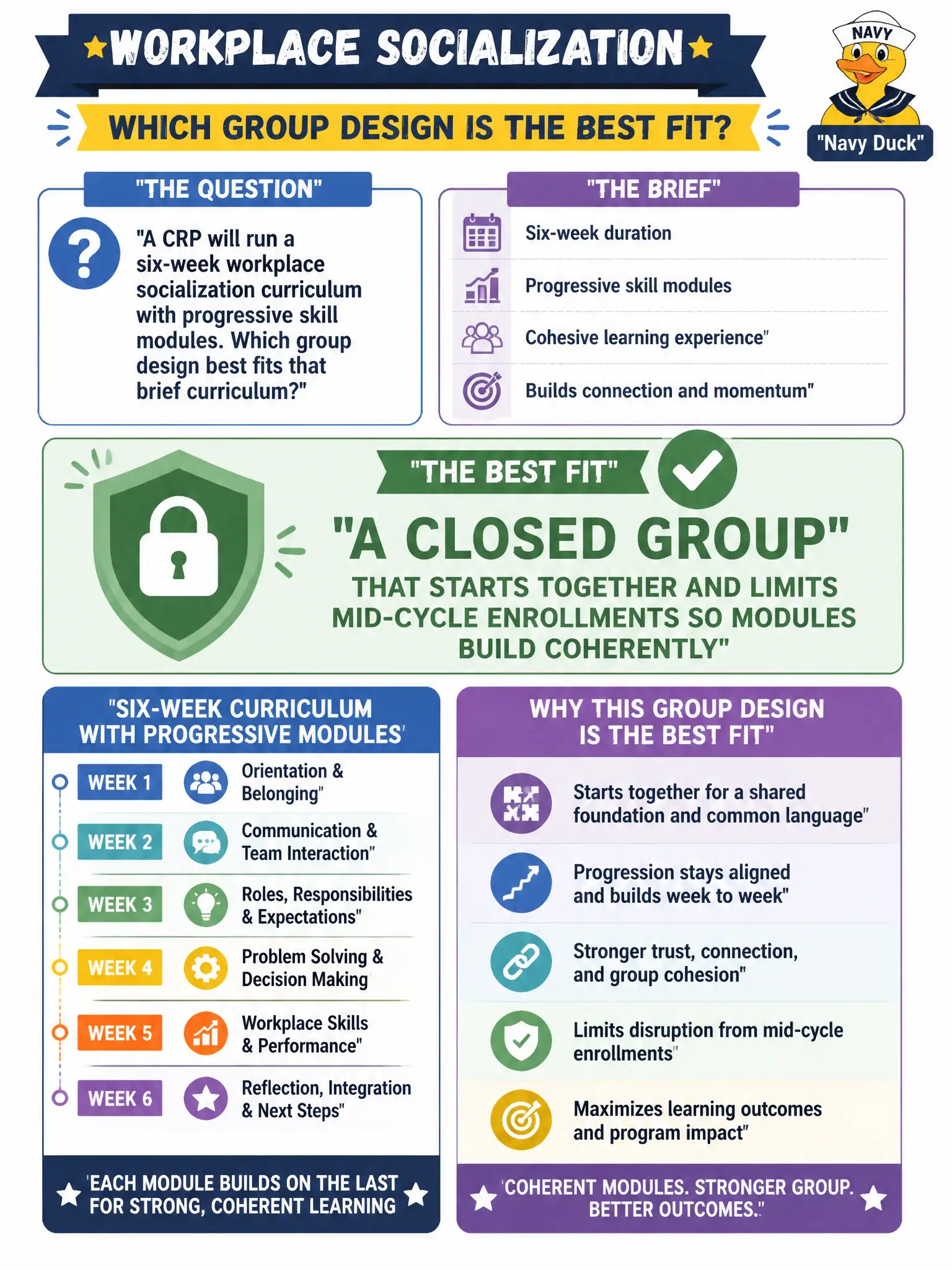
A CRP will run a six-week workplace socialization curriculum with progressive skill modules. Which group design best fits that brief curriculum?
Select an answer to reveal the explanation.
Short Explanation
A short skill ladder works best when everyone climbs the same rungs together. A closed group keeps the cohort intact so week-three skills rest on week-one practice. Constant new drop-ins force restarts and dilute the curriculum.
Full Explanation
A six-week workplace socialization curriculum with progressive modules needs shared learning history so later skills rest on earlier practice. A closed group that starts together and limits mid-cycle enrollments preserves continuity, reduces repeated orientation, and fits brief sequential civic CRP programming where staff time and curriculum fidelity matter.
A drop-in open group that admits new members every session regardless of prior modules forces constant restarting and fragments skill ladders. A one-time lecture with no membership continuity cannot deliver progressive rehearsal. An unstructured open lounge with no curriculum sequence abandons the modular design that justified the six-week plan.
State VR and CRP supervisors reviewing group fidelity should see a stable cohort roster and module map; open mid-cycle enrollment is a design mismatch for brief progressive curricula, not a neutrality virtue.
Exam caveat: match group design to curriculum length and sequencing; closed formats are preferred when modules build on one another in a short cycle.
Operational check: set a fixed start cohort and enrollment cutoff; publish the module sequence to members; if late entry is unavoidable, require a brief make-up orientation before joining ongoing skill practice.