
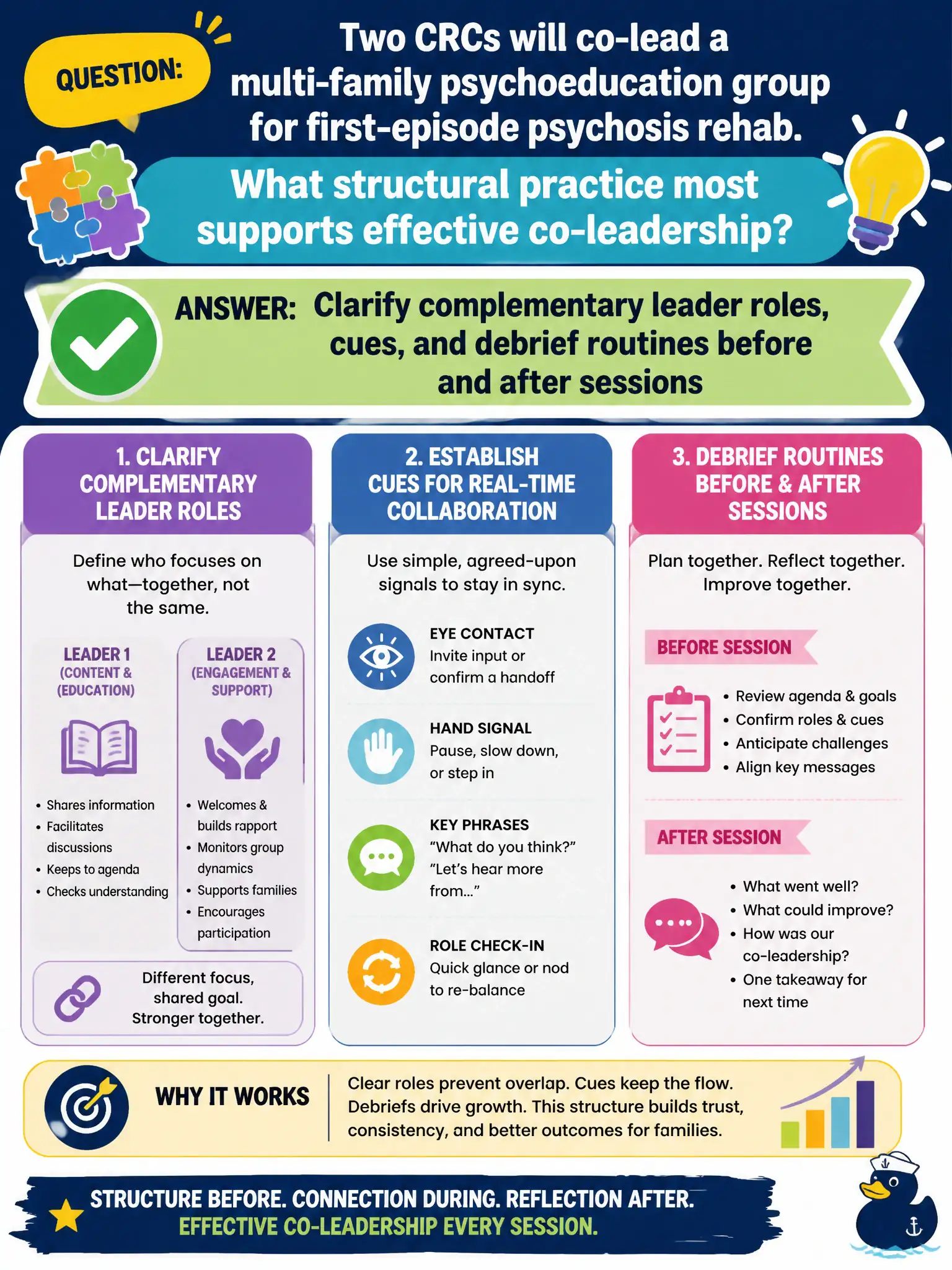
Two CRCs will co-lead a multi-family psychoeducation group for first-episode psychosis rehab. What structural practice most supports effective co-leadership?
Select an answer to reveal the explanation.
Short Explanation
Co-leading without a plan is like two captains grabbing the same wheel. Clear roles, handoff cues, and post-session debriefs keep the group steady for stressed families. Structure protects both the members and the leaders.
Full Explanation
Multi-family psychoeducation for first-episode psychosis works best when co-leaders clarify complementary roles, handoff cues, and debrief routines before and after sessions. Preplanned structure reduces mid-session confusion, keeps messaging consistent for stressed families, and models healthy teamwork—valuable in county mental-health and community rehab partnerships where two CRCs share leadership.
Arriving without planned roles and deciding leadership mid-session creates visible ambiguity that unsettles families already coping with psychosis. Letting one leader dominate while the other stays silent to avoid conflict wastes co-leadership capacity and can signal hierarchical tension. Rotating facilitation without ever debriefing between sessions allows drift in content, tone, and safety handling.
In county behavioral-health and community rehab partnerships, co-leadership also protects coverage when one facilitator must step out for a distressed family member, so role clarity is both clinical and operational continuity.
Exam caveat: co-leadership items reward explicit role clarity and reflective debrief over improvisation or silent second-chair arrangements.
Operational check: write a co-leader plan listing who opens, who teaches which module, and who monitors distress; agree on nonverbal handoff cues; schedule a 10-minute post-session debrief after every multi-family meeting.