
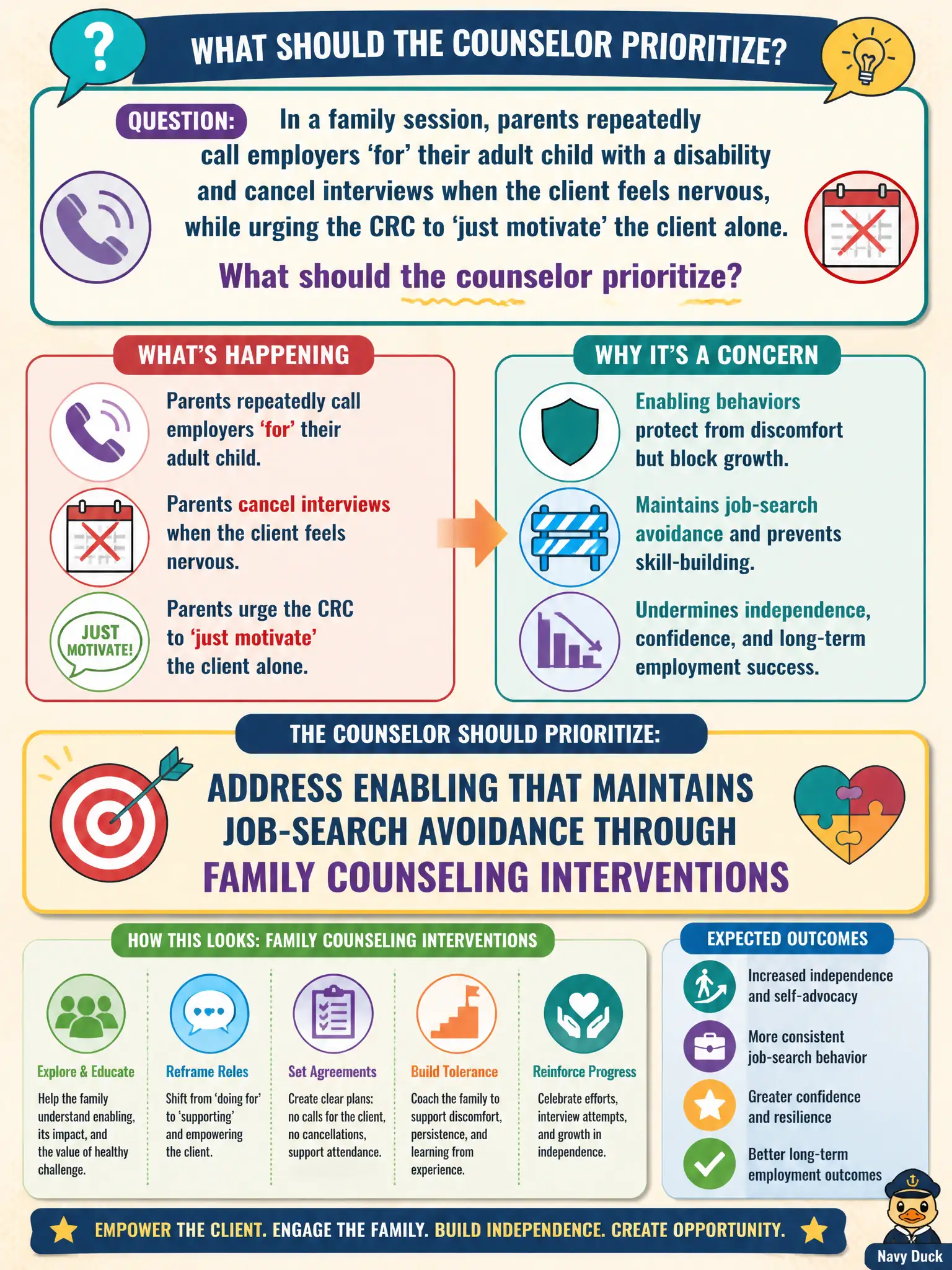
In a family session, parents repeatedly call employers 'for' their adult child with a disability and cancel interviews when the client feels nervous, while urging the CRC to 'just motivate' the client alone. What should the counselor prioritize?
Select an answer to reveal the explanation.
Short Explanation
If the family keeps clearing the path, the client never learns to walk it. Enabling that cancels interviews maintains avoidance better than any pep talk can fix. The CRC needs family work that names the pattern and redistributes responsibility toward the client's own job search.
Full Explanation
When parents repeatedly call employers for an adult child, cancel interviews during nervousness, and push the CRC to ‘just motivate’ the client alone, the maintaining system is family enabling of job-search avoidance. Family counseling interventions that name the pattern, strengthen boundaries, and support autonomous seeking address the systemic driver; individual pep talks alone leave the avoidance loop intact. In civic and public VR settings, protecting adult client autonomy while engaging family supports is central to ethical vocational progress.
Increasing individual pep talks while avoiding family patterns treats motivation as a private deficit and ignores how cancellation behavior removes practice opportunities. Discharging the client for lack of motivation without family involvement blames the person with the least control over the canceling behavior. Requiring parents to stop attending all appointments permanently without discussion can sever needed supports and skips collaborative boundary work.
Exam caveat: Domain 3 items often distinguish individual motivational framing from family/systemic interventions when enabling maintains vocational avoidance.
Operational check: map who contacts employers and who cancels interviews; convene a family session to set communication rules and client-led outreach; document boundary agreements and review them before the next interview cycle.