
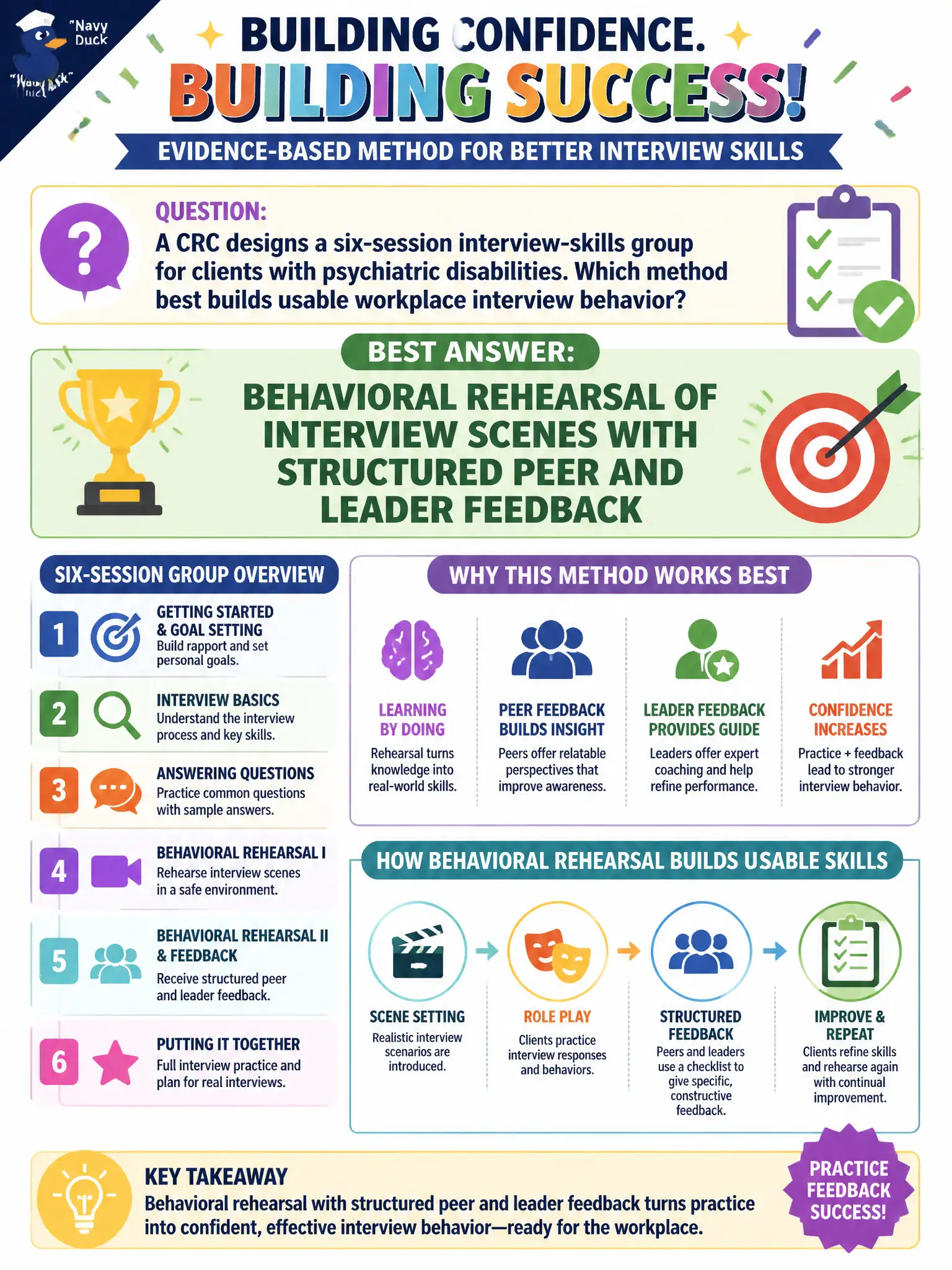
A CRC designs a six-session interview-skills group for clients with psychiatric disabilities. Which method best builds usable workplace interview behavior?
Select an answer to reveal the explanation.
Short Explanation
Interview skills stick the way piano skills stick—you have to play the keys out loud. Behavioral rehearsal lets members practice answers and body language, then get clear feedback. Talk-only theory rarely transfers to the real interview room.
Full Explanation
Vocational interview-skills groups build usable workplace behavior when members rehearse scenes, receive structured peer and leader feedback, and refine responses under mild performance pressure. Behavioral rehearsal with modeling and corrective feedback targets the same skills employers will judge—content, pacing, and nonverbal presentation—so community rehab clients with psychiatric disabilities leave with practiced competence rather than abstract theory. For public VR and CRP curricula, that method directly advances job-seeking and workplace socialization goals.
Lecture-only résumé theory without practice fails the transfer problem: clients may understand concepts yet freeze when a real interviewer asks a follow-up. Open-ended venting circles without a skills agenda may relieve emotion but do not install interview behavior. Silent independent workbook time without interaction removes modeling, feedback, and social learning that make group formats valuable.
Exam caveat: skills-training group questions typically prefer active rehearsal and feedback over didactic or purely process formats when the stated goal is workplace behavior change.
Operational check: design each session with a modeled interview vignette, timed member rehearsals, structured feedback rubrics, and a brief home practice task; document progress on specific interview behaviors rather than attendance alone.