
During orientation for a job-club group at a community rehab program, several members ask whether what they share stays private like individual counseling. What should the CRC emphasize?
Select an answer to reveal the explanation.
Short Explanation
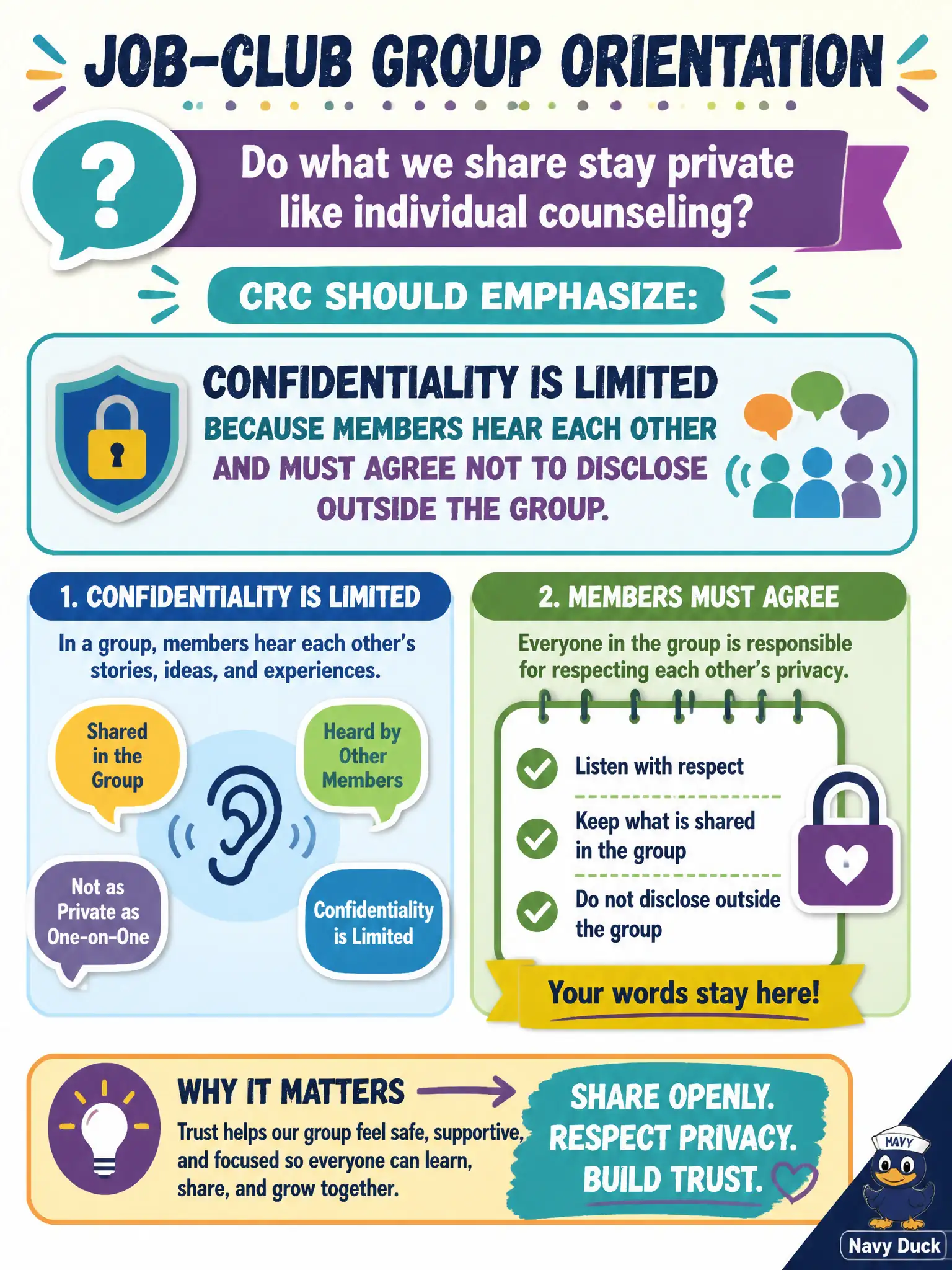
Think of group counseling like a shared locker room—everyone hears the stories, so privacy is a team sport. The CRC must spell out that members keep what they hear in the room, and that absolute confidentiality cannot be guaranteed like in one-to-one sessions. Clear informed consent up front prevents surprises later.
Full Explanation
In community rehab job-club groups, informed consent must confront a privacy reality that individual counseling does not share: peers hear disclosures and can repeat them outside the room. The CRC therefore emphasizes that confidentiality is limited, that members must agree not to disclose others’ information, and that residual breach risk remains even with strong norms. That framing protects trust, documents ethical practice, and sets civic expectations for a public or nonprofit program serving clients who often know one another through the same local service network.
Treating group confidentiality as identical to dyadic counseling understates peer-disclosure risk and misleads members about what the agency can guarantee. Claiming only the counselor may speak about sessions while members have no privacy duties flips responsibility away from the people who actually hear the stories. Asserting that signed releases are unnecessary because groups are always legally privileged like therapy dyads confuses hope with law and can leave the program exposed when privilege does not apply as assumed.
Exam caveat: CRC items on group work often test whether candidates distinguish counselor duty from member duty and acknowledge residual risk rather than promising absolute secrecy.
Operational check: put limits of confidentiality, member non-disclosure agreements, and residual-risk language into the job-club orientation script; obtain documented acknowledgment before the first sharing round; revisit the norms when a new member joins mid-cycle.