
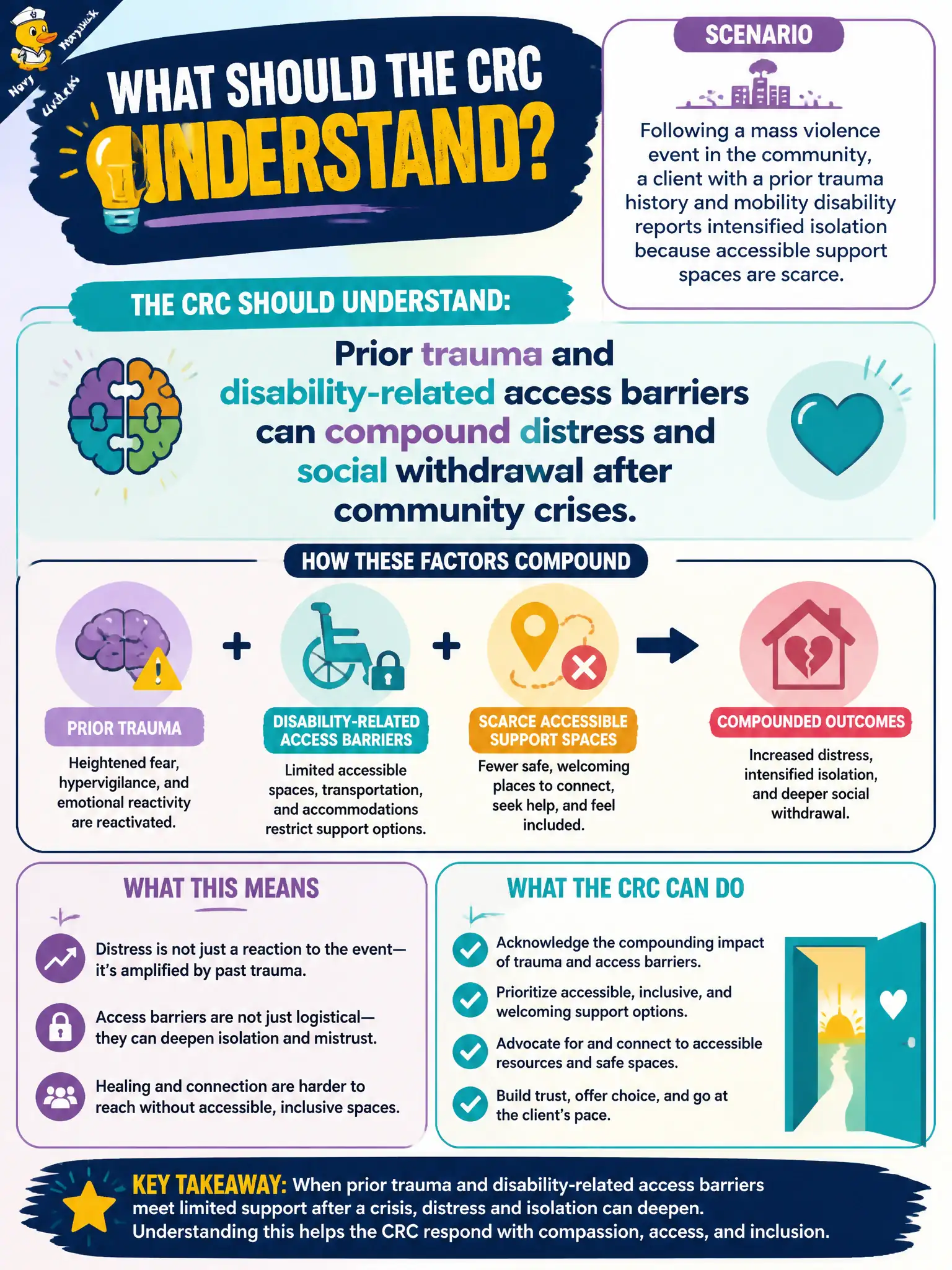
Following a mass violence event in the community, a client with a prior trauma history and mobility disability reports intensified isolation because accessible support spaces are scarce. What should the CRC understand?
Select an answer to reveal the explanation.
Short Explanation
Old wounds plus blocked doorways make community crises hit twice. Prior trauma can flare while inaccessible support spaces deepen isolation. The CRC's job is to name that double hit and open workable supports—not pretend disability and trauma don't interact.
Full Explanation
After mass violence, prior trauma can reactivate while mobility disability limits access to support spaces, compounding distress and social withdrawal. The CRC understands that community crisis and disability-related access barriers interact—psychologically and environmentally—rather than treating either factor alone. Trauma-informed civic rehab counseling then opens workable access paths and emotional supports together.
Asserting that community trauma never interacts with disability-related barriers denies compounding risk. Interpreting isolation as a reason to stop counseling removes support when it is most needed. Claiming only people without disabilities experience secondary trauma after mass violence is factually and ethically wrong.
Municipal recovery centers and peer spaces that lack ramps, transit access, or ASL/communication access recreate exclusion precisely when belonging would buffer trauma reactivation.
Exam caveat: look for compounded trauma-plus-access explanations when community crises affect clients with disabilities.
Operational check: assess trauma reactivation and concrete access barriers to support spaces; arrange accessible venues or remote options; coordinate trauma-informed supports without dropping rehab contact.