
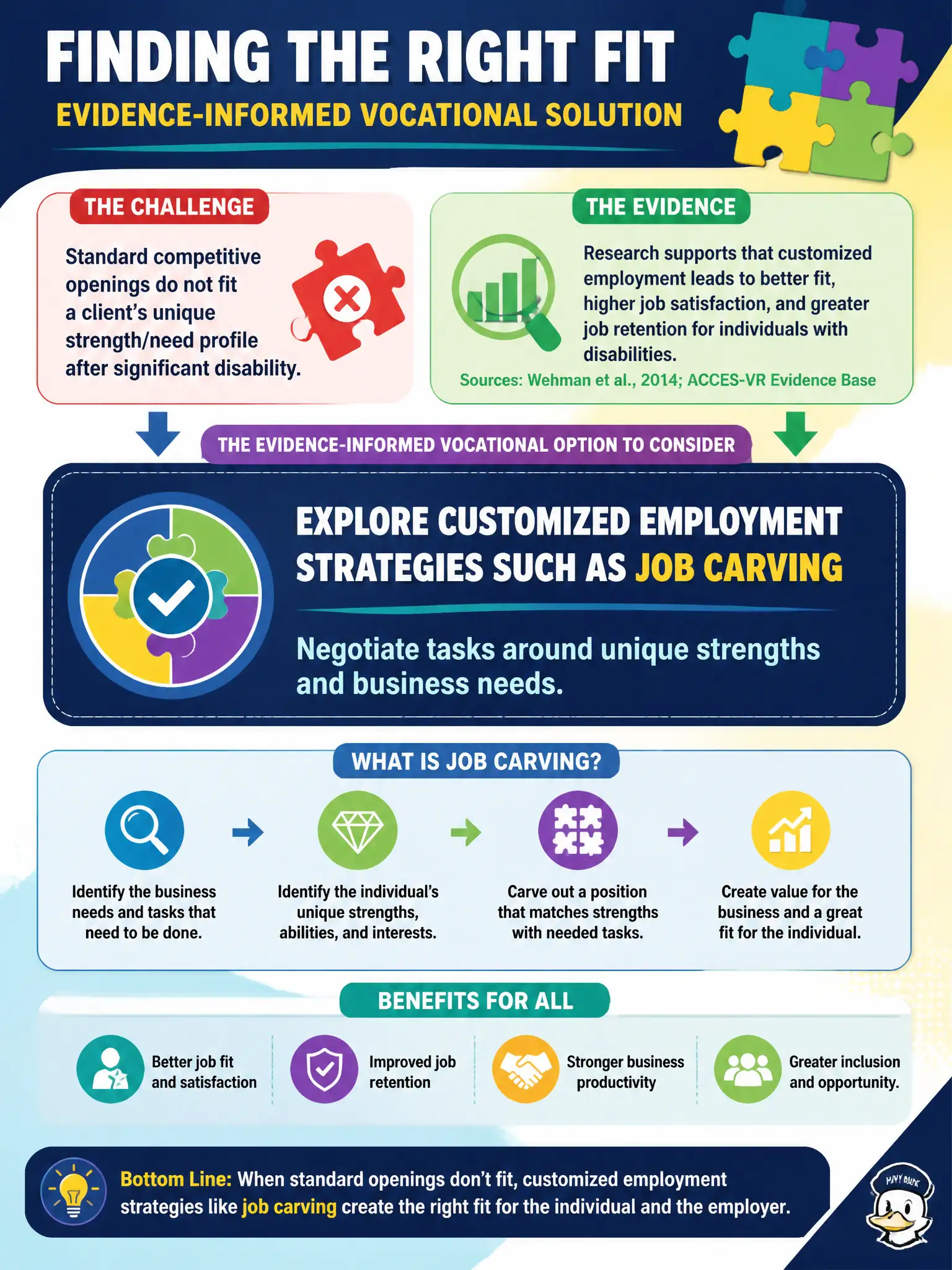
Standard competitive openings do not fit a client’s unique strength/need profile after significant disability. What evidence-informed vocational option should the counselor consider?
Select an answer to reveal the explanation.
Short Explanation
If the catalog sizes don’t fit, a tailor alters the suit—that’s job carving. Customized employment shapes tasks around real strengths and employer needs when standard postings miss. Perfect-match-or-nothing thinking leaves talent on the bench.
Full Explanation
When standard competitive openings do not fit a client’s unique strength and need profile after significant disability, counselors should explore customized employment strategies such as job carving that negotiate tasks around unique strengths and business needs. Civic labor-market inclusion includes reshaping jobs with employers, not only matching imperfect posted descriptions or concluding that work is impossible.
Concluding that no employment is possible if posted descriptions are imperfect matches fails by concept as giving up before negotiation and customization. Only increasing unpaid assessment hours indefinitely without employer negotiation fails by assessment looping instead of carving opportunities that create mutual benefit. Forcing the first posted opening regardless of essential-function mismatch and safety fails as harmful mismatching that risks injury and job loss.
Exam caveat: customized employment still requires employer benefit and informed choice—it is not inventing unpaid make-work without business value. Operational check: profile strengths and contributions, approach employers with a negotiated task set, document carved duties and wages, secure needed accommodations, and review job stability with follow-along supports after start.