
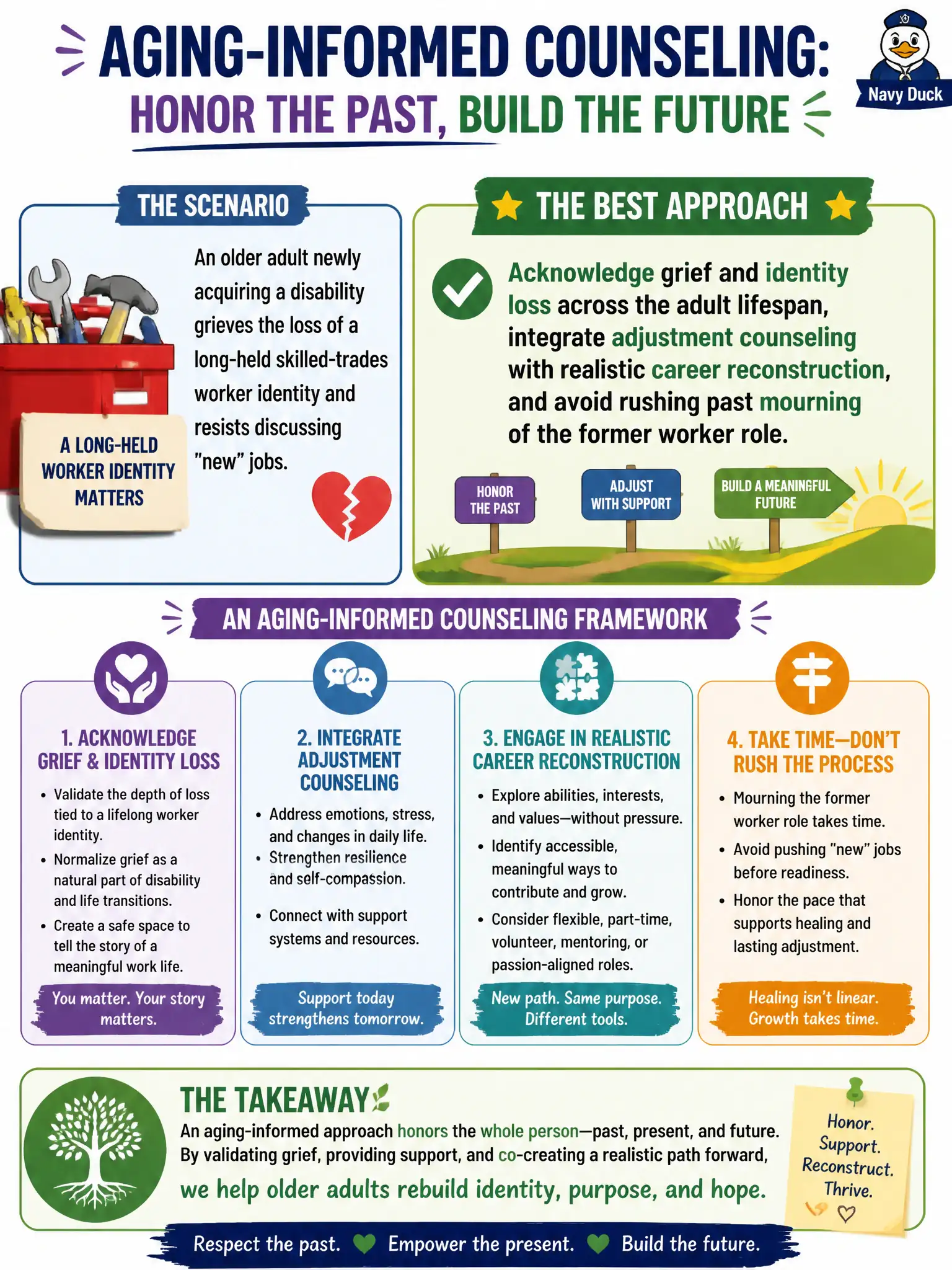
An older adult newly acquiring a disability grieves the loss of a long-held skilled-trades worker identity and resists discussing “new” jobs. What developmental/aging-informed counseling approach fits best?
Select an answer to reveal the explanation.
Short Explanation
Losing a long-time trades identity hits like losing a name tag you wore for decades. Grief is part of adult development after disability onset—not a speed bump to ignore. Sit with the loss, then rebuild career meaning without steamrolling the mourning.
Full Explanation
An older adult newly acquiring a disability who grieves a long-held skilled-trades worker identity needs developmental and aging-informed counseling: acknowledge grief and identity loss across the adult lifespan, integrate adjustment counseling with realistic career reconstruction, and avoid rushing past mourning of the former worker role. Civic rehab for aging workers is identity work as well as job placement.
Dismissing grief as irrelevant and pushing only résumé worksheets fails by concept because unprocessed identity loss often blocks engagement with new options. Saying aging means vocational counseling is never appropriate fails as ageist exclusion contrary to rehab values. Requiring immediate acceptance of any entry-level placement without exploring meaning of the prior identity fails by forcing premature foreclosure and disrespecting occupational identity.
Exam caveat: acknowledging grief does not indefinitely postpone planning; it sequences mourning with gradual career reconstruction. Operational check: name the loss explicitly, explore transferable skills and values from the prior trade, involve peer or adjustment supports as useful, and co-create a paced exploration plan that honors dignity while testing feasible new roles.