
A counselor uses CBT thought records to address catastrophic thinking that blocks a client's return-to-work plan. What does this technique primarily target?
Select an answer to reveal the explanation.
Short Explanation
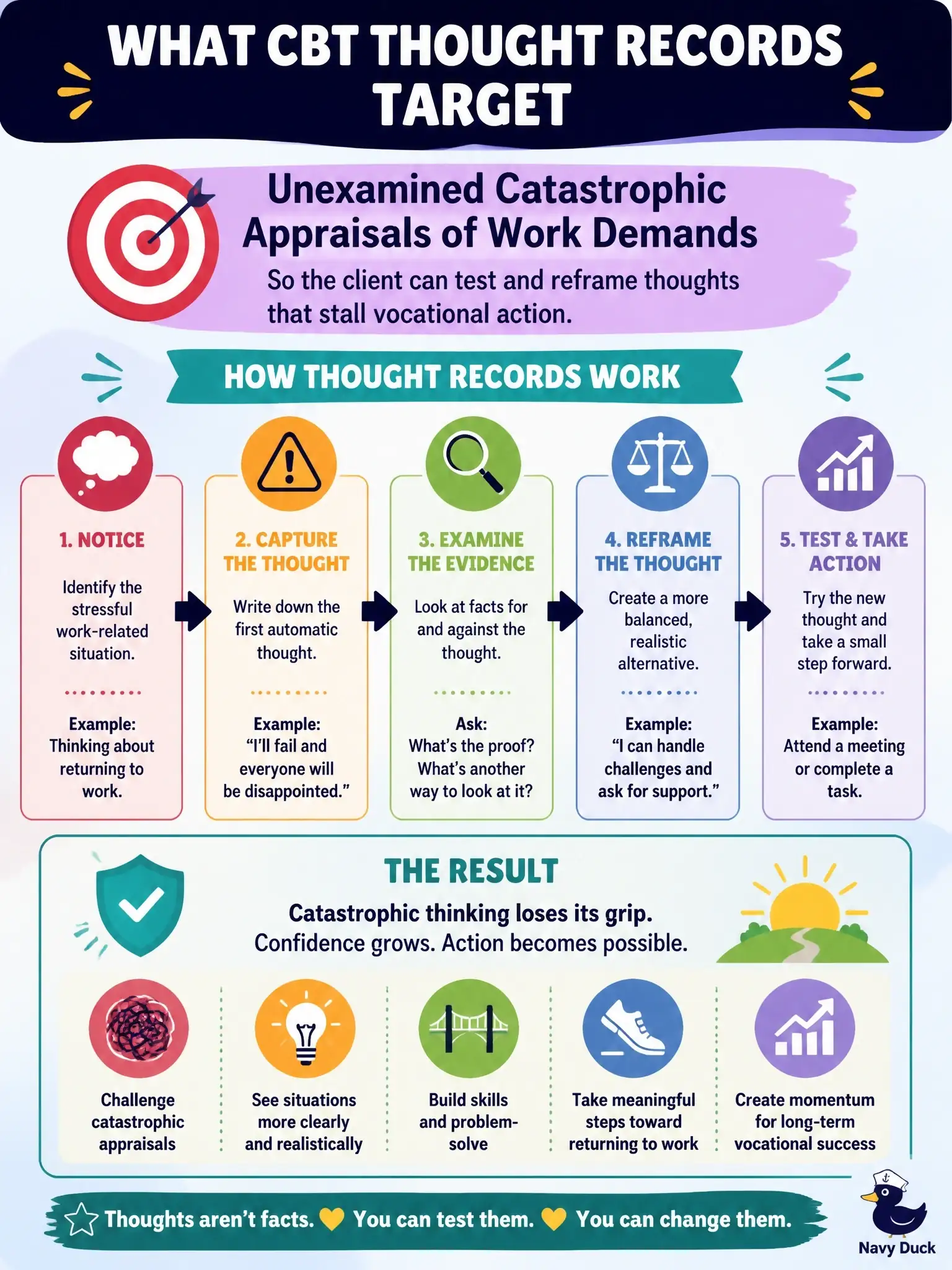
Catastrophic thoughts are like smoke alarms that scream 'house fire' when you burned toast — they shut down action. CBT thought records help you catch the alarm, check the evidence, and cool the story so return-to-work steps can move again.
Full Explanation
CBT thought records in return-to-work counseling primarily target unexamined catastrophic appraisals of work demands so the client can test and reframe thoughts that stall vocational action. In civic rehab settings, fear of failure, re-injury, coworker judgment, or relapse of symptoms often maintains avoidance; cognitive techniques make those appraisals explicit, evidence-tested, and linked to graded behavioral experiments on the job path. The idea that the technique targets only employer payroll systems unrelated to the client's beliefs fails by concept because thought records address cognitions, not payroll administration. The idea that the goal is permanent suppression of all emotional language in counseling sessions fails because CBT works with thoughts and emotions rather than banning affect. The idea that worksheets replace all medical treatment fails by overgeneralizing a counseling tool into a medical substitute. Exam caveat: CBT adjuncts do not replace indicated medical or psychiatric care; they address cognitive-behavioral barriers to vocational progress. Operational check: identify specific catastrophic predictions tied to job tasks, design behavioral experiments at work or in graded simulations, review evidence on the thought record each session, and coordinate with treating providers when symptoms escalate beyond counseling scope.