
A VR client keeps saying they 'want work' but repeatedly misses job interviews. Which clinical problem-solving move best fits before only labeling nonadherence?
Select an answer to reveal the explanation.
Short Explanation
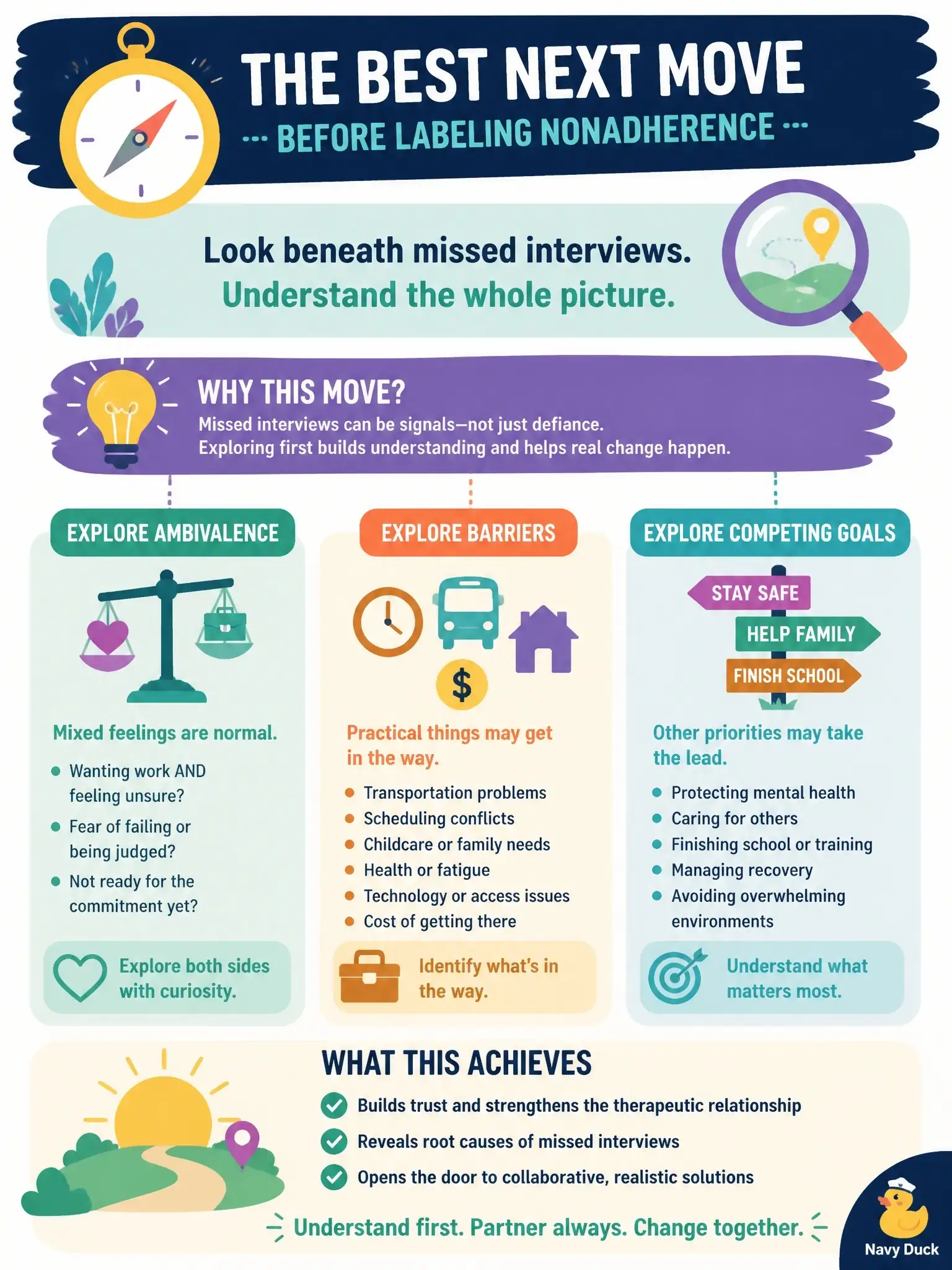
Missing interviews while saying they want work is like packing a suitcase and never leaving the driveway — something's stuck. You don't just stamp 'noncompliant' on the file; you explore ambivalence, barriers, and competing goals.
Full Explanation
Exploring ambivalence, barriers, and competing goals that may sit under missed interviews, rather than treating absences as simple defiance alone, best fits the clinical problem-solving move. Civic counselors use discrepancies between stated goals and behavior as assessment data that may reveal depression, transportation, stigma, substance use, fear, family conflict, or poorly matched job targets. Labeling nonadherence before that formulation skips the reasoning that makes later accountability fair and effective. The idea that the case should be closed immediately because missed interviews always prove lack of motivation fails as a moralistic shortcut that skips barrier analysis. The idea that interview volume should be increased without exploring barriers fails because more of a failing plan rarely self-corrects root causes and can deepen demoralization. The idea that the client should be referred only for punitive attendance monitoring while counseling contact stops fails by replacing counseling formulation with punishment. Exam caveat: after genuine collaborative problem-solving, some cases still require clear attendance agreements or closure, but exploration comes before labeling alone. Operational check: schedule a nonpunitive review of missed interviews, inventory practical and psychological barriers with the client, adjust supports or goals, document the shared plan, and only then escalate consequences if agreements are repeatedly broken without new barriers.