
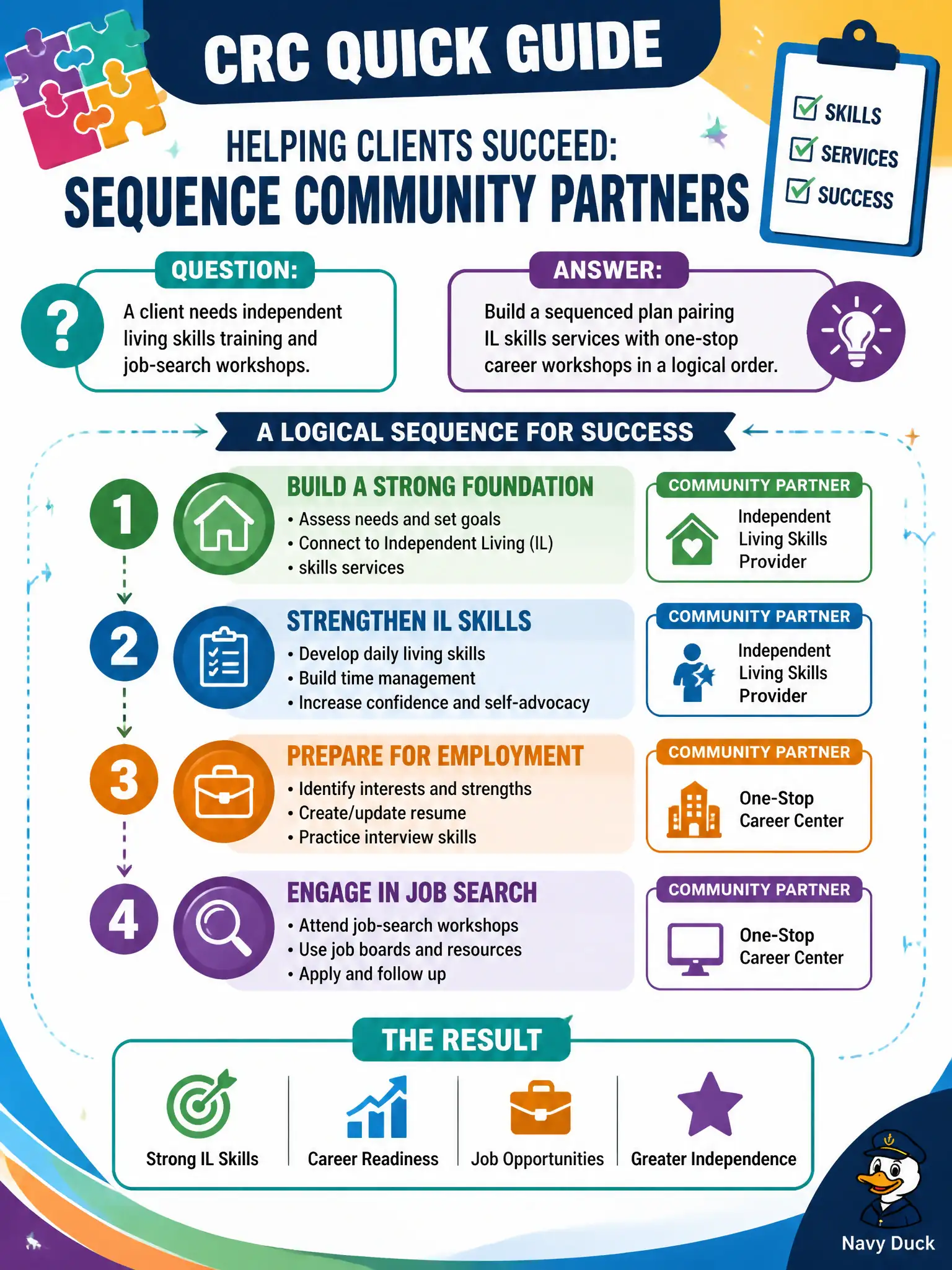
A client needs independent living skills training and job-search workshops. How should the CRC sequence community partners?
Select an answer to reveal the explanation.
Short Explanation
IL skills and one-stop workshops aren't rivals—they're chapters in the same story. Line them up so daily living skills and job-search practice land in the right order instead of colliding.
Full Explanation
Skills development and independent living services often pair with workforce partners such as municipal one-stop career centers. Effective community resource practice sequences and coordinates these civic partners so living-skills readiness and employment preparation reinforce each other. A planned partnership approach clarifies roles, timing, and shared goals rather than fragmented parallel referrals that exhaust the client. Referring only to independent living services and postponing all employment workshops indefinitely can stall vocational momentum when both domains are needed. Sending the client to simultaneous uncoordinated programs with no shared goals or timelines creates scheduling collisions and diluted accountability. Skipping independent living skills because one-stop centers always replace those supports confuses workforce workshop offerings with specialized IL training that many municipal career centers do not fully provide. Exam caveat: sequence is individualized—some clients need concurrent supports—but the exam emphasizes intentional coordination over indefinite delay, uncoordinated dual enrollment, or assuming one civic partner replaces the other. Operational check: draft a simple sequenced plan naming the IL provider, the one-stop workshop track, target start order, shared goals, and a mid-point check-in date; confirm both partners received the plan and the client can state who does what first.