
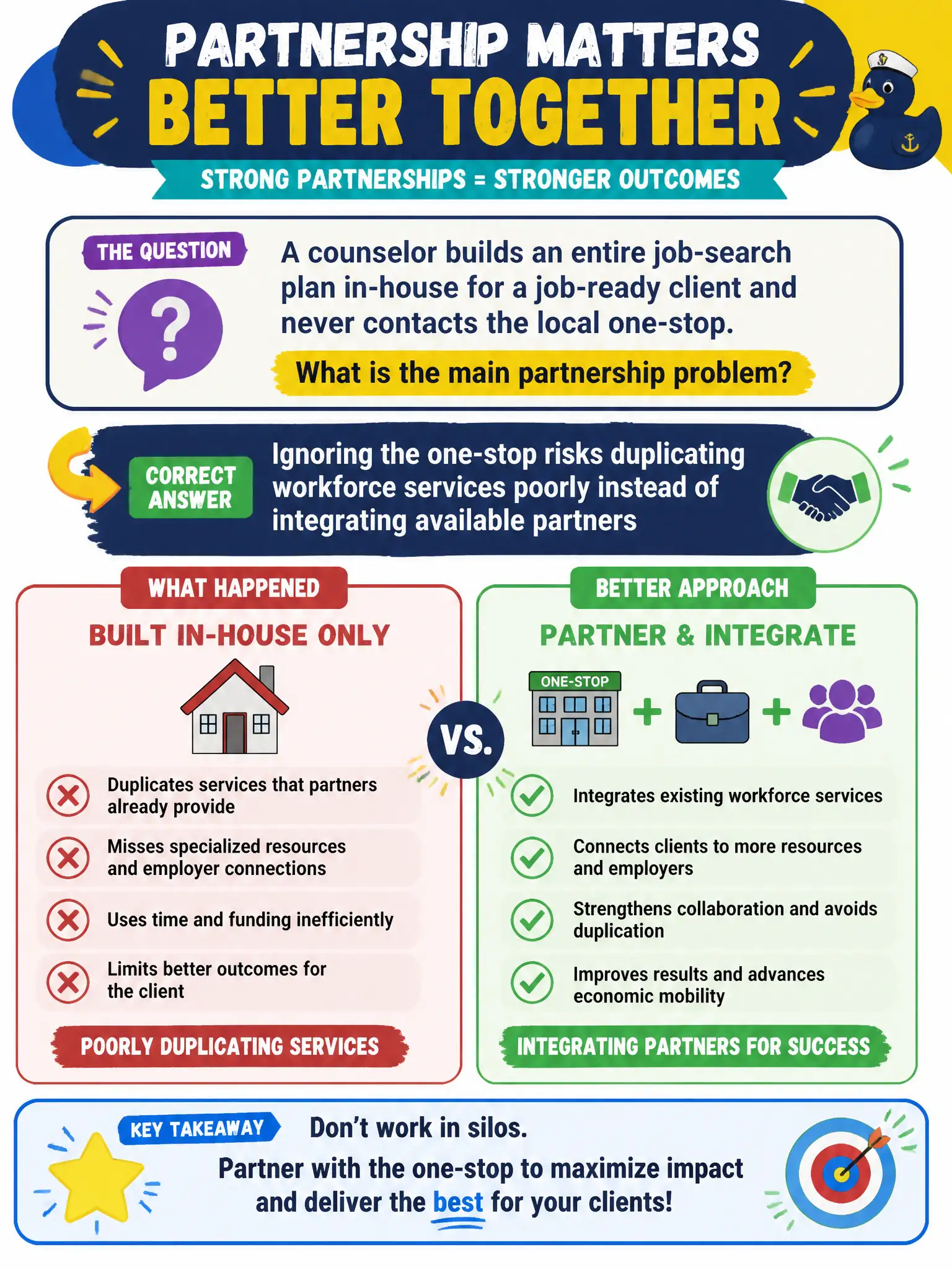
A counselor builds an entire job-search plan in-house for a job-ready client and never contacts the local one-stop. What is the main partnership problem?
Select an answer to reveal the explanation.
Short Explanation
Reinventing the entire job-search wheel while the one-stop sits unused is busywork, not brilliance. Integrate workforce partners when the client is ready. Parallel silos waste time and confuse employers.
Full Explanation
Building an entire job-search plan in-house for a job-ready client while never contacting the local one-stop risks duplicating workforce services poorly instead of integrating available partners. Domain 9 competence includes knowing when community stakeholders add labor-exchange value that a single counselor cannot match alone. Claiming one-stops are only for clients without disabilities fails because American Job Centers serve the public, including people with disabilities, often with disability resource coordination. Claiming in-house plans are always superior because community stakeholders cannot assist VR clients fails by isolating the counselor from public labor-exchange infrastructure. Claiming job-ready clients are forbidden from using American Job Center resources fails as a false restriction that harms access and informed choice. Exam caveat: some specialized disability services remain VR-led; partnership means integration of complementary services, not handing off clinical rehabilitation responsibility wholesale. Operational check: for job-ready cases, document a one-stop contact or a reasoned exception (for example, the client is already enrolled elsewhere), and list which services VR will provide versus which the workforce partner will provide.