
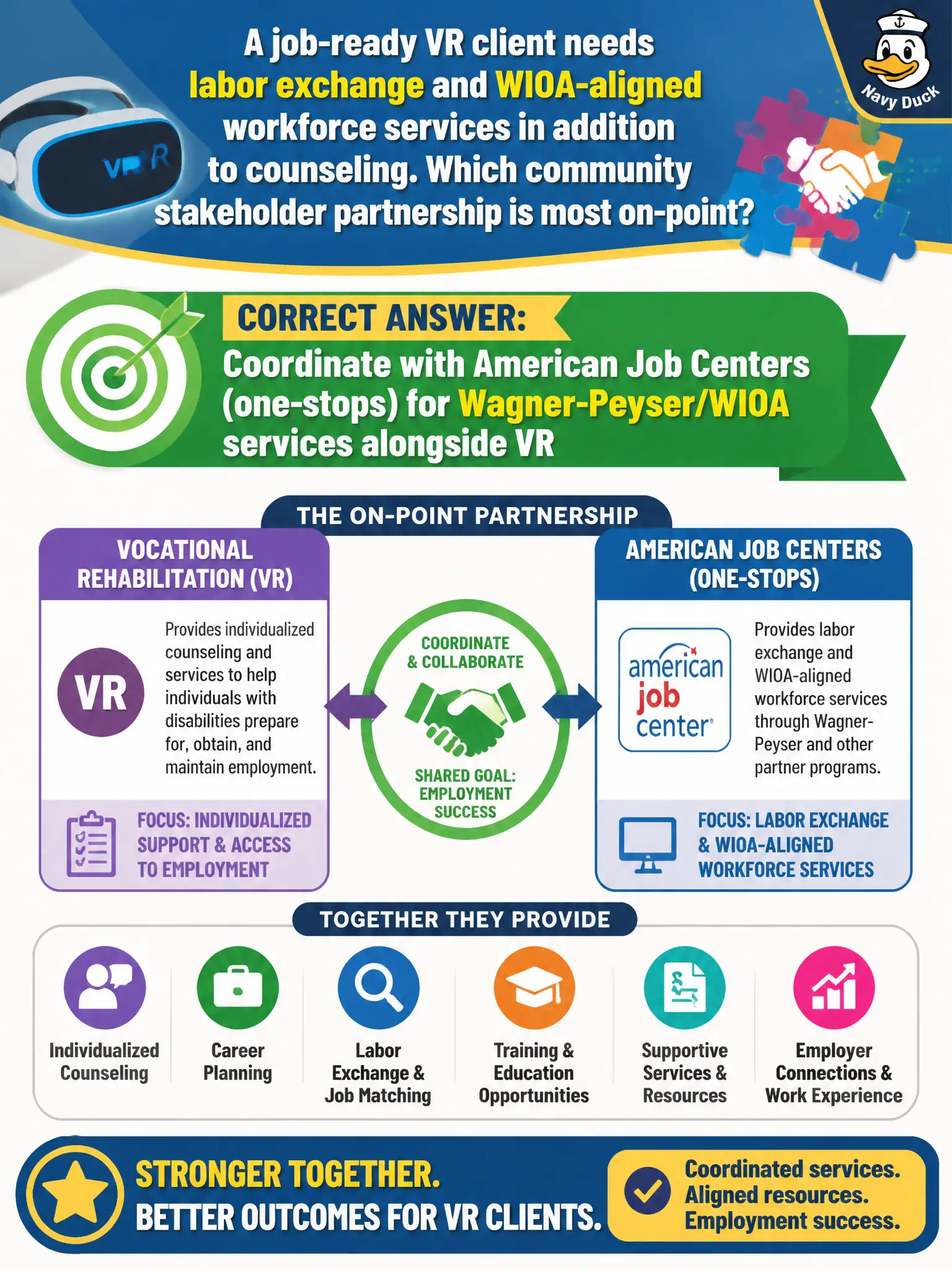
A job-ready VR client needs labor exchange and WIOA-aligned workforce services in addition to counseling. Which community stakeholder partnership is most on-point?
Select an answer to reveal the explanation.
Short Explanation
One-stops—American Job Centers—are built for labor exchange and WIOA-style help. Parking a job-ready VR client only in counseling while ignoring that partner wastes a whole system. Coordinate; do not duplicate in a vacuum.
Full Explanation
A job-ready VR client who needs labor exchange and WIOA-aligned workforce services in addition to counseling is best served by coordinating with American Job Centers (one-stops) for Wagner-Peyser/WIOA services alongside VR. Partnership expands employer contacts, workshops, and labor exchange capacity without abandoning rehabilitation counseling or disability expertise. Avoiding workforce centers so VR remains the only employment system involved fails because isolation duplicates effort and shrinks the employer network available to the client. Referring only to unpaid internships with no workforce-system connection fails when the client is already job-ready for competitive openings the one-stop can help surface. Sending the client to random online ads without partner coordination fails because it forgoes structured public workforce resources already funded for community job seekers. Exam caveat: VR and workforce partners must clarify who leads on disability accommodations and case documentation to avoid conflicting plans or dropped balls. Operational check: with client consent, make a warm referral to the local American Job Center, align IPE job goals with one-stop services, and schedule a joint or sequential appointment rather than parallel silence.