
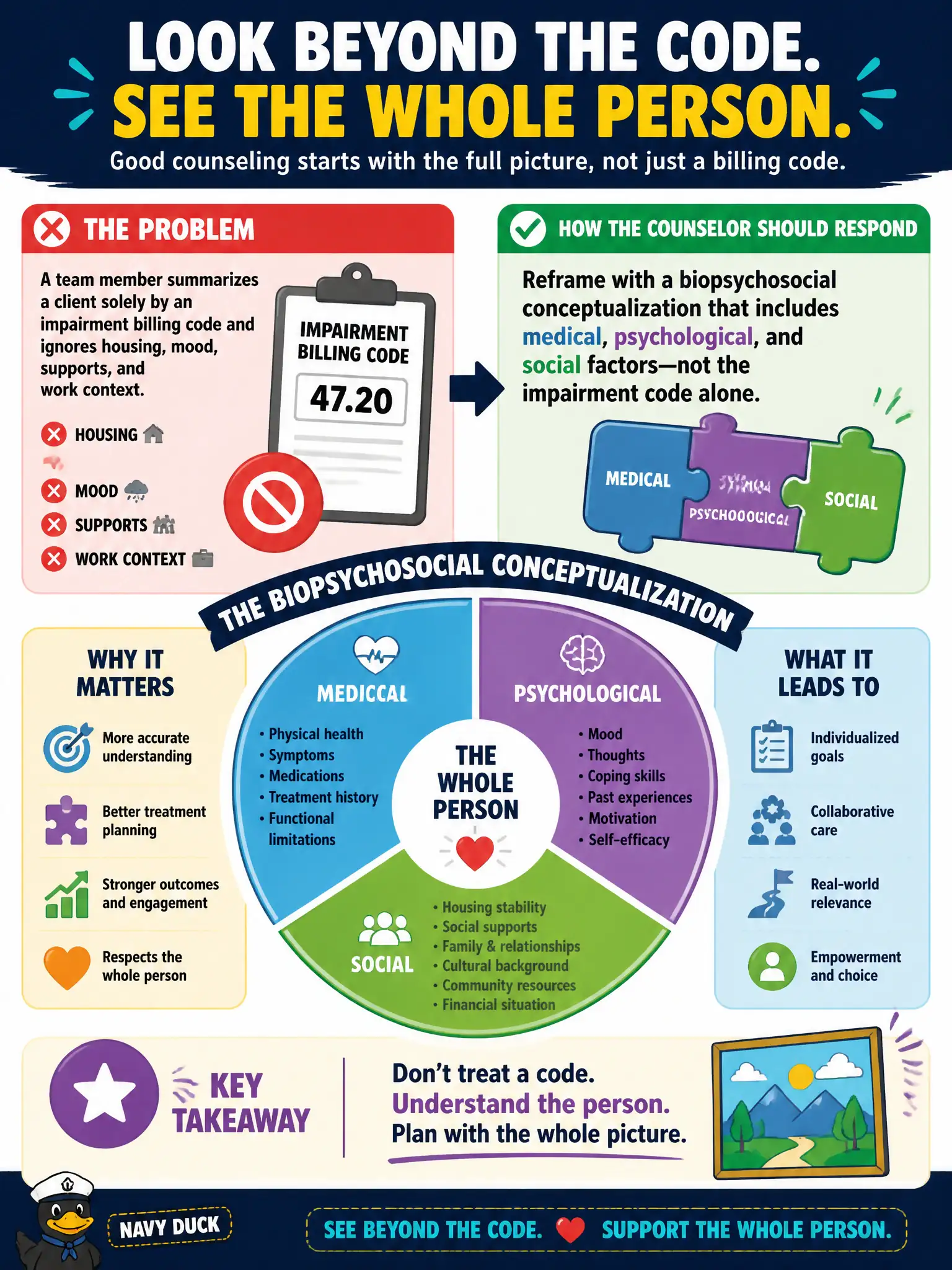
A team member summarizes a client solely by an impairment billing code and ignores housing, mood, supports, and work context. How should the counselor respond?
Select an answer to reveal the explanation.
Short Explanation
An ICD code isn't a person. Reducing someone to one impairment label misses the housing crunch, the mood piece, and the job context that actually drive the plan. Zoom out to the full BPS picture.
Full Explanation
When a team member summarizes a municipal client solely by an impairment billing code and ignores housing, mood, supports, and work context, the CRC should reframe with a biopsychosocial conceptualization that includes medical, psychological, and social factors—not the impairment code alone. Billing codes are administrative labels useful for claims, not complete case formulations for rehabilitation planning. Restoring the wider formulation improves interdisciplinary decisions and person-centered civic care across housing, mental health, and employment domains. Agreeing that the impairment code is a complete case formulation collapses complexity into a claim tag and erases barriers that determine outcomes. Deleting all psychosocial data from the chart to simplify documentation removes information needed for safe planning and continuity. Replacing counseling with coding audits as the primary rehabilitation intervention confuses revenue integrity work with clinical-vocational practice. Exam caveat: accurate coding still matters for funding; the error is treating the code as the whole person formulation rather than one administrative data point. Operational check: present a brief BPS summary (medical status, psychological factors, social/environmental context, vocational goals) in the next team meeting and update the shared civic plan accordingly.