
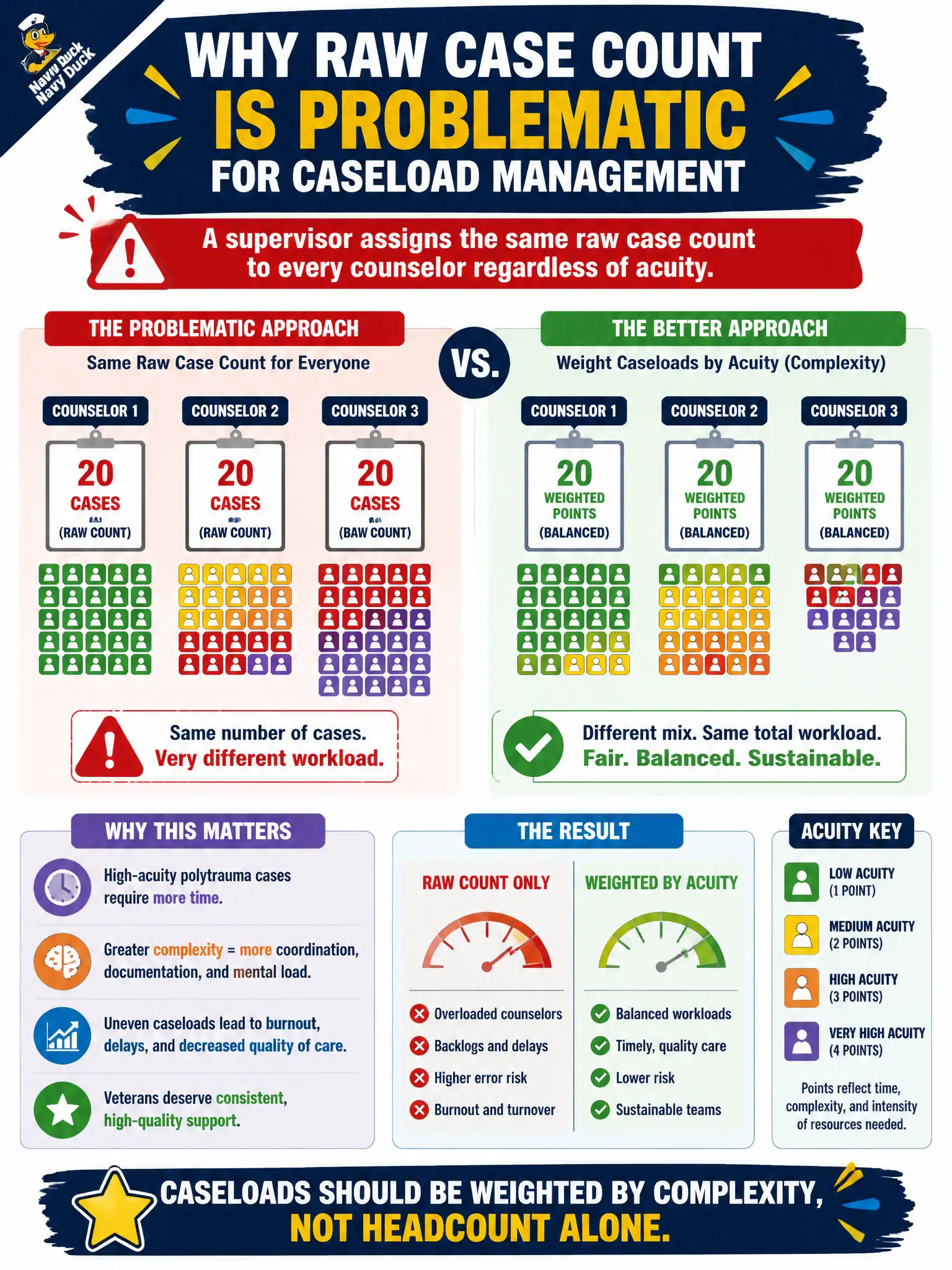
A supervisor assigns the same raw case count to every counselor regardless of acuity. Why is this problematic for caseload management?
Select an answer to reveal the explanation.
Short Explanation
Ten quiet cases aren't the same as ten fire-drill polytrauma cases. Counting noses instead of weighing intensity burns out counselors and shortchanges complex clients. Weight the workload.
Full Explanation
Caseload management in municipal rehabilitation agencies should weight assignments by complexity and acuity, not raw headcount alone, because high-acuity polytrauma cases consume more counselor time for coordination, monitoring, crisis response, and multi-vendor communication. Equal raw counts can create unequal and unsafe workloads that degrade both outcomes and documentation quality. Supervisors who ignore acuity distort capacity planning across the civic unit. Claiming all cases consume identical counselor time so raw counts are always fairest denies obvious complexity differences visible in polytrauma versus stable single-goal cases. Closing polytrauma cases automatically after two weeks to keep counts low is clinically reckless and ethically improper. Declaring caseload size irrelevant because documentation quality never depends on time available contradicts basic workload science in public human services. Exam caveat: weighting methods vary by agency—acuity scales, time studies, or tiering—but the CRC concept is that complexity-sensitive assignment beats pure census equality. Operational check: compare two counselors with equal case counts but different acuity mixes, quantify time demands, and propose a weighted caseload standard for the civic unit with a pilot review date and staffing advocacy if overload persists.