
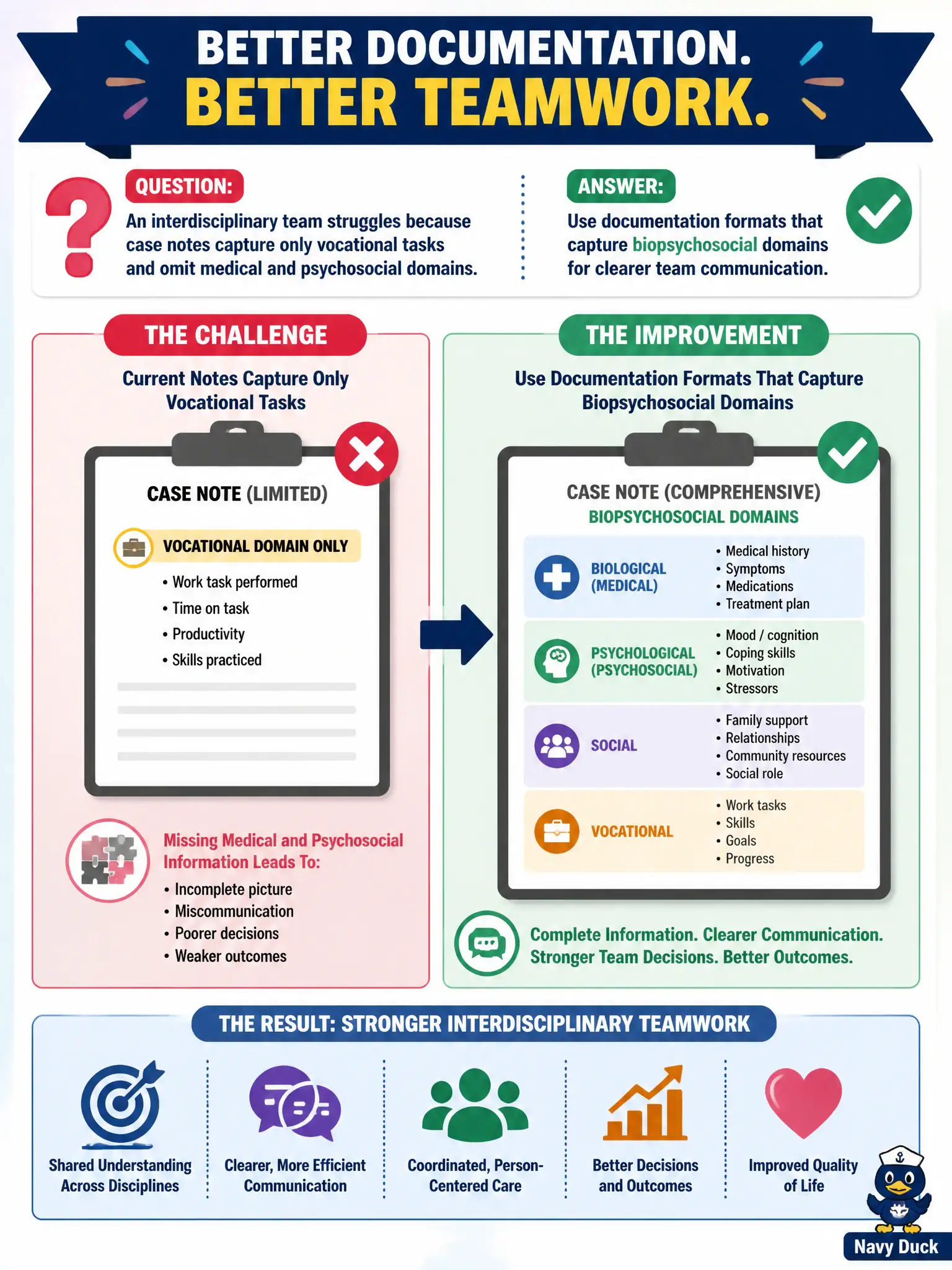
An interdisciplinary team struggles because case notes capture only vocational tasks and omit medical and psychosocial domains. What documentation improvement helps?
Select an answer to reveal the explanation.
Short Explanation
If the chart only shows job tasks, the nurse and psychologist are flying blind. BPS-structured notes give the whole team the same map.
Full Explanation
Interdisciplinary municipal teams communicate more clearly when documentation formats capture biopsychosocial domains rather than vocation-only task lists. Notes that omit medical and psychosocial context leave nurses, psychologists, and community partners flying blind about risks, mood, housing, and supports that affect work. Structured BPS documentation creates a shared map for coordinated civic rehabilitation. Continuing vocation-only notes to keep records short for auditors sacrifices clinical usefulness for brevity and weakens team decisions. Storing medical and psychosocial data only in the counselor's private memory recreates single-point failure when staff are absent. Asking each discipline to keep completely separate charts with no shared formulation fragments care and duplicates blind spots. Exam caveat: shared BPS formats must still respect privacy rules and minimum-necessary sharing across civic partners; broader documentation is not a license for gossip or irrelevant detail. Operational check: adopt or audit a note template with medical, psychological, and social fields; sample recent charts for missing domains; and confirm team members can locate those elements without hallway updates.