
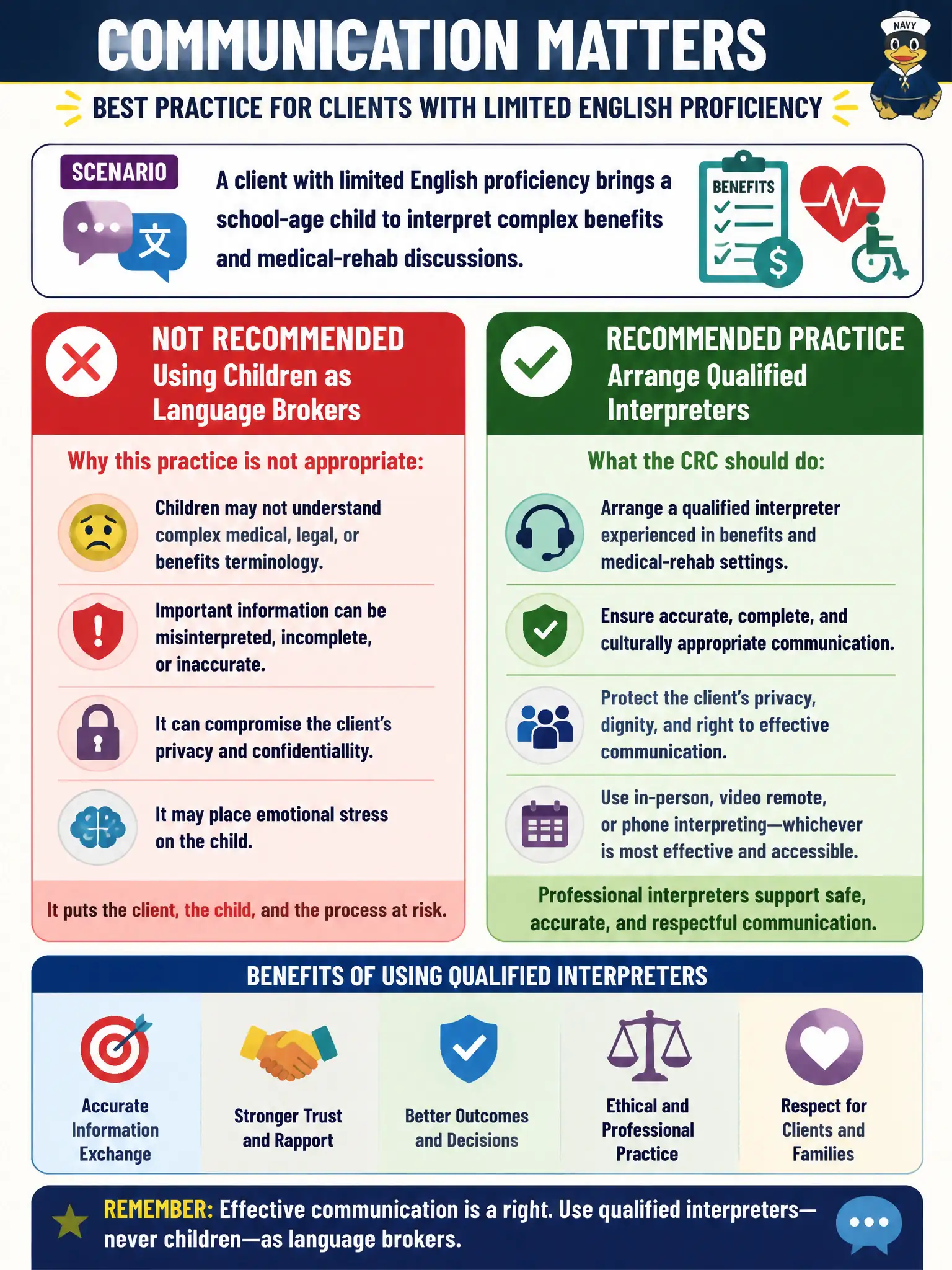
A client with limited English proficiency brings a school-age child to interpret complex benefits and medical-rehab discussions. What communication practice should the CRC follow?
Select an answer to reveal the explanation.
Short Explanation
Kids shouldn't carry adult medical and benefits talk—that's a heavy, unfair backpack. Bring in a qualified interpreter so meaning stays accurate and the child stays a child.
Full Explanation
Qualified interpreters—not school-age children—should broker complex benefits and medical-rehabilitation discussions for clients with limited English proficiency in municipal agencies. Using children as language brokers burdens minors with adult content, risks inaccurate interpretation of SNAP, Medicaid, housing, and clinical terms, and undermines informed consent. The CRC arranges qualified interpreter services so meaning stays accurate and family roles remain appropriate. Continuing to use the child as interpreter to keep the family involved confuses family presence with appropriate interpreting practice. Relying on bilingual coworkers with no interpreter qualifications for all sessions may help informally but does not meet standards for complex benefits and medical-rehab content. Proceeding in English only to encourage faster language learning during appointments sacrifices comprehension for an assimilation agenda and can invalidate consent. Exam caveat: family members may still attend for support with client consent, but they should not replace qualified interpreters for high-stakes civic benefits and medical-rehab communication. Operational check: before the next complex session, schedule a qualified interpreter (or equivalent language-access service), confirm the client's preferred language, and document that forms and discussions were interpreted rather than child-brokered.