
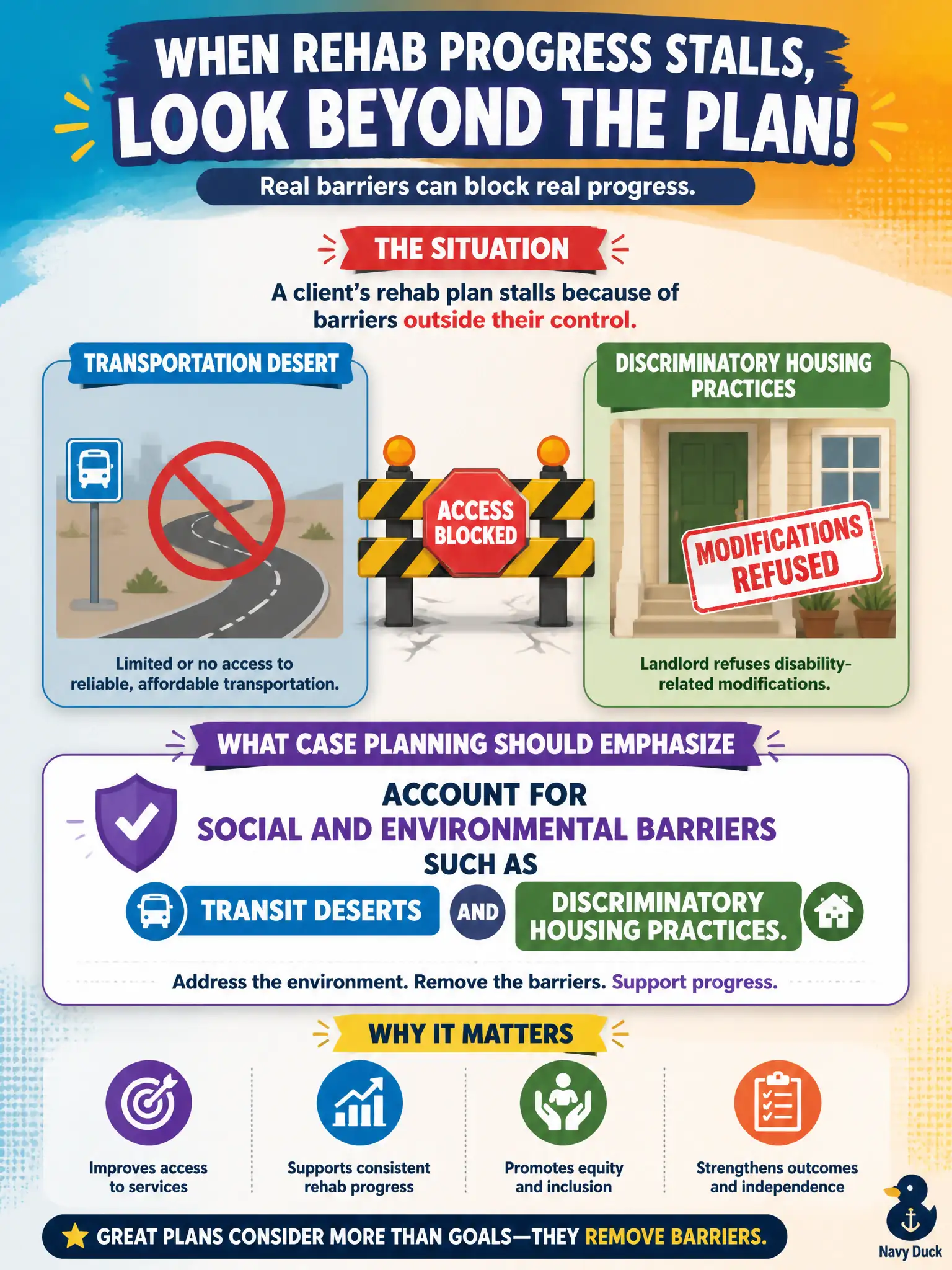
A client's rehab plan stalls because of a transportation desert and a landlord who refuses disability-related modifications. What should case planning emphasize?
Select an answer to reveal the explanation.
Short Explanation
No bus line and a hostile landlord can sink a great job goal faster than a tough interview. Build the plan around those real-world walls, not pretend they aren't there.
Full Explanation
Case planning in community rehabilitation must account for social and environmental barriers such as transportation deserts and landlords who refuse disability-related modifications. Those civic realities can stall an otherwise sound rehab plan faster than interview anxiety alone. The CRC integrates housing advocacy, transit solutions, and environmental problem-solving into the plan rather than treating goals as floating counseling statements. Assuming social environment factors are irrelevant once counseling goals are written ignores ecological constraints that determine whether goals are reachable. Treating housing and transit barriers as purely medical problems requiring only physician notes medicalizes landlord discrimination and municipal transit gaps that need advocacy and community resources. Closing the case for noncompliance without exploring community barrier solutions punishes the client for structural obstacles. Exam caveat: documenting environmental barriers does not remove client responsibility for engagement, but CRC exams expect plans to address known civic barriers instead of defaulting to noncompliance labels. Operational check: list transportation and housing barriers in the plan, assign concrete interventions (paratransit applications, fair-housing advocacy, landlord negotiation, interim ride supports), and set a review date to verify whether those barriers eased enough for the next vocational step.