
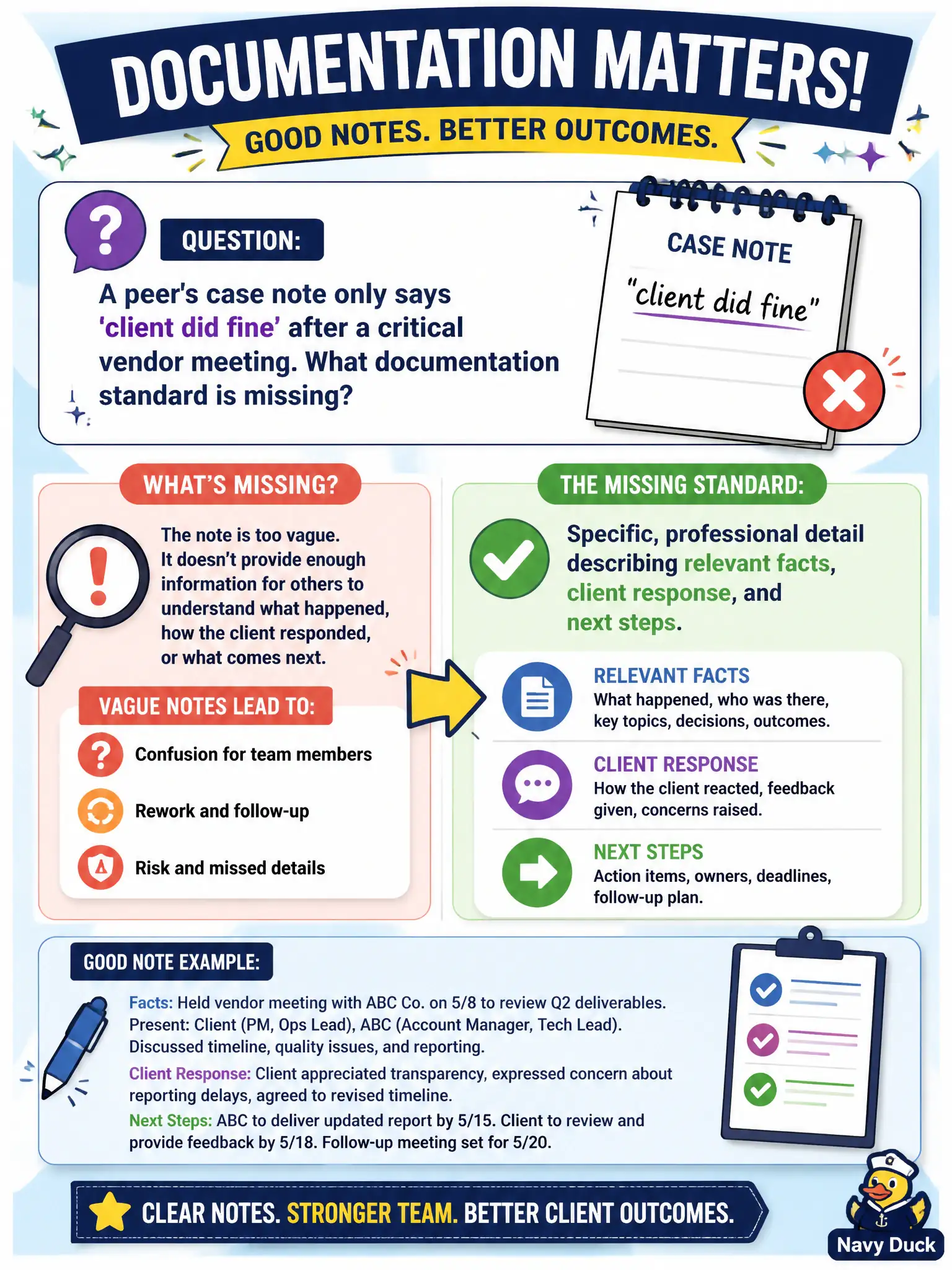
A peer's case note only says 'client did fine' after a critical vendor meeting. What documentation standard is missing?
Select an answer to reveal the explanation.
Short Explanation
'Client did fine' is a fortune-cookie note—sweet and useless. Write what happened, how the client responded, and what's next so the record actually helps someone.
Full Explanation
Professional case notes in public rehabilitation settings require specificity about contacts, observations, client responses, and plans rather than vague summaries. After a critical vendor meeting, a note that only says the client 'did fine' fails documentation standards and weakens clinical, legal, and continuity value for municipal teams. Ethical recording balances concision with enough concrete detail for another professional to understand the encounter and next steps. Longer notes that copy an entire vendor brochure into the record confuse volume with relevance and bury decision-critical facts. Using informal slang to sound more person-centered can reduce clarity and professionalism without improving client-centered substance. Omitting outcomes so future readers can interpret events freely abandons the counselor's duty to document what occurred and what was decided. Exam caveat: specificity is not a license for prejudicial labels or unnecessary sensitive detail; record what is needed for continuity, accountability, and informed care while following agency privacy rules. Operational check: rewrite any hollow summary into facts (who/what/when), client response, and next steps; have a covering counselor confirm they could act from the revised note without a hallway debrief.