
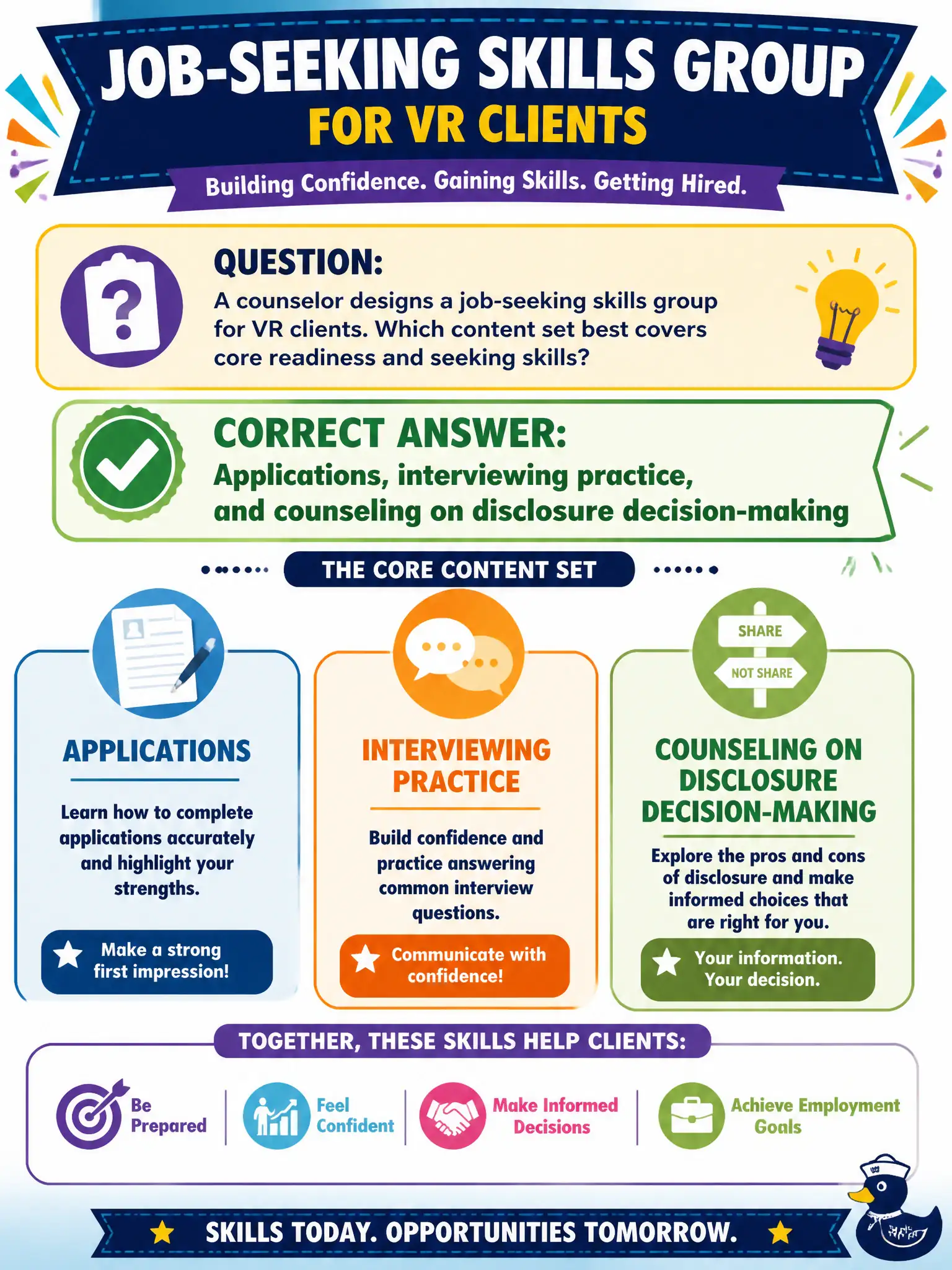
A counselor designs a job-seeking skills group for VR clients. Which content set best covers core readiness and seeking skills?
Select an answer to reveal the explanation.
Short Explanation
Job club isn’t just fonts and folders—it’s applications, interview reps, and the tough call about if and when to disclose. Those three keep showing up in real searches. Skip disclosure counseling and clients walk into interviews unprepared for the personal questions.
Full Explanation
A job-seeking skills group for VR clients should cover core readiness and seeking content: completing applications accurately, interviewing practice with feedback, and counseling on disclosure decision-making. Those topics map directly to competitive hiring steps in municipal, nonprofit, and private labor markets served by public rehabilitation programs. Teaching only calligraphy for paper forms with no interview or disclosure content fails because modern hiring is largely digital and interpersonal, and handwriting polish does not open interviews. Medical charting drills unrelated to employer applications fail because clinical documentation skills are not the placement bottleneck for most VR job seekers exploring community employment. Focusing solely on wage negotiation for C-suite roles with no basic application skills fails because advanced negotiation assumes the client can first obtain interviews through solid fundamentals. Exam caveat: groups should still individualize—members may need literacy supports, interpreters, or assistive technology to access the same curriculum without lowering the content targets. Operational check: ensure the group syllabus explicitly includes application practice, scored mock interviews with feedback, and at least one structured disclosure decision exercise before declaring job-seeking skills “covered.”