
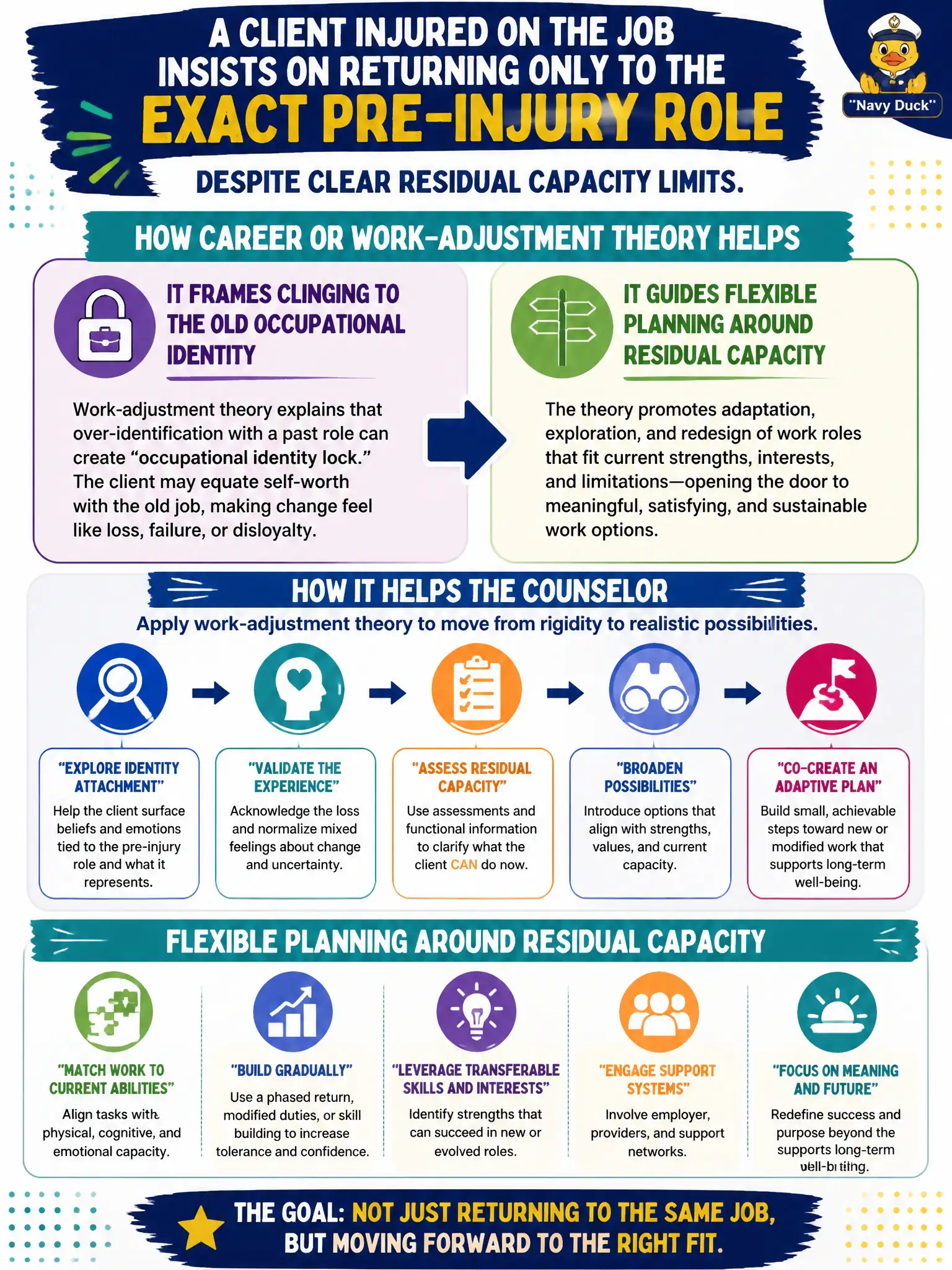
A client injured on the job insists on returning only to the exact pre-injury role despite clear residual capacity limits. How does career or work-adjustment theory help the counselor?
Select an answer to reveal the explanation.
Short Explanation
People often grip the old job title like a name tag they refuse to peel off. Career and work-adjustment ideas explain that grip and open room for a new fit. Residual capacity becomes a redesign project, not a failure of the old self.
Full Explanation
Career and work-adjustment theory helps counselors understand a client who insists on returning only to the exact pre-injury role despite residual capacity limits. The framework names occupational identity attachment, supports grieving the old role, and guides flexible planning around residual capacity toward satisfying alternatives or modified duty. Claiming the client must never discuss identity and should only memorize DOT codes fails because identity work is part of adjustment counseling, not a distraction from codes. Forcing the identical job title regardless of medical restrictions fails because essential demands that exceed residual capacity create safety and legal problems. Replacing all counseling with a single interest inventory score fails because interests alone do not resolve identity loss or medical limits. Exam caveat: some clients can return to the same employer in a modified role; theory does not forbid same-employer RTW—it forbids ignoring residual limits to preserve a title at any cost. Operational check: explicitly discuss what the old role meant (status, skills, community), document residual limits against essential demands, and generate at least two medically consistent alternatives or modifications before locking an IPE objective.