
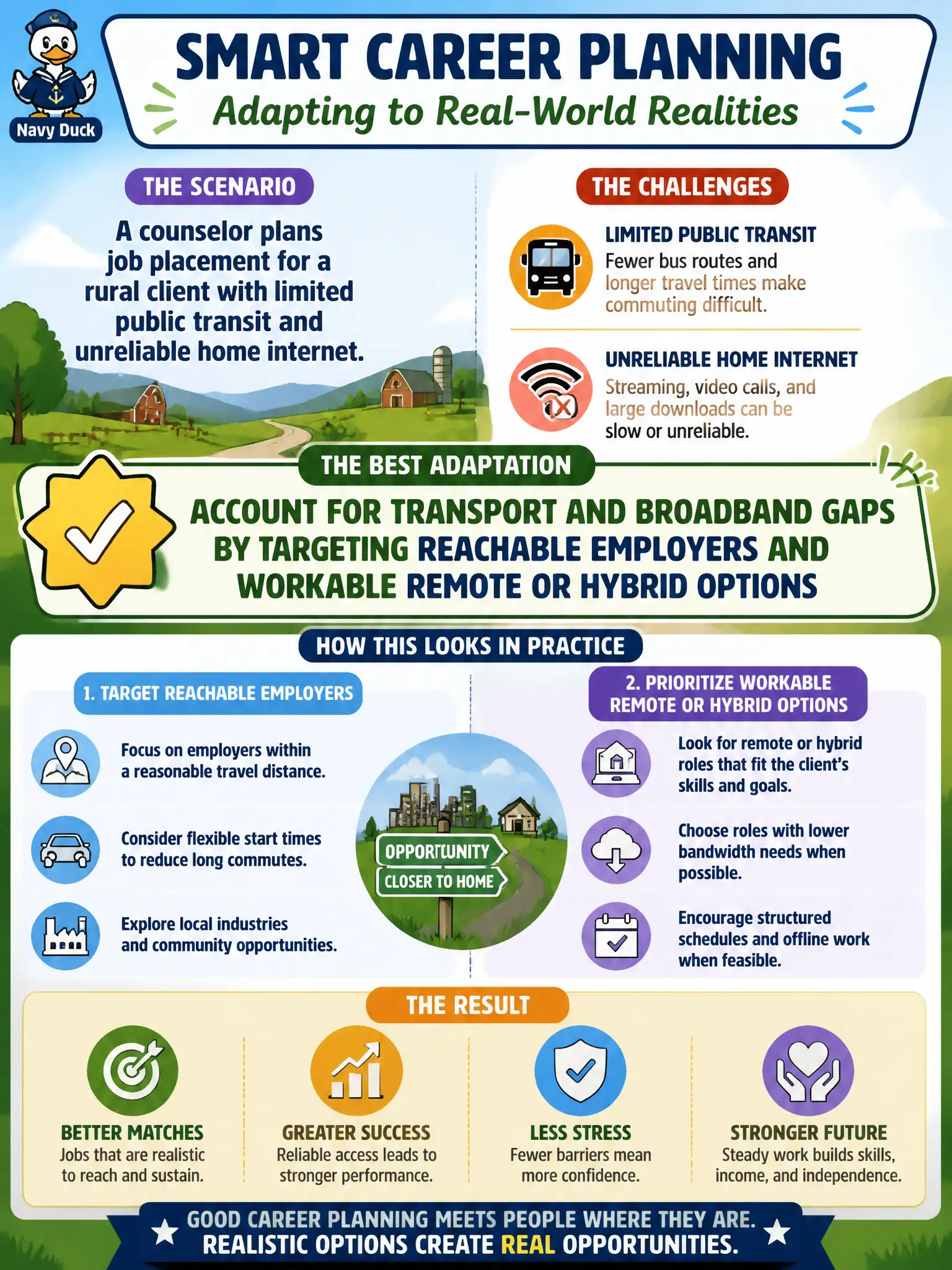
A counselor plans job placement for a rural client with limited public transit and unreliable home internet. What adaptation best fits career development strategy in this setting?
Select an answer to reveal the explanation.
Short Explanation
Rural placement is geography plus pipes—roads and bandwidth. You match jobs the client can actually reach and tools they can actually use. Wishful metro strategies crash on the first muddy mile.
Full Explanation
Rural career development strategy must account for transport and broadband gaps by targeting reachable employers and workable remote or hybrid options rather than assuming metro infrastructure. Counselors adapt job development to the client’s actual geography in county and regional VR practice, including shared rides, itinerant offices, and community internet access points. Assuming every rural employer offers same-day ride-share and fiber broadband fails because many communities lack those amenities and plans built on fantasy logistics collapse at the first shift. Requiring only downtown metro leads that demand daily two-hour unpaid travel fails because unrealistic commutes sabotage attendance and retention before the first paycheck stabilizes. Ignoring connectivity and insisting all applications be completed only at home tonight fails when home internet is unreliable; arranging alternative access is part of competent service planning. Exam caveat: remote or hybrid options must still match residual skills, supervision needs, and employer reality—not every rural job can be remote, and not every client thrives without onsite support. Operational check: map commute time, cost, and internet access for each lead; prioritize employers within feasible transport or with documented remote workflows; and arrange library, workforce-center, or VR-office application access when home broadband fails.