
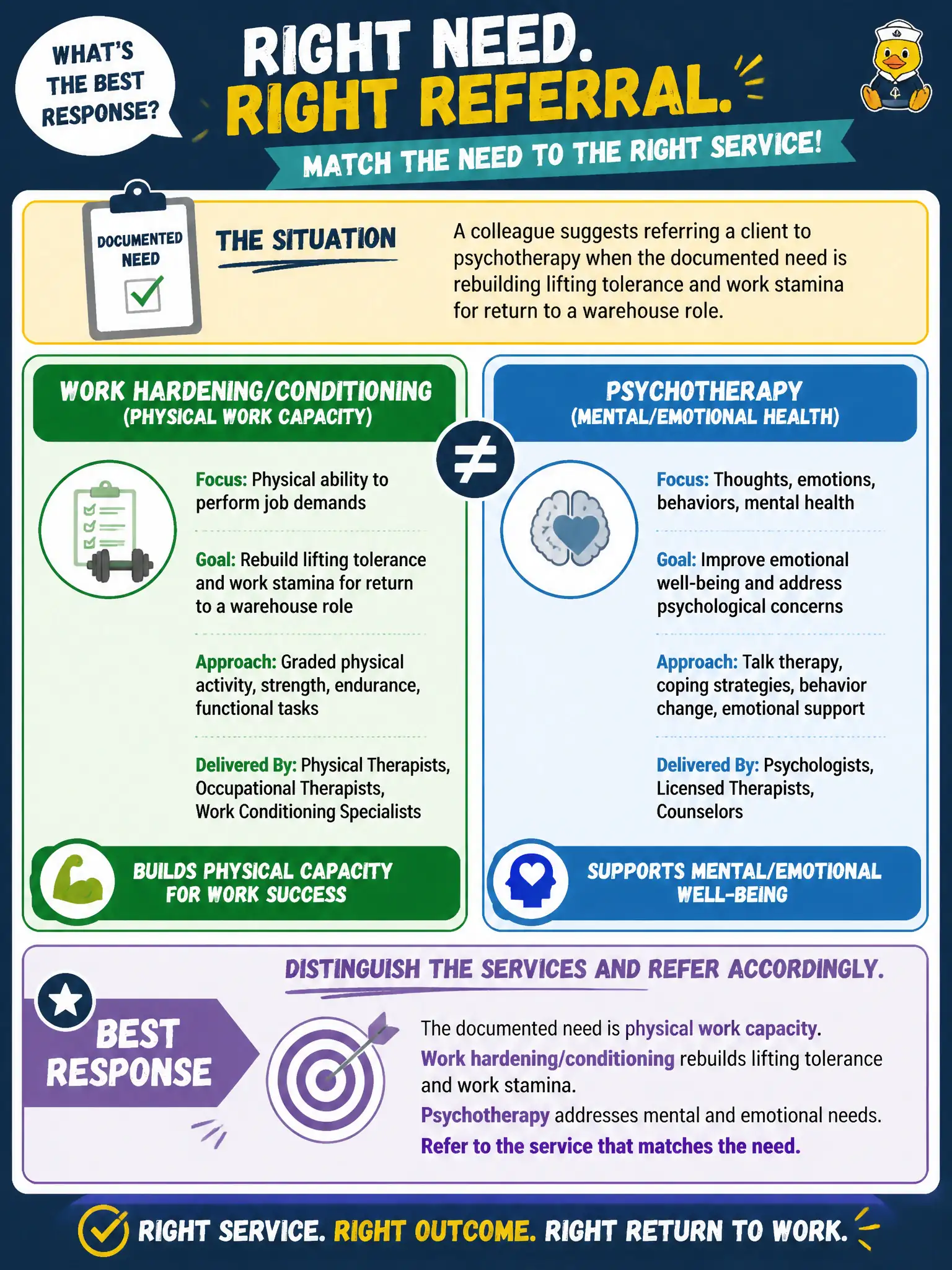
A colleague suggests referring a client to psychotherapy when the documented need is rebuilding lifting tolerance and work stamina for return to a warehouse role. What is the counselor's best response?
Select an answer to reveal the explanation.
Short Explanation
Talk therapy and a work-hardening gym aren't the same toolbox. If the gap is lifting tolerance and stamina, you need conditioning — not a couch substitute. Right referral, right purpose.
Full Explanation
Counselors must distinguish work hardening/conditioning—services aimed at physical work capacity, lifting tolerance, and stamina—from psychotherapy, which addresses emotional and cognitive concerns through clinical counseling modalities. When the documented need is rebuilding warehouse lifting tolerance, referring to psychotherapy as a substitute misaligns the service with the functional gap. Agreeing that psychotherapy and work hardening are interchangeable return-to-work services fails because they target different mechanisms of work capacity. Canceling all physical rehabilitation because talk therapy alone restores lifting capacity fails by concept: conversation does not rebuild musculoskeletal endurance for essential lifts. Refusing any referral and insisting on immediate maximum lifting without preparation fails because it ignores graded conditioning and safety. Exam caveat: clients may need both physical conditioning and counseling for adjustment or pain coping; the error is treating them as substitutes rather than potentially complementary. Operational check: match the primary functional deficit to the service class—physical capacity deficits → hardening/conditioning or physical rehab partners; mood/trauma/adjustment deficits → appropriate clinical counseling—and document why each referral was chosen.