
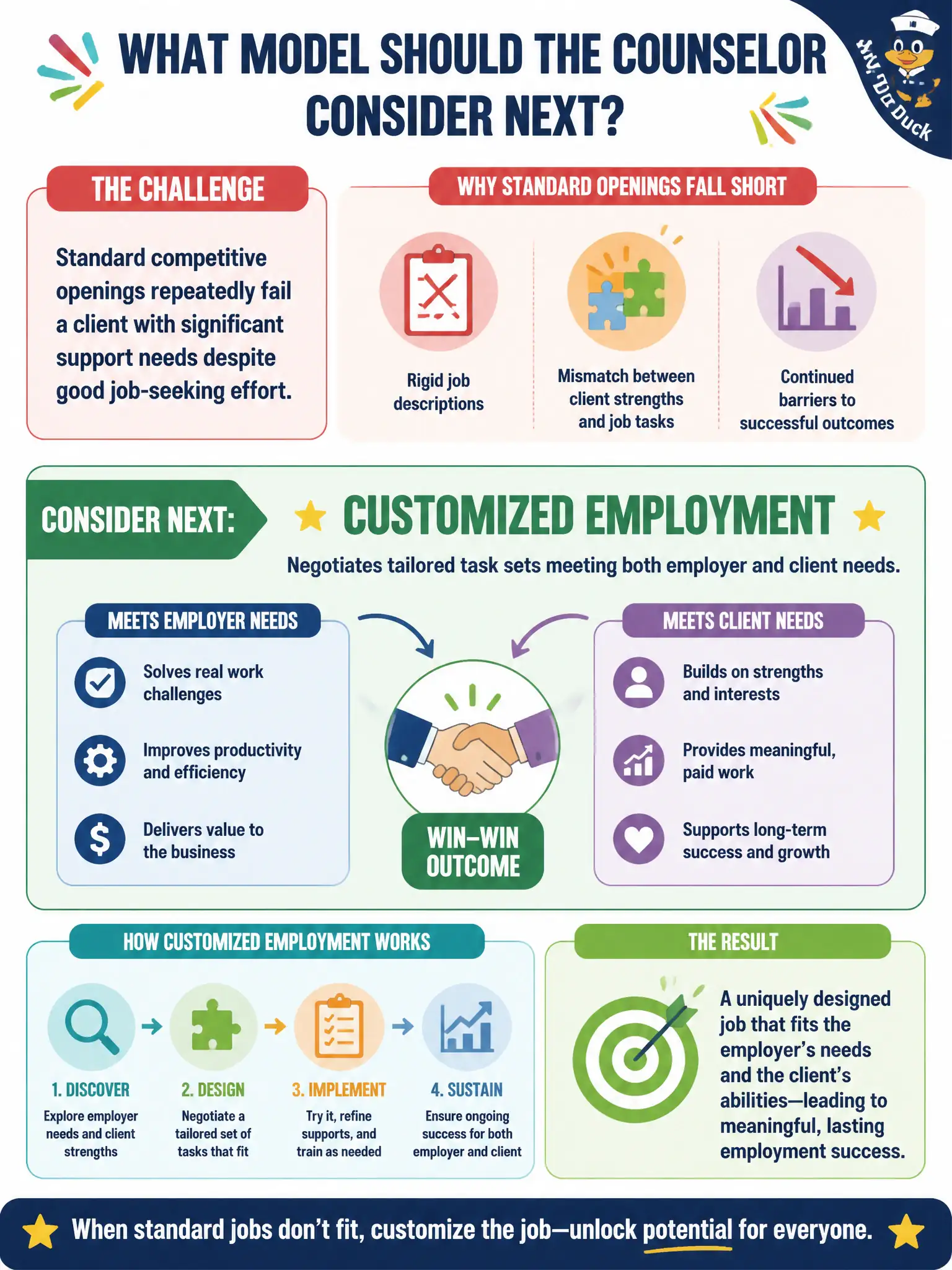
Standard competitive openings repeatedly fail a client with significant support needs despite good job-seeking effort. What model should the counselor consider next?
Select an answer to reveal the explanation.
Short Explanation
When the ready-made job slots don't fit, you tailor the suit. Customized employment carves a role from what the business needs and what the person can offer. Quitting the employment path isn't the next evidence-based step.
Full Explanation
When standard competitive openings repeatedly fail a client with significant support needs despite good job-seeking effort, customized employment is the model to consider next. Customized employment negotiates tailored task sets that meet both employer business needs and the client’s contributions, creating a role that may not exist as a standard posting. Permanently closing the case because no standard posting produced a hire fails because lack of fit with ready-made vacancies is a signal to customize, not to abandon employment services. Pursuing only academic scholarship with a ban on paid work exploration fails because education may be complementary, but it does not replace the employment pathway the client still needs. Automatic referral to long-term institutional care instead of employment services fails by concept: institutionalization is not the evidence-aligned response to placement difficulty in community rehabilitation. Exam caveat: customization requires employer discovery and negotiation skills and may take more counselor time than applying to open requisitions; it is not a shortcut around essential-function reality or labor laws. Operational check: document employer tasks that are currently unmet, map client contributions to those tasks, and draft a negotiated duty set before concluding “no jobs exist” for this client.