
In an employer meeting about a costly equipment request, how should the counselor use accommodation-related business terminology appropriately?
Select an answer to reveal the explanation.
Short Explanation
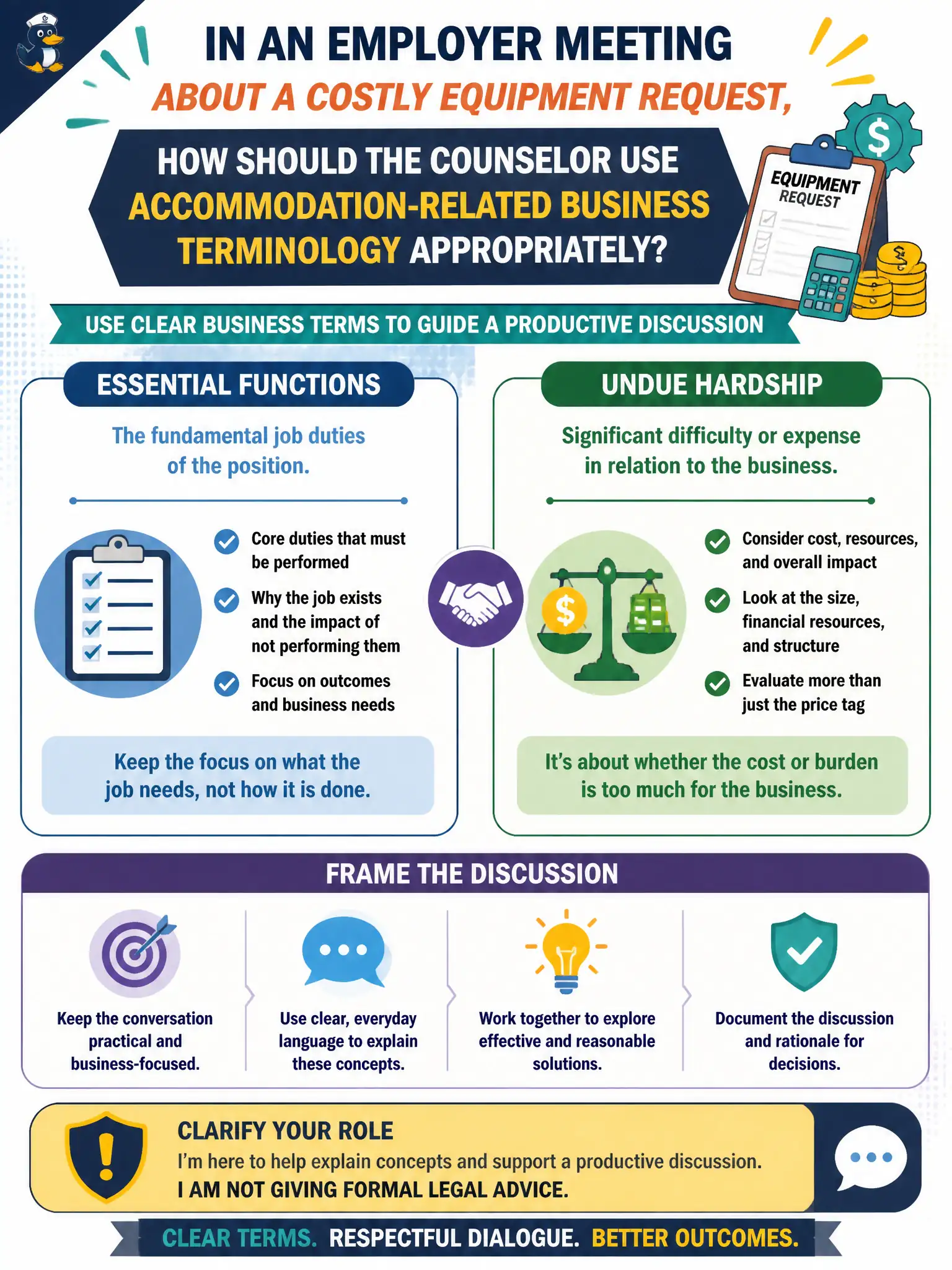
Employers calm down when you speak their language—essential functions and undue hardship—without playing courtroom lawyer. Frame the talk in plain practical terms and say clearly you are not handing down a legal ruling. Clarity builds trust; jargon wars do not.
Full Explanation
In employer meetings about costly equipment requests, counselors may explain essential functions and undue hardship in practical terms to frame discussion while clarifying they are not giving formal legal advice. Using accurate business-legal vocabulary carefully helps employers think systematically without the counselor practicing law. Promising that any requested equipment is automatically required regardless of cost or impact fails because undue hardship and essential-function analyses exist precisely for that reason. Avoiding the terms entirely and telling the employer to ignore written job descriptions fails because job descriptions help identify essential functions in accommodation talks. Stating that undue hardship always means the company must create a new nonessential role fails because undue hardship concerns significant difficulty or expense regarding a requested accommodation—not a mandate to invent nonessential jobs. Exam caveat: for contested high-cost decisions, urge the employer to consult HR counsel; the counselor’s role is facilitation, functional analysis, and alternative idea generation. Operational check: list essential functions, cost and alternatives for the equipment, and any cheaper equally effective options; document that legal conclusions were referred to the employer’s counsel.