
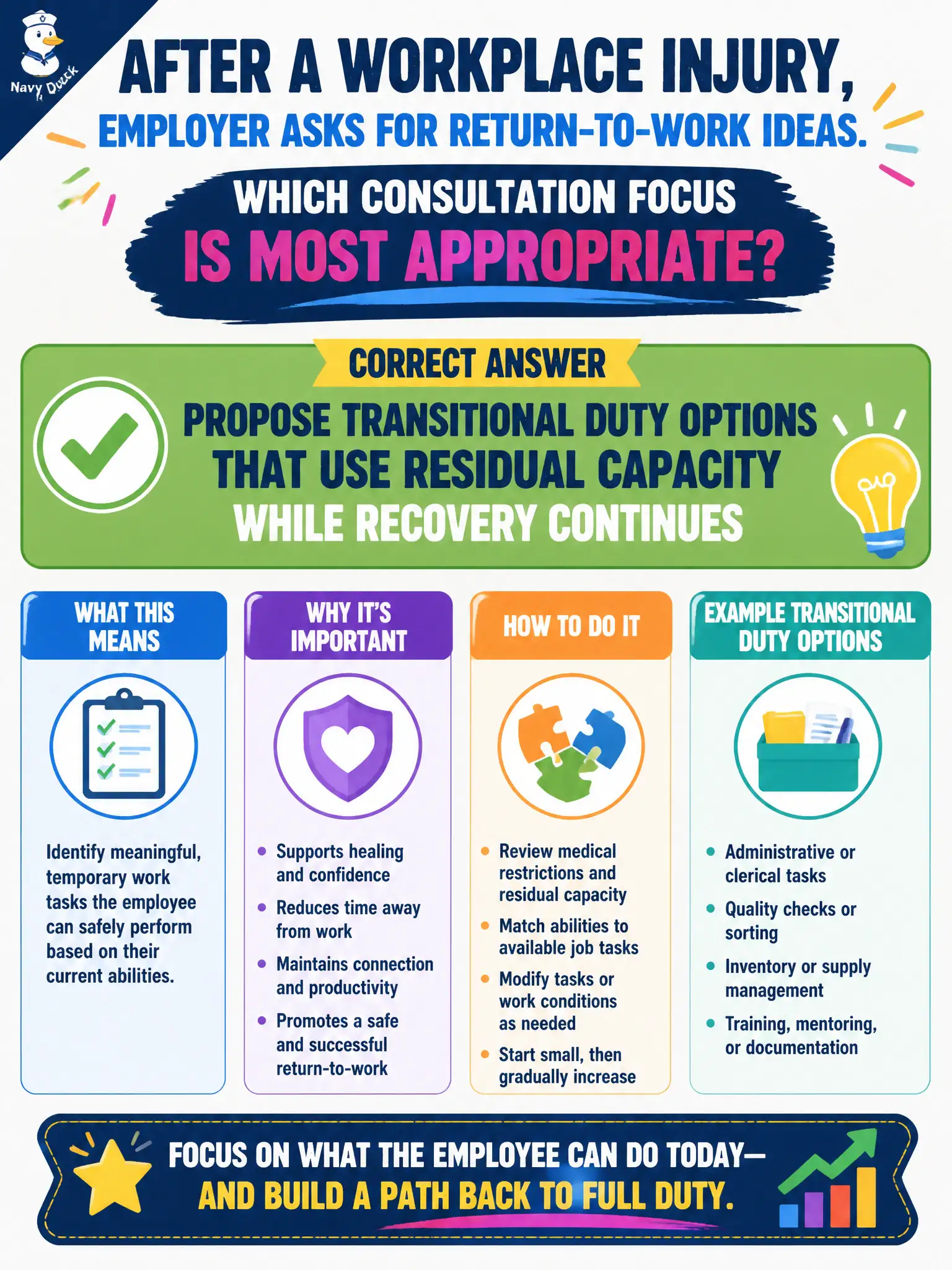
After a workplace injury, an employer asks the counselor for return-to-work ideas. Which consultation focus is most appropriate?
Select an answer to reveal the explanation.
Short Explanation
Return-to-work rarely needs an all-or-nothing cliff. Transitional duty is the bridge—useful tasks that fit today’s capacity while healing continues. Employers often just need a menu of interim ideas.
Full Explanation
After workplace injury, employer consultation on return-to-work appropriately focuses on transitional duty options that use residual capacity while recovery continues. Transitional duty maintains attachment to work, reduces prolonged disability, and uses real tasks scaled to current function in industrial and municipal settings. Advising the employer to forbid any return until full unrestricted recovery with no interim options fails because all-or-nothing RTW prolongs absence, deconditioning, and detachment from the workplace culture. Recommending permanent unpaid leave as the only RTW strategy fails because leave without a progressive work plan is not return-to-work service. Refusing transitional duty discussion because only full-duty or termination exists fails by presenting a false dichotomy that ignores temporary alternative tasks and graded exposure. Exam caveat: transitional duties must be medically consistent, time-limited, and not used to warehouse workers indefinitely without progress toward essential functions or a permanent accommodation analysis. Operational check: propose specific temporary tasks mapped to current residual capacity, set a review date with medical input, and define criteria for increasing duty or exploring permanent accommodation.