
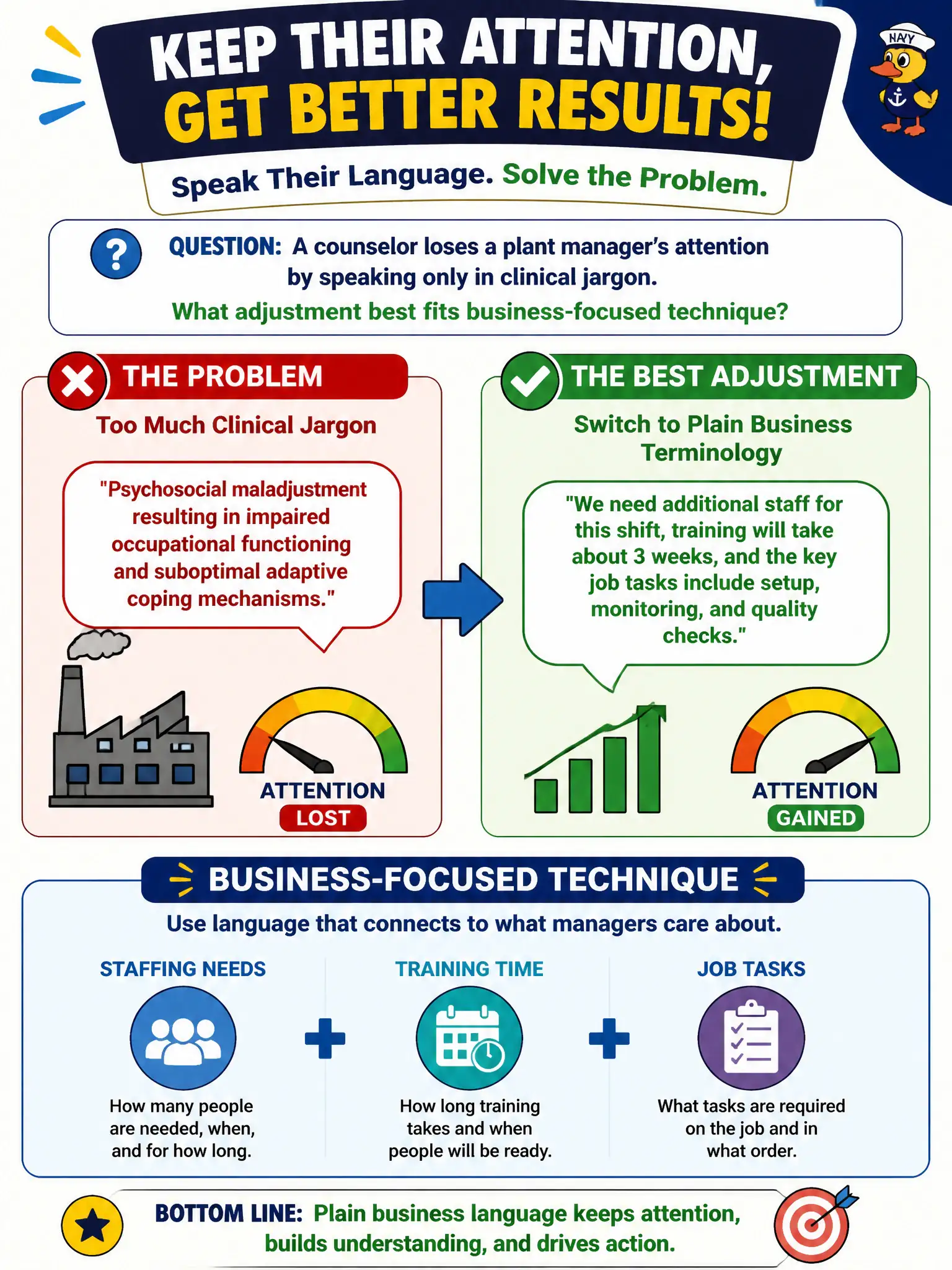
A counselor loses a plant manager’s attention by speaking only in clinical jargon. What adjustment best fits business-focused technique?
Select an answer to reveal the explanation.
Short Explanation
If the manager’s eyes glaze over at DSM codes, change the channel. Talk tasks, training days, and open shifts. Matching the audience’s language is part of the craft, not selling out the client.
Full Explanation
When a counselor loses a plant manager’s attention by speaking only in clinical jargon, the corrective business-focused technique is switching to plain terminology about staffing needs, training time, and job tasks. Translation is a core engagement skill in rehabilitation counseling with civic and industrial employers. Adding denser clinical acronyms until the manager agrees out of confusion fails because confusion is not informed partnership and produces shallow agreements that collapse later. Refusing to meet employers who lack counseling degrees fails because employers are dual customers whose expertise is operations, not DSM fluency. Replacing all meetings with unread academic journal PDFs fails because passive literature drops do not create dialogue about real vacancies, shifts, or supervision capacity. Exam caveat: accurate clinical constraints still matter inside the rehab team; the adjustment is audience-appropriate translation for employers, not falsifying limitations or overselling capacity. Operational check: after any jargon-heavy meeting that stalled, rebook with a one-page brief stating job tasks, training estimate, and candidate strengths in nonclinical language, then confirm the manager can restate the ask in their own words.