
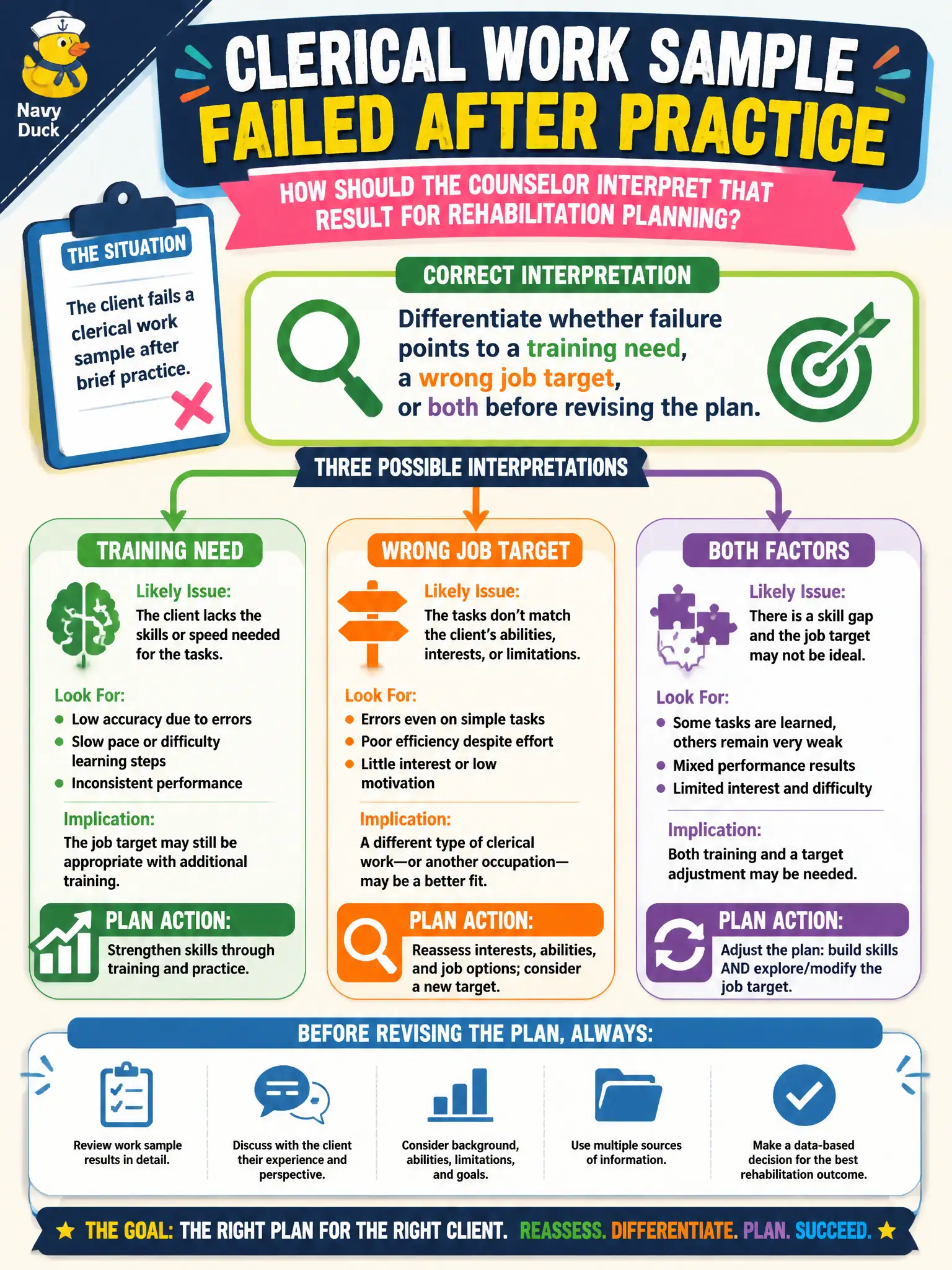
A client fails a clerical work sample after brief practice. How should the counselor interpret that result for rehabilitation planning?
Select an answer to reveal the explanation.
Short Explanation
A failed practice run isn't a life sentence — it asks "need coaching, wrong lane, or both?" Good counselors separate skill gaps you can train from targets that never fit. Jumping to "unemployable" skips the real question.
Full Explanation
A failed clerical work sample after brief practice is assessment data, not a global verdict of unemployability. The counselor differentiates whether the failure reflects a remediable training need, a mismatched job target, or both, then revises the rehabilitation plan accordingly. That interpretive discipline keeps state VR planning focused on skill development versus occupational redirection instead of premature case closure. Concluding the client is unemployable in any occupation from one failed sample fails because one task battery cannot represent the entire labor market or future learning with instruction. Treating the failure as proof that formal aptitude testing should never be used again fails because one poor work-sample outcome does not invalidate all assessment methods; it invites better interpretation and possibly different measures. Automatically raising the career goal to a supervisory title without further assessment fails because promoting the goal does not fix the skill or fit problem and may increase mismatch. Exam caveat: repeated failures after adequate training and reasonable accommodations may support changing the vocational objective, but the first failure after brief practice is usually a cue for analysis, not a career death sentence. Operational check: after a failed sample, list observed skill gaps, estimate trainability with coaching, compare essential demands of the target job, and choose explicitly among train-then-retry, change target, or both before amending the plan.