
After an industrial injury ends a client's manufacturing role, the counselor completes a transferable skills analysis and a local labor market analysis. How do those tools best support a career pivot?
Select an answer to reveal the explanation.
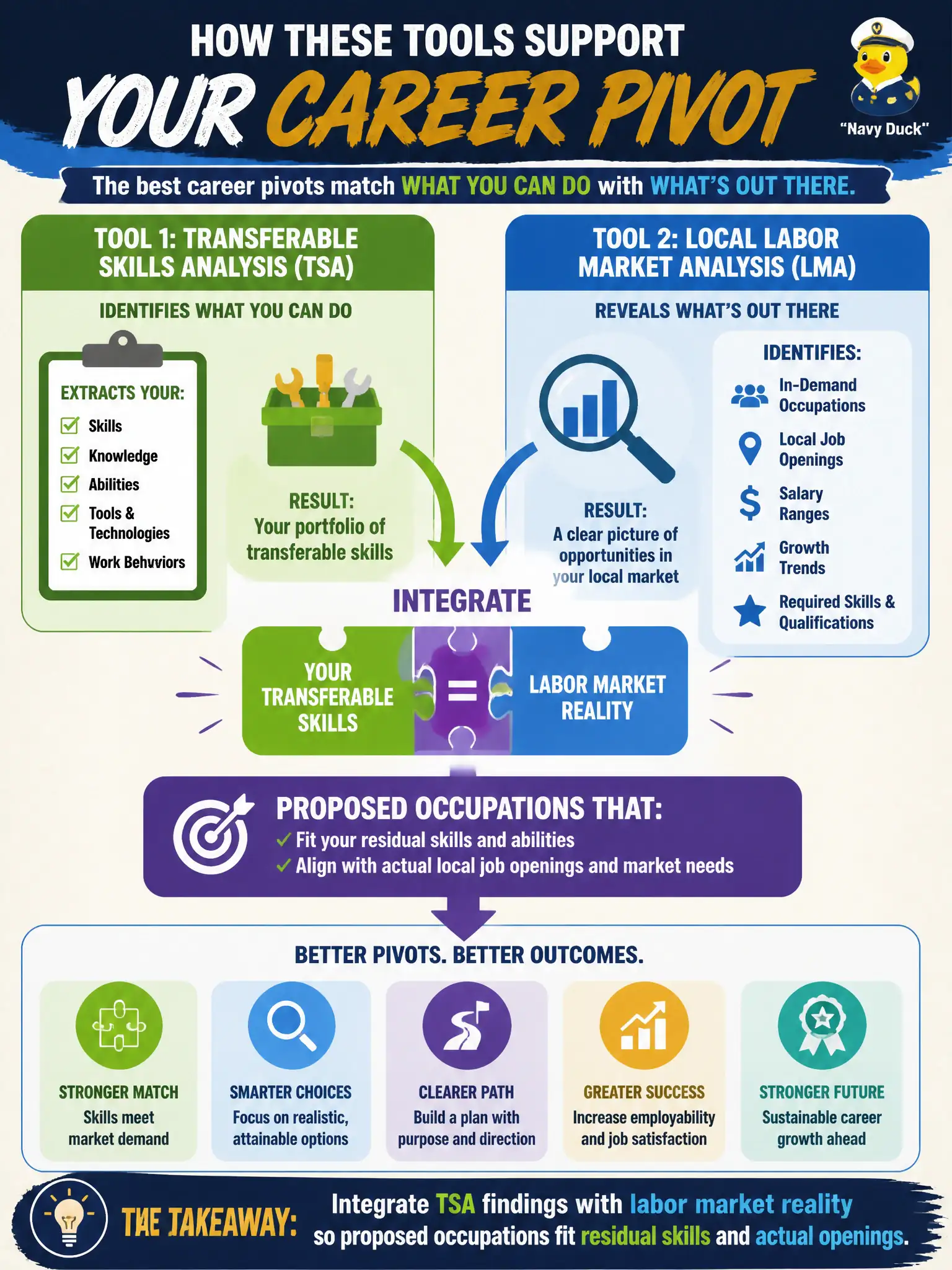
Short Explanation
Skills on paper and jobs that actually hire are two different maps — you need both. TSA says what still travels; LMA says which doors are open nearby. Pairing them keeps the career pivot realistic instead of wishful.
Full Explanation
After an industrial injury ends a manufacturing role, career pivot planning in public VR depends on integrating what skills still transfer with what the local labor market actually hires. Transferable skills analysis (TSA) identifies residual capacities and prior competencies that travel across occupations; labor market analysis (LMA) checks wages, demand, and openings in the service area. Used together, they keep proposed occupations realistic for residual function and civic employment conditions rather than aspirational titles with no pathway. Relying only on interest inventories while ignoring skill transfer and wage/demand data fails because interests without capacity and demand produce plans that stall at placement. Discarding TSA whenever wages differ from the prior job fails because wage change is common after injury; the question is whether residual skills and local demand support a viable alternative, not whether pay is identical. Relying on computer match titles alone without checking local demand or residual function fails because software suggestions are hypotheses, not verified local opportunities or medically consistent job demands. Exam caveat: TSA and LMA inform counseling and informed choice—they do not dictate a single forced occupation, and clients may need bridging training when transfer alone is insufficient. Operational check: for each candidate title, document residual skills that map to essential tasks and cite local demand or employer evidence; drop titles that fail either residual-function fit or labor-market reality before IPE amendment.