
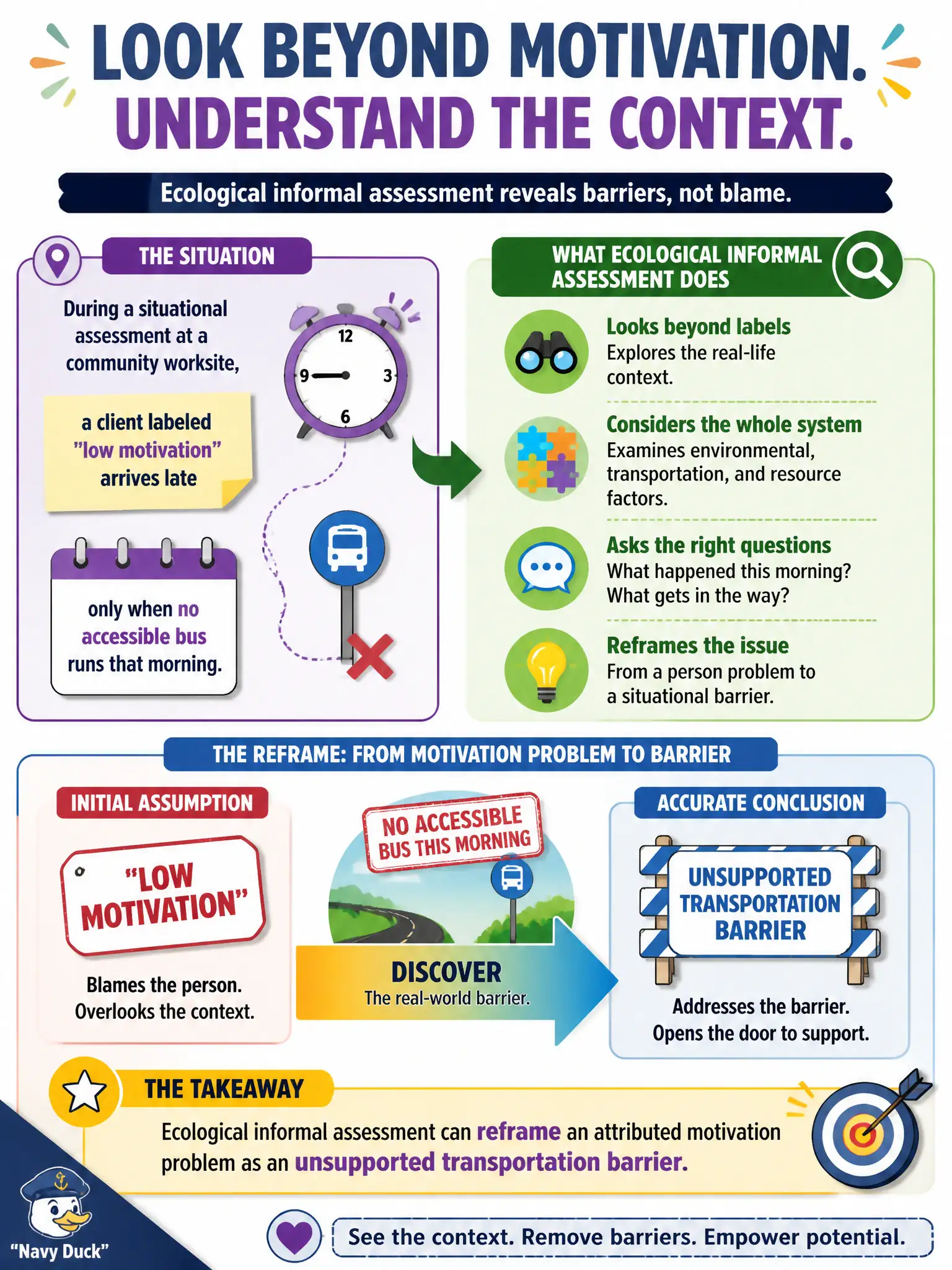
During a situational assessment at a community worksite, a client labeled "low motivation" arrives late only when no accessible bus runs that morning. What should the counselor conclude?
Select an answer to reveal the explanation.
Short Explanation
Sometimes the "lazy" story falls apart when you watch the real setting — like blaming the runner when the starting gun never fires. Situational assessment showed lateness tracked with missing accessible transit, not indifference. Fix the ecology before you write off motivation.
Full Explanation
Ecological and situational assessment in community worksites helps counselors separate attributed personal deficits from unsupported environmental barriers. When lateness appears only on mornings without accessible bus service, the pattern points to a transportation access problem rather than confirming a global “low motivation” trait. Reframing through informal, setting-based observation preserves a more accurate functional picture for municipal and state VR planning and prevents disability stigma from hardening into an unjust label. Treating any lateness as proof of poor work ethic regardless of transit access fails because it ignores the ecological hypothesis and mistakes a systems barrier for character. Abandoning situational assessment for paper-and-pencil aptitude tests alone fails because aptitude scores do not capture worksite access, schedule logistics, or supports that determine real-world performance. Declaring transportation irrelevant once a clinician wrote a motivation diagnosis fails because prior clinical labels do not override observable environmental contingencies; rehabilitation counseling revises attributions when data change. Exam caveat: motivation concerns can still be real for some clients, but they must be tested against environmental evidence rather than assumed from a single delayed arrival. Operational check: chart lateness against transit schedules, accessibility of routes, and backup options; if delays disappear when accessible transport is available, revise the motivation narrative and add transportation supports to the plan before any punitive case note.