
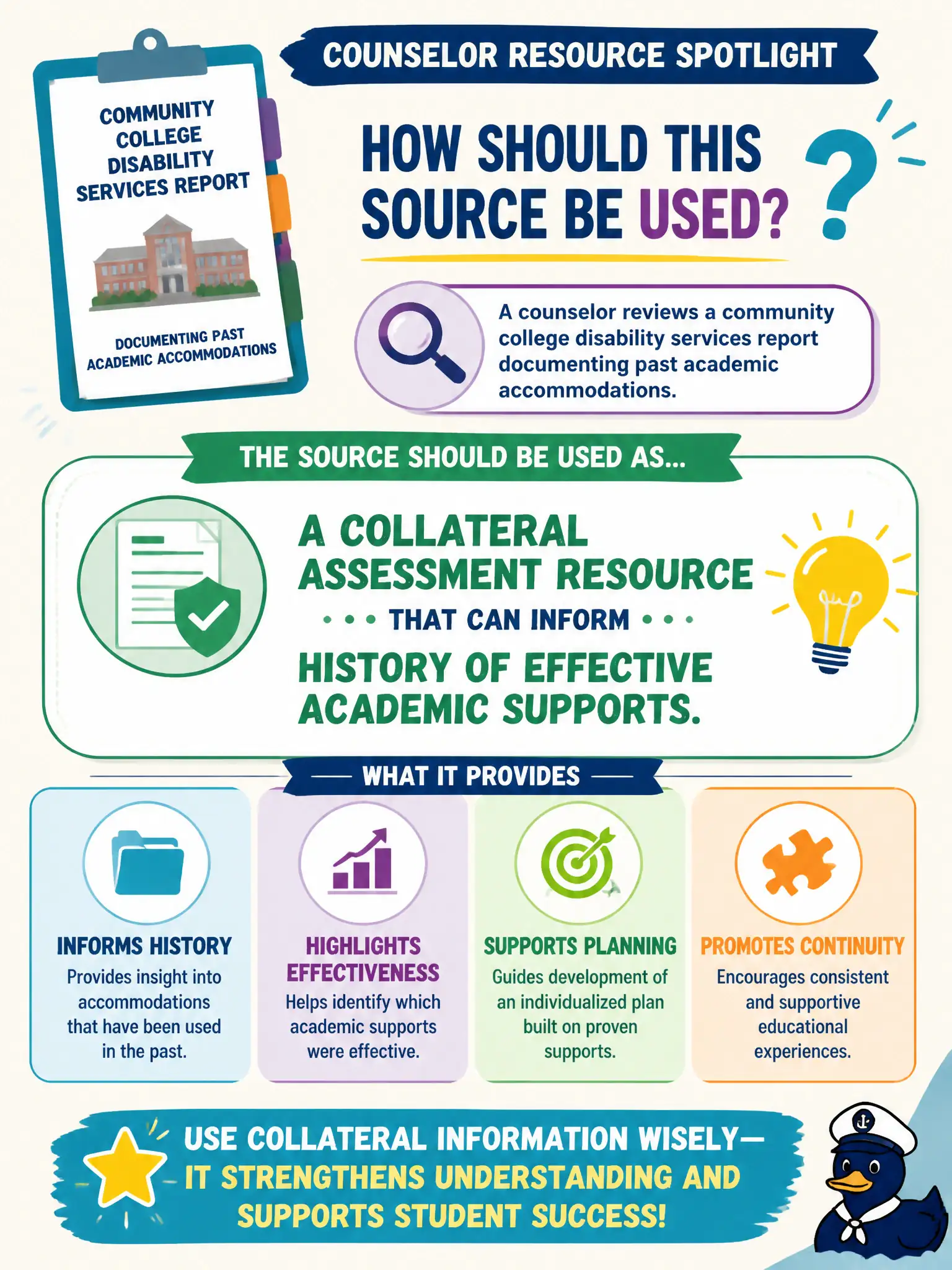
A counselor reviews a community college disability services report documenting past academic accommodations. How should this source be used?
Select an answer to reveal the explanation.
Short Explanation
Old school support notes are like a travel diary — they show what already worked on the road. A disability office report is collateral assessment gold for accommodation history. Use it to inform, not to replace, the rest of your evaluation.
Full Explanation
A community college disability services report documenting past academic accommodations is a collateral assessment resource that can inform history of effective academic supports. It should neither be discarded automatically nor used only to deny further help, and it does not replace vocational or functional assessment. Civic VR counselors wisely integrate educational collateral with current vocational data.
Discarding it because only brand-new testing is ever allowed wastes relevant history. Using it only to deny all further accommodations automatically weaponizes the record. Treating it as replacing any vocational or functional assessment overextends academic history beyond job demands.
Collateral academic accommodation history speeds hypothesis-building for workplace supports while current job analysis confirms transferability.
Exam caveat: prior disability-services reports are useful collateral; they inform but do not replace current vocational/functional assessment.
Operational check: review which academic accommodations worked; hypothesize workplace analogs; still complete needed vocational/functional assessment; document how collateral informed—not replaced—planning. Re-verify length and fidelity of the written plan at the next supervisory case review so civic accountability stays visible.