
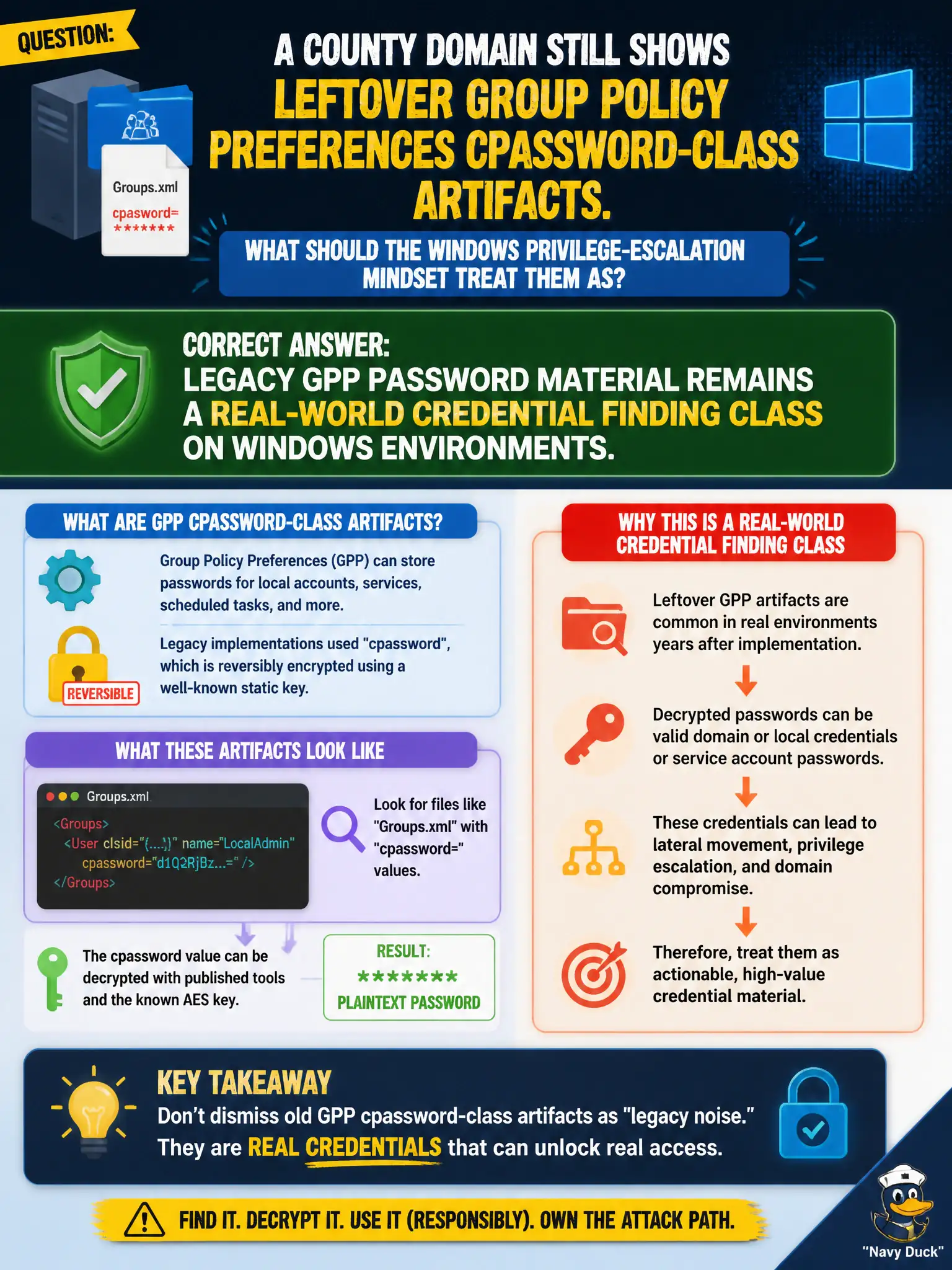
A county domain still shows leftover Group Policy Preferences cpassword-class artifacts. What should the Windows privilege-escalation mindset treat them as?
Select an answer to reveal the explanation.
Short Explanation
Old GPP cpassword leftovers are the forgotten spare keys still taped inside the policy cabinet. Even years later, that legacy secret class keeps showing up in real networks. Treat them as live credential findings, not decorative XML.
Full Explanation
Leftover Group Policy Preferences cpassword-class artifacts in a county domain remain a real-world Windows credential finding class: historically encrypted GPP passwords can be recovered and reused against accounts still valid in the environment. Privilege-escalation and lateral-movement mindsets should treat them as live secrets until proven otherwise.
They are not harmless XML comments that can never be misused. They do not prove Kerberos AES is disabled or that ticket attacks are impossible. They are not a Linux /etc/shadow format alien to Active Directory estates.
Exam caveat: Microsoft deprecated vulnerable GPP password storage—persistence of old files is the residual risk.
Operational check: search SYSVOL for GPP credential artifacts within authorization, validate whether accounts remain active, and recommend purge plus forced resets for county identities. In municipal operations, record the rationale in the engagement notes so future assessors know which control was chosen and which failure modes the rejected options would create for city services. Re-validate after the next maintenance window that the same finding class still applies under the estate's current patch and configuration baseline.